Is your company ready for the biggest change in search engines since Google was created? MeetGenerative Engine Optimization (GEO), the essential strategy for a world where AI such as ChatGPT and Gemini provides instant answers. Think of GEO as training an expert sales assistant who knows your products inside out and therefore recommends you first.
The New Search Landscape of Generative AI
The way your customers find information is changing rapidly. For years, the goal was simple: be at the top of the first page of Google. Now, users get direct, summarized answers from AI, often skipping traditional search results altogether. This shift calls for a new approach.
Traditional search engine optimization (SEO) is no longer sufficient. While it remains an indispensable foundation, focusing on keywords and rankings does not fully prepare your business for this new, conversational world.Generative Engine Optimization (GEO)is the next step; it focuses on making your content the most reliable, authoritative, and useful source for AI to learn from.
Why GEO is Crucial for Dutch Companies
For entrepreneurs and marketing managers in the Netherlands, ignoring this change is not an option. The Dutch digital economy is incredibly active and competitive. As users increasingly rely on AI-generated summaries for quick answers, your online visibility depends on your presence in those answers.
If you don't adapt, you run the risk of becoming invisible to a growing portion of your target audience, leading to less website traffic and fewer leads. This is where GEO becomes your competitive advantage. It helps you to:
- Stay visible:Ensure your brand is mentioned when AI answers questions related to your industry.
- Attracting high-quality traffic:Users who click through from an AI recommendation are often highly qualified and ready to convert.
- Build authority:By becoming a trusted source for AI, you strengthen your brand's reputation as an expert.
This infographic shows the key differences between conventional SEO and the emerging focus of Generative Engine Optimization.
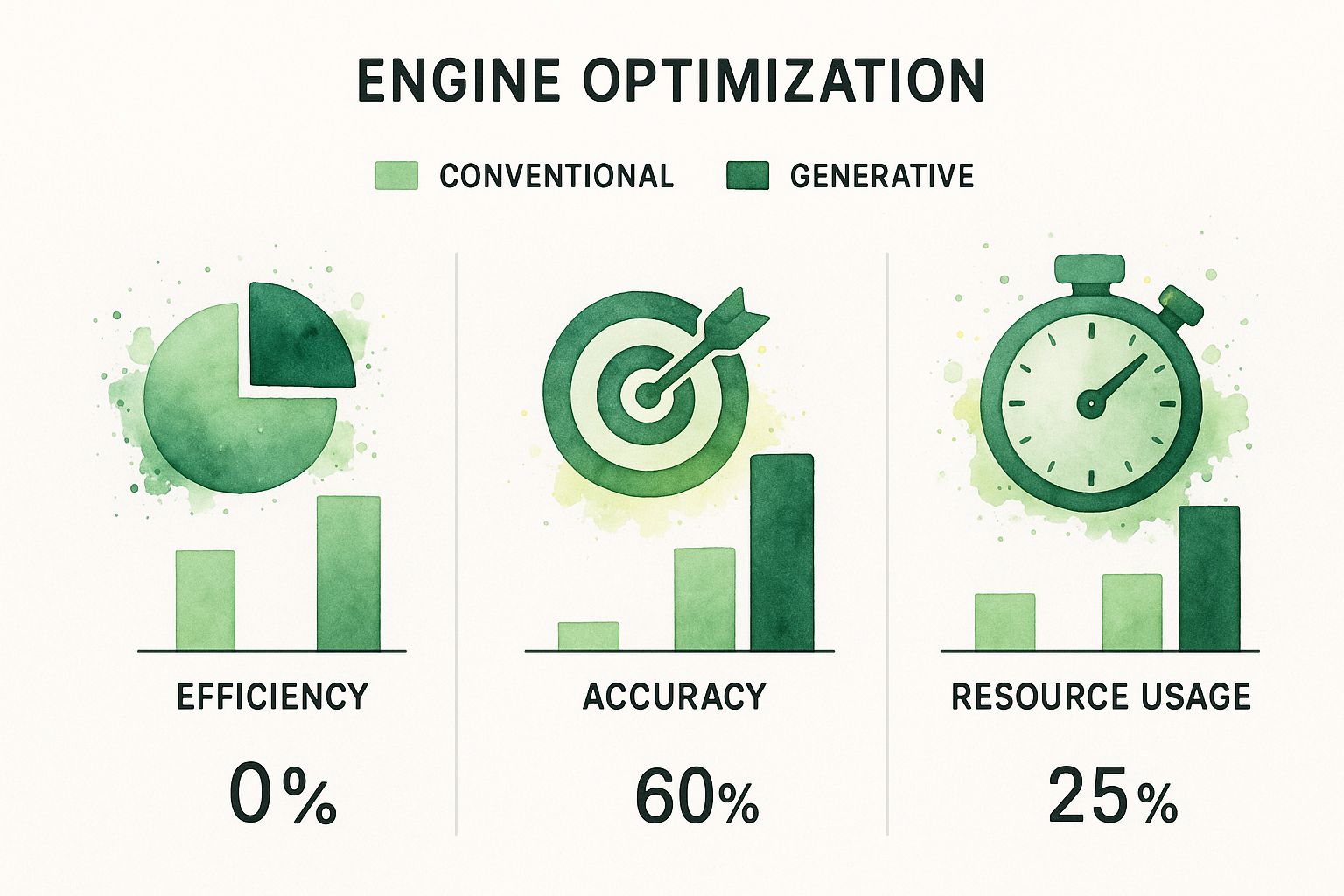
The data clearly shows how GEO strategies have been designed for greater accuracy and efficiency in delivering relevant information to AI models.
To make the difference even clearer, we compare them side by side.
Traditional SEO vs. Generative Engine Optimization
| Aspect | Focus on Traditional SEO | Focus on Generative Engine Optimization |
| Primary Goal | Rankings on a search engine results page (SERP). | Being cited as a source in an AI-generated response. |
| Content strategy | Keyword-optimized pages, backlinks, technical site health. | Factual accuracy, clear data, conversational language, building thematic authority. |
| Key Metrics | Keyword positions, organic traffic, bounce rate. | Brand mentions in AI responses, citation frequency, quality of referred traffic. |
| User interaction | User clicks on a link to find an answer on your website. | The user receives an immediate response from the AI and may bypass your site. |
| Technical Focus | Schema markup, site speed, mobile-friendliness. | Structured data, clear source attribution, entity recognition, content freshness. |
While traditional SEO lays the foundation, GEO adds the crucial layer needed to thrive in an AI-driven search world. It's not about replacing one with the other, but integrating them into a more complete strategy.
A Fast-Growing Market
The transition to AI-driven search is not a distant dream; it is happening now. The Generative Engine Optimization market in Europe, including the Netherlands, is experiencing explosive growth. Forecasts show that the European GEO market will be worth approximatelyUSD 195 millionby 2025, with a compound annual growth rate of no less than49.6%. This reflects a major shift in user behavior and marketing strategy, forcing Dutch companies to innovate or fall behind.
GEO is not about chasing algorithms; it's about becoming the undisputed authority in your field. When your content provides the clearest, most reliable answers, AI has no choice but to mention you.
This strategic shift is essential for long-term growth and maintaining a strong online presence. For a deeper dive into how you can leverage AI for your business, you may be interested in ourwhite paper on artificial intelligence. It offers practical insights to help you get started.
How AI Search Engines "Think"
To truly mastergenerative engine optimization, you first need to understand how these new AI search platforms "think." It's a completely different game. We are moving away from simply matching keywords and toward satisfying a deep, data-driven curiosity.
Forget trying to trick an algorithm. Instead, imagine you're explaining a complex topic to a brilliant student who has read almost everything on the internet. That's the mindset you need.
This 'student' is powered by aLarge Language Model (LLM). Think of an LLM as an advanced AI system, a digital brain that has absorbed countless books, articles, and websites. It has been trained on enormous amounts of text and data to understand the patterns, context, and subtle details of human language. That's why it not only seeswhatyou're asking, but also theintentionbehind your question.

From Keywords to Concepts
Traditional search engines have always relied heavily on keywords. If someone searches for "best running shoes," the machine looks for pages that use that exact term. Simple enough. AI search engines, however, are much more advanced and use a method calledsemantic search.
Semantic search revolves around understanding the meaning and relationships between words and ideas. It knows that "running shoes," "athletic shoes," "jogging footwear," and "athletic sneakers" are all part of the same conversation. More importantly, it understands the user's likely intent: they probably want to compare different models, read reviews, and find out where to buy them.
This means thatkeyword stuffing, the old trick of cramming your content full of your target keywords, is officially a thing of the past. AI is looking for real depth and context.
The AI Learning Process Explained
So how does an LLM learn? And how does it decide which pieces of information to trust and include in its answers? It is a multi-stage process in which reliability and clarity are paramount. Understanding this is your key to creating a winning content strategy.
The entire process boils down to a few key steps:
- Data Training:The AI is fed enormous datasets, from which it learns grammar, facts, and even reasoning skills. This enables it to make connections, such as the fact that "Digitalique" is a "digital marketing agency."
- Pattern recognition:When you ask a question, the AI recognizes patterns in your search query and compares them to the patterns it learned during training. This allows it to gather the most relevant information to formulate an answer.
- Contextual Understanding:This is the crucial part. The AI doesn't just look at individual words; it considers the entire context of a question. It weighs the user's intent to provide a much more useful and complete answer.
The goal of generative engine optimization is to make your content the most logical, well-structured, and authoritative piece of the puzzle that the AI can use when compiling its answer.
What AI Values in Your Content
Let's get practical. What does all this mean for the content on your website? To become a source that AI trusts, your content must have certain qualities. AI behaves like a meticulous researcher and prefers sources that make it easier to find and verify information.
Your focus should be on creating content that:
- Factually Accurate and Verifiable:AI verifiesits facts by comparing information from multiple sources. If your data is accurate and supported by other authoritative sites, your content will immediately gain credibility.
- Clearly Structured:Using clear headings (H2, H3), bullet points, and short paragraphs helps the AI process your content efficiently. Think of it as providing a clean, easy-to-read table of contents for your information. For an in-depth look at structuring your pages, check out our detailed guide onSEO services.
- Authoritative and Trustworthy:AI isalways looking for signs of Experience, Expertise, Authoritativeness, and Trustworthiness (E-E-A-T). This means clear author information, citing your sources, and linking to other reputable websites.
- Complete and Direct:Your content should answer questions completely and directly. The best content even anticipates follow-up questions a user might have and answers those as well.
Once you realize that AI search engines don't just match keywords, but actively try to understand and synthesize information, you can fundamentally change your strategy. It's no longer about beingseenby an algorithm; it's about beingunderstoodandtrusted. This is the basis of effectivegenerative engine optimization.
Build your Practical GEO Framework
Okay, we've looked at how AI thinks. But how do you actually start influencing it? Building a practicalgenerative engine optimizationframework doesn't mean throwing your current SEO work out the window. It's about giving it a serious upgrade for the AI era. Think of it less as writing a simple manual and more as creating an in-depth, comprehensive knowledge base that an expert would be proud to refer to.
This entire framework boils down to two things: structuring your content for "answerability" and proving that you are a true expert. If you do this well, your website will no longer be just a collection of pages, but a reliable source that generative search engines will naturally turn to for solid answers. The ultimate goal is to make your information so clear and authoritative that citing you becomes the most logical move for the AI.
Identify Your Customers' Conversational Questions
First of all: you need to get inside your customers' heads. Forget broad keywords for a moment and think about the specific, conversational questions theyactuallyask. GEO is all about providing answers to these concrete questions.
Start by mapping out the entire customer journey and note down the questions that arise at each stage. This often looks like this:
- Awareness stage:Instead of just "digital marketing services," someone might ask, "How can I increase website traffic for my small business?"
- Consideration phase:They may move from "SEO agency Netherlands" to a more nuanced question such as: "What are the advantages of hiring an SEO expert versus doing it yourself?"
- Decision phase:Here, the questions become hyper-specific, such as: "What is the average cost of a monthly SEO contract in Amsterdam?"
To find these questions, use tools such asAnswerThePublic, dive into the "People also ask" sections on Google, and—most importantly—talk to your sales and customer service teams. They are on the front line. Your goal is to build a huge library of real questions that you can answer better than anyone else.
Structure Your Content for Maximum Responsiveness
Once you have your list of questions, you need to format your content in a way that makes it easy for AI to process and understand. Generative search engines are built to process information, and they love clarity and organization. They hunt for content that is broken down into logical, digestible chunks.
The core principle of accountability is simple: ask a clear question and follow it up with a direct, concise answer. Structure your pages almost like a mini FAQ, even within a larger article, to make it incredibly easy for AI to find exactly the information it needs.
Here is a quick checklist to get your content structure in order:
- Use Question-Based Headings:Directly convert the questions you have found into your H2 and H3 headings. Simple and effective.
- Provide Direct Answers First:Immediately below the heading, provide a short, clear paragraph that answers the question. No unnecessary language.
- Elaborate with Details:After the direct answer, use the rest of the section to add context, examples, and deeper insights.
- Use Formatting:Use bullet points, numbered lists, andbold textto highlight important information and break up large blocks of text.
This approach isn't just focused on AI; it also improves the experience for human readers who are quickly searching for answers. A real win-win.
Showcase Your Expertise with E-E-A-T
Google's E-E-A-T principles—Experience, Expertise, Authoritativeness, and Trustworthiness—are more important than ever forgenerative engine optimization. AI models are specifically designed to prioritize information from sources that have proven their credibility time and time again.
To really strengthen your E-E-A-T signals, you need to:
- Demonstrate first-hand experience:Share your own case studies, use practical examples, and publish unique data from your company. Show, don't just tell.
- Highlight Your Expertise:Create detailed author bios with references and links to their professional profiles (such as LinkedIn).
- Build Authority:Get mentions, citations, and backlinks from other respected websites in your industry.
- Ensure Reliability:Make your contact information easy to find, proudly display customer reviews, and ensure your site is secure (HTTPS).
Here in the Netherlands, we are already seeing this comprehensive approach bear fruit. Agencies that have embraced advanced content structuring and semantic optimization are reporting real, measurable improvements in their AI-driven visibility. For inspiration, read more about how Dutch companies are succeeding with GEO.
To help you get started, we have compiled a checklist of the most important actions you need to take to build a successful GEO strategy.
GEO Action Plan Checklist
| Action item | Priority | Main objective |
| Mapping Customer Journey Questions | High | Build a library of real, conversational questions to draw upon. |
| Use Question-Based Headings | High | Structure content around the questions that users actually ask. |
| Implement Instant Answer Snippets | High | Provide concise, direct answers for easy AI extraction. |
| Improve Author Bios & References | On average | Showcase the expertise of your content creators. |
| Publish Original Case Studies/Data | On average | Demonstrate first-hand experience and unique value. |
| Get Industry Citations/Mentions | On average | Build authority and third-party validation. |
| Check & Standardize Company Info | Low | Ensure reliability through consistent business data. |
| Optimize for Semantic Search | Continuous | Tailor content to the contextual meaning behind search queries. |
This checklist is not exhaustive, but it is a solid starting point. By systematically working through these points, you will be well on your way to making your content not only visible, but also truly valuable for the next generation of search engines.
On-Page Tactics for GEO Success

Okay, you have the framework. Now let's dive into the details: the specific on-page tactics that have a direct impact on yourgenerative engine optimizationperformance. These are the practical adjustments you can make to show AI models that your content is not only relevant, but also authoritative and easy to understand.
Think of it this way: you give a file to an AI. If that file is messy and disorganized, it will be pushed aside. But if it is perfectly structured, the AI will use it. These techniques make the difference between the brands that are mentioned in AI responses and the brands that bite the digital dust.
Master Conversational Language and Natural Questions
The days of cramming your content full of robotic keywords are over. AI searches are based on natural human conversations, and your writing style should follow that rhythm.
It's a change in mindset. You no longer focus on individual keywords, but on the complete, conversational questions that your audience actually asks. So, instead of just emphasizing the term "SEO costs," your content should be built to answer the complete question: "What is the average cost of a monthly SEO contract in the Netherlands?" This approach creates a perfect target for AI-driven searches.
Organize Content with Clear Q&A Sections
One of the most effective on-page actions you can take for GEO is to structure parts of your content into clear question-and-answer sections. Why? Because you are literally formatting your information in the exact way that generative search engines are designed to find and deliver it.
Use a question as a heading (such as an H3) and follow it immediately with a sharp, direct answer. This creates a perfect little "answer snippet" that makes it ridiculously easy for an AI to grab that information and cite you as the source.
Consider Q&A formatting as pre-digesting your information for the AI. You take away all the guesswork and provide the answer on a silver platter, making your content an ideal source for its responses.
Build Robust Internal Link Structures
Your internal links are the roadmap to the knowledge on your website. For an AI model, these links are absolutely crucial for understanding how all your content is connected and for establishing your authority on a subject.
When writing aboutgenerative engine optimization, you should link to your main page aboutSEO services, your blog about AI trends, and other related posts. This weaves a web of connected information that conveys expertise to the AI.
Here are a few quick tips to get it right:
- Use Descriptive Anchor Text:Avoid "click here." Instead, use anchor text that clearly describes the destination, such as "discover our SEO strategies."
- Link Deep:Don't send every link to your homepage. Refer to specific, highly relevant blog posts and service pages that add value.
- Create Topic Clusters:Group your content into clusters. Create a single central "pillar" page that links to various related subpages. Both traditional search engines and AI models love this organized structure.
Semantic HTML and Schema Markup Explained
Finally, let's touch on the technical side. These terms may sound intimidating, but the concepts behind them are simple and absolutely essential to GEO.
Semantische HTML is een chique manier om te zeggen dat je de juiste HTML-tags voor de juiste taak moet gebruiken. Gebruik een <h1>-tag voor je hoofdtitel en <p>-tags voor je alinea's. Het is als het gebruiken van de juiste grammatica voor de code van je website, waardoor je zoekmachines vertelt over de hiërarchie en structuur van je content.
Schema markupgoes one step further. Think of it as a "cheat sheet" that you give to search engines and AI. It's a piece of code that explicitly tells them what your content is about, so nothing is left to chance. For example, you can use schema to indicate:
- The author of an article
- The price and reviews of a product
- The specific answers in an FAQ section
This structured data, as schema markup is also known, eliminates any ambiguity and ensures that the AI perfectly understands the context of your information. By putting these on-page tactics into practice, you stop optimizing for keywords alone and start optimizing for true understanding. This will make you an indispensable source in the new era of AI-driven search.
Measuring Success in the Age of AI Search
How do you know if yourgenerative engine optimizationefforts are paying off? It used to be simple: a high ranking for a keyword usually meant more traffic. Simple. But with AI search, that metric only tells part of the story.
Traditional KPIs are becoming obsolete because users often find what they need in the AI-generated answer itself, without ever visiting your site. This shift calls for a completely new way of thinking about performance and proving your return on investment.
The game has changed. Your focus must shift from pure traffic volume to thequalityof that traffic and the overall visibility of your brand within AI conversations. It's no longer about chasing clicks; it's about becoming the trusted authority that AI consistently relies on.
Beyond Rankings: New KPIs for a New Era
To get a true picture of your GEO performance, you need a new set of Key Performance Indicators (KPIs). These metrics provide a much clearer picture of your brand's influence in a world where AI comes first.
These are the most important metrics you should start tracking immediately:
- Citation frequency:How often is your brand, content, or website mentioned as a source in AI-generated responses? Think of this as the new number one position.
- Share of Voice (SOV) in AI:For your most important topics, what percentage of AI responses mention your brand versus your competitors? This is a direct measure of your thematic authority.
- Visibility in AI Overviews:Track the percentage of times your content appears in Google's AI Overviews for your crucial search queries. This is one of the most direct indicators of GEO success.
- Quality of Referral Traffic:When a userdoesclick through from an AI response, what happens? Look for higher engagement rates, longer session durations, and better conversion rates. This traffic is often highly qualified and ready to take action.
Demonstrating a Clear ROI on Your Marketing Expenditures
When you start tracking these new KPIs, you can finally demonstrate a clear return on your marketing spend. Take, for example, a recent case study from the Netherlands. The digital agency DEPT® worked with a global CRM provider whose content appeared in Google's AI Overview for the search query "What is a CRM database?" in only33%of cases.
After implementing GEO strategies such as content restructuring and schema markup, their visibility shot up by65%, increasing their appearance rate to around55%. You can learn more about howDutch companies are applying GEO strategies at deptagency.com. This is concrete proof that a targeted GEO strategy delivers real, measurable results.
Measuring GEO is no longer about counting clicks. It's about measuring influence. Your goal is to become so authoritative that AI systems consistently rely on your content to form their answers.
By focusing on these more advanced metrics, you can paint a much more accurate picture of the impact of your marketing. It allows you to show stakeholders that, while raw traffic figures may fluctuate, the quality of engagement and the authority of your brand are growing where it really matters.
The Right Tools to Track Your GEO Performance
You don't have to navigate this new measurement landscape alone. A few key tools are essential for monitoring your GEO success and refining your approach.
Platforms such asGoogle Analytics 4are still indispensable for understanding user behavior on your site. You can use it to create segments for traffic coming from AI-driven sources and see how valuable it is. For a complete explanation of how to get the most out of it, check out our guide onleveraging Google Analytics.
In addition, specialized tools are beginning to emerge that can track brand mentions and visibility within specific LLMs. This gives you the hard data you need to make informed decisions and stay ahead of the curve. A data-driven approach is what ensures sustainable growth in the long term.
Ready for the Next Step in Generative Engine Optimization?

We have now discovered whatGenerative Engine Optimizationis, why it matters, and how to approach it. The next step? Converting this knowledge into concrete action. The shift to AI-driven search engines is no longer a thing of the future; it is happening now and offers a huge opportunity to connect with your customers more directly. For Dutch entrepreneurs and marketing managers, embracing this change is the key to a stronger and more visible online brand.
Remember that GEO is not a one-time project. It is a continuous evolution of your digital marketing, building on your existing SEO foundation.
Key Takeaways for Your Strategy
To keep things practical, it's best to focus on these core principles. Think of them as the pillars of a successful GEO strategy that delivers sustainable growth and gives you a competitive edge.
- Respond, Don't Just Focus on Rankings:Shift your focus from targeting keywords to answering the specific, conversational questions your customers are asking.
- Structure for Clarity:Organize your content with clear headings, Q&A sections, and structured data. This makes it much easier for AI models to understand and cite your information.
- Prove your Expertise (E-E-A-T):Consistently demonstrate your experience, expertise, authority, and trustworthiness. This is absolutely essential if you want to become a source that AI trusts.
- Measure What Really Matters:Look beyond traditional metrics. Track how often you are cited and what yourshare of voiceis in AI responses to measure your true impact.
Embrace the Opportunities for Growth
It is crucial to view GEO as an opportunity, not a threat. By optimizing your content to be the clearest and most reliable source of information, you are not only serving algorithms; you are fundamentally improving the value you deliver to your audience. This approach strengthens customer trust and reinforces your position as a leader in your field.
Generative Engine Optimization is your opportunity to become the definitive answer your customers are looking for. By proactively shaping how AI understands your expertise, you build a competitive advantage that is difficult to replicate.
The playing field is new, but the goal remains the same: build relationships with customers and grow your business. Let's explore this new terrain together and achieve lasting success.
Frequently Asked Questions about GEO
The transition to AI-driven search is a significant step, and it undoubtedly raises questions. As an entrepreneur or marketing manager, it is natural to be curious about howgenerative engine optimizationwill shape your strategy. Here are the answers to some of the most common questions we hear from customers.
Is GEO replacing SEO?
Absolutely not. Thinkof GEO as the next evolution of SEO, not a replacement. Your traditional SEO foundation—a technically sound website, high-quality content, and solid backlinks—is still the basis. Without that, you have nothing to build on.
GEO simply adds a new, essential layer. It's all about refining your content so that it's not only visible to search engines, but also easily understood, trusted, and ultimately cited by AI models. To win in today's search world, you need both working together.
How long does it take to see results from GEO?
As with traditional SEO, the timeline for seeing results fromgenerative engine optimizationcan vary. It's a long-term strategy, not a quick win. You may notice early signs within a few weeks, especially after technical updates such as schema markup, as AI models begin to pick up your newly structured data.
However, earning consistent visibility in AI-generated responses often takes several months. It really depends on how often your site is recrawled, how quickly search engines recognize your growing authority, and what your competitors are doing. The most important factor?Consistency.
Can I do GEO myself or do I need an agency?
You can definitely get started with some fundamental GEO principles yourself. Simple things like creating content with a conversational tone, using a clear Q&A format for articles, and complying with Google's E-E-A-T guidelines are great first steps that any company can take internally.
Where things get a little more technical is with advanced schema markup, semantic HTML optimization, and accurately tracking performance across different AI platforms. That's where specialized expertise comes in handy. Working with an agency ensures you're using the most up-to-date and effective strategies.
An agency can help you avoid costly mistakes and accurately measure your return on investment, saving you valuable time and allowing you to focus on running your business. This partnership accelerates your path to authority in the AI-driven search landscape.
Ultimately, the right path depends on your team's skills, the resources available, and what you are trying to achieve.
AtDigitalique Marketing, we specialize in unraveling complex topics such as GEO and translating them into concrete growth strategies for your business. Ready to navigate the new world of AI search with a trusted partner?
