Have you ever wondered what exactly happens when a potential customer searches for your services onGoogle Search? It's not magic, but a powerful, step-by-step system. Understanding this process is the first crucial step for any Dutch company that wants to be more visible online and attract more customers.
As an entrepreneur or marketing manager, you are busy. You know that online visibility is essential, but you may be struggling with low website traffic, low conversions, or unclear marketing ROI. You are looking for practical, reliable advice that will help your business grow, without technical jargon. In this guide, we explain exactly how you can make Google Search work for you.
How Google Search Really Works for Your Business
To achieve online success, you first need to understand how Google finds, understands, and then shows your website to the right people. Think of the internet as a giant, constantly growing library. Google is the hyper-efficient librarian that performs three core tasks to connect searchers with exactly what they need.
This three-step process ensures that when someone enters a search query, they receive the most relevant, high-quality results.

Step 1: Crawling – The Discovery Phase
It all starts withcrawling. Google uses automated programs called "crawlers" or "spiders" that tirelessly scour the web. These spiders jump from link to link, discovering new pages and updated content to add to their database.
Imagine that our librarian is constantly walking through the aisles, looking for new books (your web pages) and updated editions. If your website is difficult for these crawlers to access, it is practically invisible to Google.
Step 2: Indexing – The Archiving System
Once a page has been discovered,indexing follows. In this phase, Google analyzes everything on the page—text, images, videos—and stores this information in a gigantic database, the index.
This is when the librarian reads each new book, analyzes its content, and archives it in the right place in the enormous catalog. Well-structured content with clear headings and descriptive alt text for images helps Google index your pages accurately, making them much easier to find later on.
Step 3: Ranking – The Final Selection
The final and most important step isranking. When someone enters a search query into Google, Google's complex algorithms dive into the index to find the best possible answers. These algorithms weigh hundreds of factors to determine which pages are most relevant and reliable for that specific search query.
What are they looking for? It boils down to a few key things:
- Relevance:How well does the content on your page match what the user is looking for?
- Quality:Does your content offer real value and demonstrate your in-depth knowledge?
- User-friendliness:Is your website mobile-friendly, fast, and easy to navigate?
- Authority:Do other reputable websites link to yours? This is a sign of trust.
This is precisely where our work in search engine optimization (SEO) makes a difference. By strategically optimizing your website, we ensure that when Google's algorithms do their job, they see your pages as the best answer for your target audience. We build a solid foundation so that your business ranks at the top when someone searches.
Deciphering the Search Intent of Your Dutch Customer
To really make Google Search work for you, you need to get inside your customer's head. What do Dutch consumers type into the search bar? And more importantly,why? This isn't about guessing; it's about understanding the need behind every search query. Every search starts with a question or a problem. If you tailor your content to this, you'll attract exactly the right people.
The goal is to not only focus onwhatpeople are searching for, but to dig deeper intowhy. We call thissearch intent, the key to a marketing strategy that not only attracts visitors, but also converts them into loyal customers.
This infographic shows the enormous scale of Google. It reminds us how many searches take place every day and why that top position is so valuable.
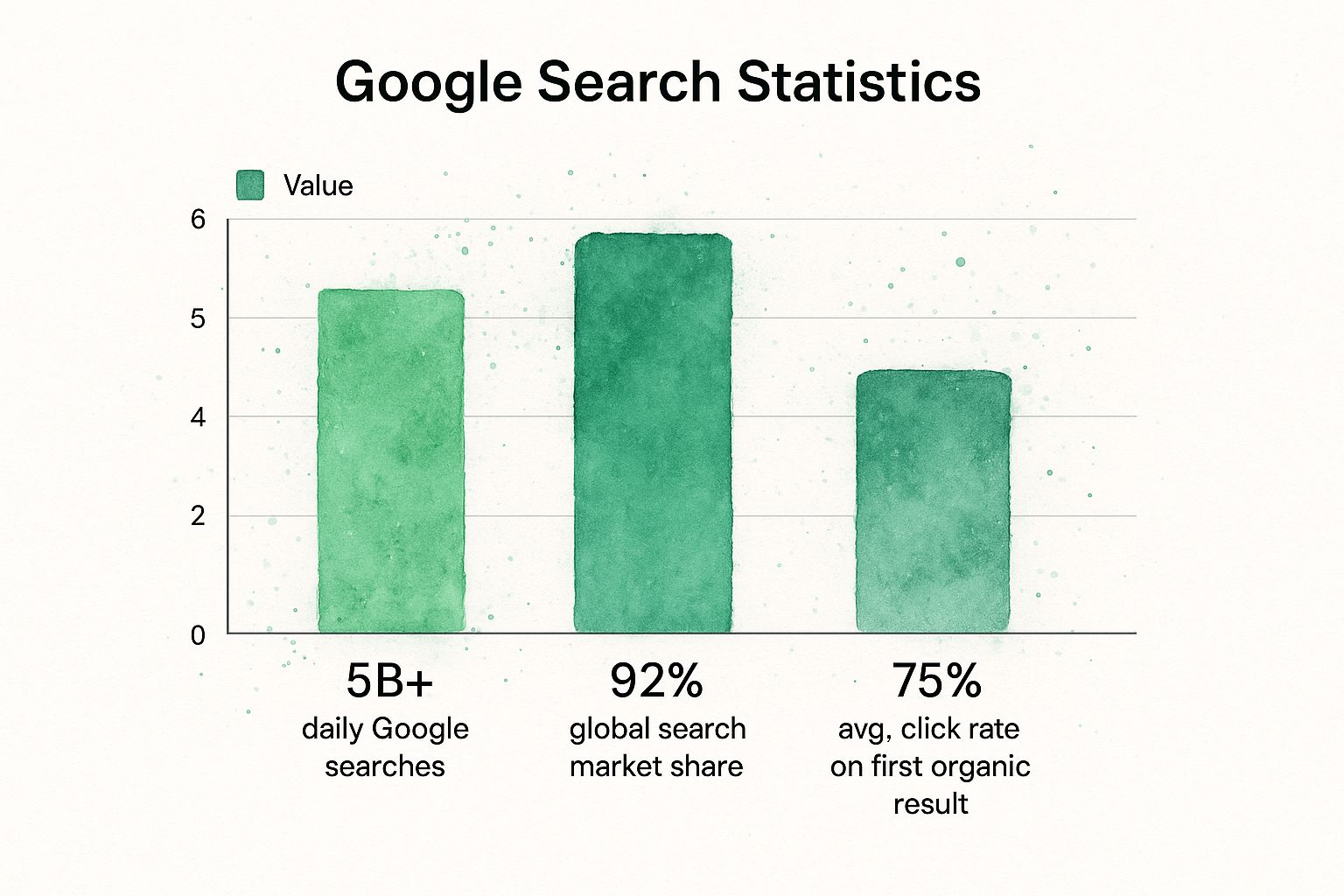
The numbers don't lie. With more than5 billion daily searches, competition is fierce. But the reward for a number one position is huge: you get the lion's share of all clicks.
The Three Core Types Search Intent
Almost every Google search falls into one of three main categories. If you know which category your target customer falls into, you can offer them the perfect content at the perfect moment. Let's take a look at them.
1. Informational Intent
This is by far the most common type of search query. The user is looking for information, answers, or a solution to a problem. They are still in the research phase and are not yet ready to open their wallet.
Search queries often begin with question words.
- Examples:"how to fix a leaky faucet," "best running shoes for beginners," or "Rijksmuseum opening hours."
- Your Strategy:Your task is to create helpful content that directly answers these questions. Think of blog posts, manuals, checklists, and videos. By offering value in advance, you build trust and position your company as a reliable expert.
2. Navigational Intent
In this case, the user already knows exactly where they want to go online. They use Google as a quick route to a specific website or physical location. The search bar is their shortcut.
Think of navigational searches as a digital address book. The user is not looking for new options, but for the direct route to a known destination.
For example, they might type "Digitalique login" or "bike shop Amsterdam address" into Google instead of the full URL in their browser. Your main task here is simple: make sure you appear when someone searches for your brand name or location.
3. Transactional Intent
This is when the money is made. The user is ready to make a purchase or take a specific action. Their intention is purely commercial, and their search terms often include words that indicate a willingness to buy, such as "buy," "price," "discount," or "order online."
- Examples:"buy stroopwafels online," "leather men's jacket sale," or "book a hotel in Utrecht."
- Your Strategy:For these searches, your product pages, service pages, and e-commerce categories must be perfectly optimized. The page must be clear and compelling, making it incredibly easy for the user to complete the transaction.
Capitalizing on Local Dutch Search Behavior
Understanding local trends is crucial to reaching your audience. The most popularGoogle Searchqueries in the Netherlands often reflect practical, everyday needs and local interests. In 2023, for example, the most searched term was "Weather," closely followed by "Amsterdam." This shows how residents use Google for their daily planning and for information about their capital city. By paying attention to these trends, you can better understand the mindset of Dutch consumers. Read more aboutDutch search trends on Statista.
Understanding why a user searches is key to providing the right content. This table provides an overview of the most important search intentions with examples relevant to Dutch companies.
Understand the Reason Behind Every Google Search
| Type Search Intent | Purpose of the User | Example Keyword | Your Content Solution |
| Informational | Find information, learn something, or get an answer. | "How do I prune a rose bush?" | A detailed blog post or a step-by-step video guide. |
| Navigation | Find a specific website or physical location. | "bol.com account" | An optimized homepage and a complete Google Business Profile. |
| Transactional | Purchase a product or service. | "buy new iPhone 15" | A clear, user-friendly product page with a prominent "buy now" button. |
| Commercial | Doing research before making a purchase. | best coffee maker review | An in-depth comparison guide or a list of the best-rated products. |
By tailoring your content to these different intentions, you meet potential customers exactly where they are in their purchasing journey.
Navigating the Modern Google Search Results Page
Let's be honest: the days when aGoogle Searchshowed a simple list of ten blue links are long gone. Today's search results page—what we call theSERP(Search Engine Results Page)—is a whole different beast. It's a dynamic, interactive space full of features designed to give you answers instantly, often before you even click on a website.
For every Dutch entrepreneur, appearing in these special features is no longer a luxury, but a huge competitive advantage. Think of them as prime locations on the front page of Google, grabbing the user's attention long before they scroll down to the traditional results.

Beyond the Blue Links: Important SERP Features
When you search on Google now, you'll see all kinds of boxes and interactive elements. Each one has a specific function and offers a unique opportunity for your business to shine. Let's discuss the most important features you need to know about.
- Featured Snippets:Often referred to as "Position Zero,"this is the box that appears at the very top with a direct answer to a question. Google pulls this information from a highly ranked web page, giving that site incredible visibility.
- People Also Ask (PAA):This is the smart expandable box with related questions. When you click on it, it expands and shows a short answer, similar to a Featured Snippet. It's a gold mine for understanding what else your potential customers are curious about.
- Knowledge Panels:Search for a specific brand, person, or place, and you'll likely see a large panel on the right side of the screen. This panel collects important information from various sources, including Wikipedia and, crucially, your Google Business Profile.
These features have one goal: to provide users with a better, faster experience. Earning a spot here sends a powerful signal to both users and Google that your content is authoritative and highly relevant.
The Local Pack: Your Gateway to Local Customers
For any Dutch business with a physical location—whether you run a café in Utrecht, are a plumber in Rotterdam, or own a boutique in Maastricht—theLocal Packis the holy grail. This is the box that displays a map alongside a list of three local businesses when someone performs a search with local intent, such as "bike repair shop near me."
Making it into this top three can be a game changer, resulting in a huge increase in store visits and phone calls. It puts your business right in front of people who are actively looking for what you offer, right now.
The basis for getting into the Local Pack is a well-managed and fully optimized Google Business Profile. Think of it as your digital storefront on Google; it must be accurate, complete, and active.
But it's not just about being the closest. Google also looks at the completeness of your profile, the number and quality of your reviews, and the overall consistency of your business information on the web.
How to Optimize for These Modern Features
Appearing in these top positions is not a matter of luck, but strategy. It comes down to structuring your content in a way that makes it super easy for Google to understand and highlight.
Here are a few practical steps you can take:
- Claim and perfect your Google Business Profile:This is absolutely essential for local SEO. Fill in every section, upload high-quality photos, actively encourage customer reviews, and use the Q&A feature to answer frequently asked questions. This is your ticket to the Local Pack.
- Answer Questions Directly:To be eligible for Featured Snippets and PAA boxes, you need to structure your content in such a way that you answer specific questions clearly and concisely. Use question-based headings (e.g., "How do I fix a leaky faucet?") and provide a clear answer right in the first paragraph.
- Use Structured Data:This may sound technical, but the concept is simple. It involves adding a special type of code to your website calledschema markup. Think of it as labels on your content that tell search engines exactly what the information is, for example: "This is a recipe," "This is a product review," or "These are our opening hours." Read more in Google's official documentation.
By focusing your strategy on these features, you stop thinking solely about rankings and start striving to dominate the entireGoogle Searchresults page.
Adapting Your SEO to an AI-Driven Google
Artificial intelligence (AI) is no longer a thing of the future; it is already actively changing howGoogle Searchunderstands and ranks your website. Google looks beyond just keywords. Advanced AI systems focus on understanding the true meaning and usefulness of your content. This shift renders many old-fashioned SEO tricks useless.
For your business, this is both a challenge and a huge opportunity. It's no longer a game of ticking boxes. It's about creating content that really helps people. This is the new reality of search, and you need to adapt your strategy to not only survive, but thrive.
People-oriented content is now king.
Google's mission has always been to provide the best answers. AI has accelerated that mission. With updates such as the"helpful content system,"Google's AI actively rewards content created for people, not search engine bots. It now better recognizes pages that provide a satisfying experience and pushes down content designed purely for ranking.
What does this mean for you? Your focus must shift entirely to creating content that proves you have practical experience and in-depth expertise. In other words, if a customer called you with a question, you would give them a clear, honest, and helpful answer. The content on your website must do exactly the same thing.
Understanding E-E-A-T in the Age of AI
To guide this shift toward quality, Google uses a framework calledE-E-A-T. Think of it as a checklist for creating reliable content.
- Experience:You need to demonstrate that you have practical, personal experience with your subject. If you sell hiking boots, content that shows you have actually tested them on Dutch hiking trails is much more powerful than a generic product description.
- Expertise:Showcase your specialized knowledge. This can come from official qualifications, years of experience in the industry, or a deep, passionate knowledge of your niche.
- Authoritativeness:Build your reputation as the go-to source in your field. This gets a huge boost when other respected websites link to you or when people talk positively about your brand online.
- Trustworthiness:Be transparent and honest. Make it super easy for visitors to find your contact details and ensure that all your claims are accurate and substantiated.
In an AI-driven search world, content that perfectly masters these four pillars is considered much more valuable and ranked higher. Want to dive deeper into how AI can work for you? Check out our guide onleveraging AI for your business.
Preparing for AI Overviews and the Future
You've probably already seenAI Overviewsappear at the top of some search results. These are AI-generated summaries that provide a direct answer to a question, based on information from multiple high-quality web pages. While this may sound concerning, it actually reinforces the need for top-quality, E-E-A-T-focused content.
If you want your content to be eligible for these summaries, your information must be crystal clear, well structured, and above all, reliable.
AI Overviews are not intended to replace websites. They are a new way for Google to highlight the most reliable and helpful information. Your goal is to become one of those trusted sources.
This new format emphasizes the importance of being the definitive answer in your niche. And with Google's enormous market share in the Netherlands, adapting to AI features is not optional. In September 2025, Google controlled approximately87.68% of the search engine market in the Netherlands. Discover more insights about theDutch search engine market on StatCounter.
Practical Steps to Future-Proof Your SEO
Adapting to an AI-driven Google doesn't mean you have to completely overhaul your strategy. It's more of a strategic shift in focus. Here are a few practical things you can do right now:
- Write for Your Customer, Not for a Robot:Before you type a word, ask yourself, "What problem is my customer trying to solve?" and "How can I give them the most complete and useful answer?"
- Show, Don't Just Tell:Don't just claim to be an expert—prove it. Use case studies, original photos, personal stories, and customer testimonials to demonstrate your practical experience.
- Dominate your niche:Instead of competing on broad, popular terms, go in-depth. Cover specific topics within your industry in detail. This is where you can really showcase your expertise and build authority.
From Google Search Traffic to Sales and Leads
Ranking high inGoogle Searchfeels great, but what does it really do for your business? Visibility is just the beginning. The real goal is to convert that hard-earned traffic into concrete results: sales, quote requests, and new customers. Here, you bridge the gap between attracting visitors and actively growing your revenue.
This doesn't happen by accident; it requires a purposeful process. It's all about guiding visitors who come to your website via Google toward a specific, valuable action. Simply directing them to your homepage isn't enough. You need a clear path that converts their initial interest into a measurable result for your business.
From Click to Customer: The Conversion Journey
Think of your website as your digital storefront. When someone arrives via a Google search, you have a very brief moment to make a great impression and prove that they've come to the right place. Their journey, from that first click to becoming a paying customer, should be as smooth and intuitive as possible.
This requires more than just a "Contact" page. It requires a strategic approach to your page design, your message, and the overall user experience you offer.
Building Landing Pages That Convert
A landing page is not just any web page. It is a specialized page built for a single purpose: to get a visitor to take a specific action. Instead of sending all your Google traffic to your homepage, it is much more effective to create special landing pages tailored to specific search queries.
For example, if someone searches for "emergency plumber Rotterdam," they should land on a page that directly addresses that urgent need—not on your general "About Us" page.
A successful landing page must absolutely have:
- A Clear and Compelling Headline:This should immediately confirm that the visitor has found the solution they were looking for.
- Persuasive Text:The text should focus on the benefits for the customer and directly address their pain points and needs.
- A Strong Call-to-Action (CTA):This is the most crucial part. The button or link should tell the user exactly what to do, using action-oriented words such as "Request your free quote now" or "Download the guide."
Simplifying the Path to Contact
Once a potential customer decides to get in touch, you need to make it incredibly easy for them. A long, complicated contact form is a major conversion killer. People are busy and have short attention spans; every extra field you ask them to fill in increases the chance that they will drop out.
Your goal is to remove all friction. Only ask for the information that is absolutely necessary to start a conversation. You can always gather more details later.
Take a critical look at your contact forms and ask yourself: "Do Ireallyneed their company name, size, and address right now?" Often, a name, email address, and a simple message field are more than enough to open the door to a new lead.
Measuring What Really Works
How do you know if all this is actually producing results? Simple: you can't improve what you don't measure. Setting upconversion trackingis essential to understanding how visitors from a Google search behave on your site and which actions lead to business success.
Tools such as Google Analytics 4 allow you to track important actions, which we call conversions.
- For a service company:This could be a completed form, a phone call, or starting a live chat.
- For a webshop:This is a completed purchase, adding a product to the shopping cart, or subscribing to a newsletter.
By tracking these goals, you will obtain valuable data that shows which pages and keywords deliver real results. This allows you to focus on what works and improve what doesn't. Optimizing this entire process is a specialty, and our expertise in Conversion Rate Optimization (CRO) can help you get more value from every visitor.
When you viewGoogle Searchnot just as a source of traffic, but as a powerful engine for your business results, you can transform your entire digital marketing strategy.
Your Questions About Google Search Answered
Many Dutch entrepreneurs have the same questions aboutGoogle Search. It's a powerful tool, but let's be honest, it can also feel incredibly complex. In this final part, we provide clear, direct answers to the questions we hear most often.
We cover everything from how long SEOreallytakes to whether blogging is still worth it, giving you the practical insights you need to make smarter decisions for your business.
How Long Does It Take to See Results from SEO?
This is the key question everyone asks. The most honest answer?It depends. SEO is not a quick fix; it is a long-term strategy. Think of it as planting a tree: you have to give it time to develop strong roots before you can expect to see any fruit.
Generally, you will see the first movement within4 to 6 months. However, for significant, business-critical results, you often have to wait6 to 12 months. Various factors can accelerate or delay this process.
- Competition:If you are in a competitive market, such as retail or travel, you are competing against established players. It will naturally take longer to grow.
- Website history:A brand new website starts from scratch. An older site with a solid, penalty-free history has a head start.
- Your Budget:A larger investment allows you to be more aggressive with content, technical optimizations, and authority building, which can certainly shorten the turnaround time.
The most important lesson here is that SEO builds sustainable, long-term value. Unlike paid ads that disappear as soon as you stop paying, the authority you build with good SEO can continue to generate organic traffic for years to come.
Do I really need a blog for my business?
In short:yes. For most companies, a blog is one of the most powerful tools in your SEO arsenal. It's not just about writing articles; it's about creating opportunities to connect with your audience and prove that you know what you're talking about.
A well-maintained blog helps you to:
- Informational Keywords to Target:This is your opportunity to answer the specific questions your potential customers are typing into Google, allowing you to reach them early in their purchasing journey.
- Building E-E-A-T:A blog is the perfect platform to showcase your Experience, Expertise, Authority, and Trustworthiness.
- Generating Internal Links:You can create a web of content that guides both users and Google through your site to your most important service or product pages.
Think of it this way: your service pages are your sales pitch. Your blog posts are the helpful, free advice you give away. That advice builds trust, and trust ultimately leads to sales.
What is the Difference Between SEO and SEA?
Another common point of confusion. Both are essential for visibility onGoogle Search, but they work in completely different ways.
- SEO (Search Engine Optimization):This revolves around earningorganic(unpaid) traffic. You optimize your site to rank as high as possible in natural search results. It is a long-term investment in building authority and trust with Google.
- SEA (Search Engine Advertising):Here, youpayto place ads at the top of the results page (you can recognize them by the label "Sponsored"). It generates immediate traffic, but that traffic stops as soon as you turn off your advertising budget.
A smart digital strategy often combines both. SEA can deliver quick wins and valuable data, while SEO lays the sustainable foundation for long-term growth.
How do I know which keywords to focus on?
Finding the right keywords is all about striking the perfect balance between what your customers are actually searching for and what your company has to offer. A good place to start is brainstorming topics related to your products or services.
Then put yourself in your customer's shoes. What problems are they trying to solve? What questions would they ask? This simple shift in perspective helps you look beyond basic product names to more specific, intention-driven phrases.
For example, a plumber in Rotterdam should not only focus on "plumber." He should focus on longer phrases such as "emergency boiler repair Rotterdam" or "how do I fix a leaking tap." These "long-tail keywords" are not only less competitive, but also attract visitors who are much closer to making a purchase decision.
Understanding what people in the Netherlands are searching for also means keeping an eye on the culture. Major events such as the European Football Championship can completely take over search trends, with searches such as "What time is the Netherlands playing?" Cultural figures such as Joost Klein can also capture the nation's attention, demonstrating how entertainment shapes our search behavior. These trends showcase the dynamism ofGoogle Searchin our region. Read more aboutwhat Dutch people searched for on Google in 2024 on IamExpat.
AtDigitalique.nl, we believe that a solid understanding of Google Search is the first step toward a powerful online presence. We specialize in converting these insights into measurable growth for your business through transparent, expert digital marketing strategies.
Ready to turn your search traffic into real results? Let's build tomorrow's success together.
Find out more about our approach at Digitalique or leave your comment below.
