Is your website traffic stalling? Are you wondering why visitors aren't converting into paying customers? The solution isn't in isolated tricks, but in a smart, integrated system.Online marketingis the engine that drives your business growth by giving your visibility, trust, and ultimately your revenue a significant boost.
In this guide, we show you how to develop a strategic approach that really works. We cover the most important channels, from SEO to AI, and give you practical tools to convert your online marketing into measurable results.
Why Online Marketing Your Growth Engine Is
Many entrepreneurs see online marketing as an endless to-do list: a little SEO here, a social media post there. But these isolated efforts often lead to frustration and disappointing results. The real power of online marketing lies in synergy. It is not an expense, but the most predictable and scalable investment in the future of your business.
Imagine your company as a physical store. Without marketing, no one will know you exist. Online marketing is the combination of your storefront (your website), the signs that lead customers to you (SEO and ads), and the conversations you have to build relationships (social media and email). If these elements don't work together, your store will remain empty.
From Invisible to Indispensable
The main goal of a well-thought-out online marketing strategy is to transform your business from an unknown player to a trusted authority in your market. This process directly addresses the most common problems that entrepreneurs and marketing managers struggle with, such as low website traffic and poor online visibility.
An effective strategy focuses not on "doing" marketing, but on systematically solving business problems. It's about getting the right message to the right person through the right channel at the perfect moment.
The Foundations for Success
Before we delve deeper into the specific channels, it is crucial that you understand the bigger picture. A successful approach is always built on a few core principles that we at Digitalique.nl adhere to:
- Customer focus comes first:Everything starts with a deep understanding of your ideal customer. What are their problems, where do they look for solutions, and how do they make decisions?
- Data-driven decisions:Instead of guessing, we use data to understand what works. This allows us to continuously adjust campaigns for an ever-improving return on your investment (ROI).
- Integration is everything:SEO strengthens your ads. Content feeds your social media. Email marketing converts leads into customers. No channel stands alone; together they create a powerful growth engine.
By approaching online marketing as a strategic driver rather than a to-do list, you lay the foundation for sustainable growth. In the following sections, we'll show you exactly how to start this engine and keep it running.
Your Core Channels for the Online Understanding Marketing
Feeling a little lost in the sea ofonline marketingoptions? You're not alone. The best way to think about it is as a toolbox full of specialized tools, each designed for a specific task. The secret is knowing which tool to pick up to solve a specific problem—whether that's more website visitors, better leads, or a higher return on your budget.
Let's break down the most powerful channels. Once you understand what each channel does best, you can build a strategy that not only costs money but actually drives sales and sustainable growth.
Search Engine Optimization (SEO): The Foundation of Your Digital Storefront
What's the first thing you do when you need something? You look it up on Google, right? Your potential customers do exactly the same thing, every day.Search engine optimization (SEO)is the art of making your website irresistible to search engines such as Googleso that you appear at the top when people search for what you sell.
Think of SEO as building the best-located and most inviting store on Main Street. It's not a quick fix; it's a long-term investment in a valuable digital asset. Good SEO delivers a steady stream offree, organic trafficfrom people who are actively looking for a solution that you offer. It's about being there at the exact moment of need, building trust and authority from the very first click.
Search Engine Advertising (SEA): The Fast Track to Visibility
While SEO builds your long-term presence, sometimes you need resultsnow. That's whereSearch Engine Advertising (SEA), also known as Pay-Per-Click (PPC), comes into play. With SEA, you pay to place your ads at the top of search results, essentially renting prime digital real estate.
This channel is perfect for:
- Launching new productsor promotions that require immediate attention.
- Targeting highly specific keywordsto capture customers who are ready to buy.
- Quickly testing different marketing messagesto see what resonates with your audience.
The big advantage of SEA is its speed and precision. You can launch a campaign in the morning and see traffic coming in by the afternoon. It gives you immediate data, allowing you to determine what works and adjust your strategy for the best return. If SEO is a marathon, SEA is a sprint—incredibly powerful for achieving short-term goals and gathering market insights.
This image highlights the trade-offs between organic SEO and paid search, showing the differences in click-through rates and costs.
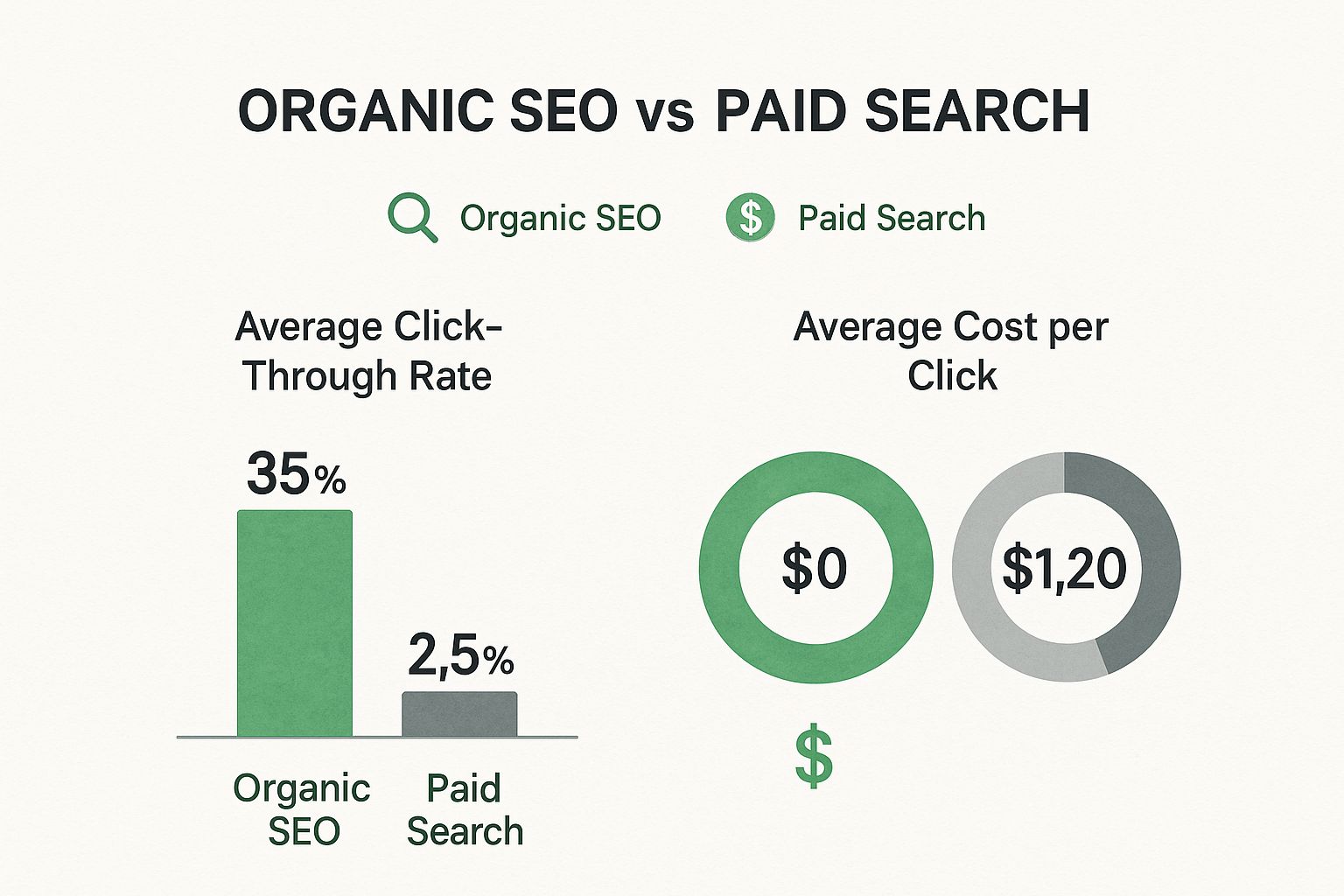
Although paid ads give you immediate visibility, data shows that organic SEO often yields a much higher click-through rate in the long term, allowing you to build traffic that doesn't cost you per click.
Content and Social Media Marketing: Building Relationships at Scale
If SEO and SEA are the ways to get people to your front door, then content and social media are what happens once they're inside. These channels are all about building relationships, showcasing your expertise, and staying top-of-mind with your audience. Content marketingis the art of creating and sharing valuable content—such as blog posts, videos, or guides—that truly solves your customers' problems.
It's not a direct sales pitch. It's about education and assistance. When you consistently provide useful information, you build trust and position your brand as the go-to authority, making it a logical choice for customers to choose you when they are ready to buy.
Social media marketingis the megaphone for this effort. It enables you to:
- Share your brilliant content with a much wider audience.
- Engage in direct conversations with customers and prospects.
- Build a genuine community around your brand.
Consider social media as the village square. It is the place where you connect with your community, listen to what they need, and build genuine connections that grow into long-term loyalty.
Your online content is a direct reflection of your expertise. By consistently offering value without asking for anything in return, you create a powerful magnetic attraction that draws in ideal customers and builds unwavering trust.
To help you see how these pieces fit together, here is a quick comparison of the main channels.
The Most Important Online Marketing Channels at a Glance
| Channel | Primary Goal | Dear For | Time to Result |
|---|---|---|---|
| SEO | Long-term organic visibility | Building brand authority, sustainable traffic | 6-12+ months |
| SEA (PPC) | Direct traffic & leads | Promotions, testing, quick profits | Immediately |
| Content marketing | Building trust & expertise | Lead nurturing, audience engagement | 3-6 months |
| Social Media | Brand awareness & community | Direct involvement, building loyalty | Continuous |
| Email marketing | Nurturing & converting leads | Customer retention, direct communication | Immediate to ongoing |
Each channel has its own rhythm and timeline. A great strategy doesn't just choose one channel; it combines them to create a system in which each channel supports the other, leading to results that are greater than the sum of their parts.
Building a Strategy who Sales Stimulates
Having a box full of shiny tools is one thing; knowing how to build something incredible with them is quite another. This is exactly where many companies get stuck with theironline marketing. A Facebook post here and a Google Ad there won't build real momentum. To drive sales and achieve sustainable growth, you need a cohesive strategy—a blueprint that directly links every action to your bottom line.

Think of it as building a house. You wouldn't just start laying bricks and hope for the best. You start with an architect's plan that describes every room, every connection, and the final result. An online marketing strategy does the same thing, ensuring that each effort builds on the previous one to create a strong, stable structure for your business to grow.
Defining Your SMART Goals
The very first step in any good strategy is knowing where you are going. Vague goals such as "more traffic" or "increase sales" are not enough. You need clear, measurable objectives to guide your decisions and actually measure what works. This is where theSMART goals frameworkbecomes your best friend.
Your goals should be:
- Be specific:Determine exactly what you want to achieve. Instead of "more leads," aim for "generate50qualified leads per month through our website."
- Measurable:How do you know you are successful? Use concrete figures, such as "increase online sales by20%in the next quarter."
- Achievable:Be realistic. Set ambitious goals, certainly, but ensure they are achievable with the resources you have.
- Relevant:Is this goal truly important to your larger business objectives? Growing your email list is relevant if email is an important sales channel for you.
- Time-bound:Set yourself a deadline. For example, "achieve a top3position for our most important service keyword within six months."
Setting SMART goals transforms your marketing from a series of hopeful guesses into a focused plan designed to deliver a clear return on your investment.
Understanding Your Ideal Customer
Who are youreallytrying to reach? If your answer is "everyone," your marketing will ultimately appeal to no one. A winning strategy is based on a deep understanding of your ideal customer, often formalized in abuyer persona. This is a semi-fictional profile of your perfect customer, based on market research and real data from your existing customers.
Your buyer persona should be detailed: their job, daily struggles, what they are trying to achieve, and where they look for information online. This clarity makes critical decisions much easier. It tells you which social media platforms they use, what language to use in your ads, and what problems to solve. Are you interested in outsourcing online marketing? Take a look at one of the online marketing solutions.
When you know exactly who you are talking to, every part of your marketing becomes more personal, relevant, and effective. You stop shouting into the void and start having meaningful conversations with people who are genuinely interested in what you have to offer.
Select and Integrate Your Channels
Once you have clear goals and a well-defined audience, you can choose the right channels. Don't feel pressured to be everywhere at once. Focus on the platforms where your ideal customer is most active. If you're a B2B tech company, LinkedIn and SEO are likely your most important channels. If you sell handmade jewelry, Instagram and Pinterest are probably the places to be.
But the real magic happens when you let these channelswork together. This is the core of a powerfulonline marketingstrategy.
For example, it could look like this:
- You publish a detailed blog article optimized for SEO (content marketing).
- Next, promote that article on LinkedIn and Facebook to generate initial traffic (Social Media Marketing).
- The article includes a call-to-action to download a free guide, which allows you to collect email addresses (lead generation).
- Then, you use email marketing to nurture these new leads with more valuable content, ultimately leading them to a sale (Email marketing).
In this scenario, each channel supports and reinforces the others, creating a smooth customer journey. This integrated approach is especially essential in a crowded market. By building a strategy that unifies your goals, audience, and channels, you create a marketing engine that not only runs, but accelerates, driving consistent and predictable revenue growth for your business.
Connecting with Customers on Social Media
Where do your ideal customers hang out, share their opinions, and discover new brands? The answer is almost always social media. These days, effectiveonline marketingmeans looking beyond your website and actually talking to people on the platforms they use every day. Social media isn't a digital billboard; it's a dynamic community where you can build real trust and lasting relationships.
Consider platforms such as Instagram, Facebook, and LinkedIn as the modern village square. This is where conversations arise, trends are set, and purchasing decisions are strongly influenced. When you are consistently visible with content that is truly useful and authentic, you are no longer just another anonymous company. You become a trusted voice. That shift is what turns casual followers into loyal customers.
Creating Content That Truly Connects
The secret to success on social media is not relentless posting, but posting with a purpose. Your content must connect with your audience on a personal level. Forget generic sales pitches. Invest your energy in creating content that educates, entertains, or inspires.
Here are a few practical ideas to get you started:
- Share a glimpse behind the scenes:Connecting people with people. Show the faces behind your brand, the production process of your product, or a typical day at the office. This humanizes your company and builds authenticity.
- Answer frequently asked questions:What are the top three questions your sales team constantly gets asked? Turn the answers into a short video, a handy infographic, or a simple tip post. This showcases your expertise and offers real value.
- Four customer stories:Post testimonials or share user-generated content (with permission, of course). This serves as powerful social proof and makes your existing customers feel valued.
Remember that the goal is to start a conversation, not just send out a message. Ask questions in your posts, hold polls, and always respond to comments. This interaction tells both your audience and the platform's algorithm that your content is worth paying attention to. Our dedicated social media marketing services can help you build a content strategy that encourages these meaningful interactions.
Using GEO Targeting for Local Impact
For many businesses, attracting local customers is the most important goal. This is whereGEO targetingbecomes an incredibly powerful tool in your online marketing toolkit. Simply put, GEO targeting allows you to show your social media ads specifically to people within a certain geographical area—such as a city, a specific neighborhood, or even a small radius around your physical store.
Imagine you own a restaurant. With GEO targeting, you can advertise a lunch special that is only shown to people within a one-kilometer radius of your front door, between 11:00 a.m. and 1:00 p.m. That's the power of precision.
This technique revolves around using your advertising budget more intelligently. Instead of spending money on people who live too far away to ever become customers, you focus every dollar on the audience that is most likely to convert. This not only improves your return on investment, but also makes your message highly relevant to those who see it, increasing its impact. By combining great content with smart targeting, you can effectively turn your social media presence into a powerful engine for local leads and sales.
Using AI and Analytics To Measure What Matters
How do you know if youronline marketingis paying off? Putting your budget into campaigns is one thing, but truly understanding the return on that investment is what separates gambling from growth. This is where we stop relying on gut feelings and start treating data as our most valuable teammate. Let's cut through the noise of analytics and focus on the metrics that truly reflect the health of your marketing.

It is incredibly easy to drown in a sea of flashy dashboards and so-called "vanity metrics" such as page views or social media likes. Instead, we need to focus on the Key Performance Indicators (KPIs) that directly impact your bottom line. Think conversion rates, cost per lead, and customer lifetime value. This sharp focus transforms your marketing from a hopeful expense into a predictable growth engine.
Define your Key Performance Indicators (KPIs)
The first step toward making smart, data-driven decisions is knowing what to measure. Not all numbers are created equal. An abundance of website visitors may feel good, but it means nothing if none of them actually become customers. You need to track the KPIs that are directly linked to your business goals.
For most companies, these are the statistics that really matter:
- Conversion rate:This is the percentage of visitors who take the desired action, whether that is filling out a contact form, downloading a guide, or clicking the "buy now" button. It is the ultimate test of how persuasive your website and marketing messages are.
- Cost per Lead (CPL):Simple but crucial: how much do you spend to bring in one new lead? Knowing your CPL is essential for managing your budget and determining which campaigns are actually profitable.
- Customer acquisition cost (CAC):This goes one step further. It calculates thetotalcost of acquiring a new paying customer. A healthy business always ensures that the lifetime value of a customer is much higher than the CAC.
- Return on Investment (ROI):The most important factor. For every dollar you invest in marketing, how many dollars do you get back in revenue? ROI gives you the definitive answer to what works and where you should double down.
By closely monitoring these KPIs, you get a clear, unfiltered picture of your performance. It helps you leave assumptions behind and base your entire strategy on hard facts.
The Rise of AI in Marketing
Beyond simply tracking data, Artificial Intelligence (AI) is completely changing the game. AI is no longer a futuristic fantasy; it is a practical tool that automates tedious tasks and reveals powerful insights, allowing you to focus on the bigger picture.
Think of AI as your smartest, most tireless marketing assistant. It can sift through thousands of data points in seconds to recognize patterns, predict what customers will do, and personalize experiences on a scale that no human team could ever match.
AI excels at tasks that require speed and precision. For example, AI-driven tools can automatically adjust your ad bids in real time for the best possible ROI. They can also tailor website content for each individual visitor, showing them the products or messages most relevant to their previous behavior. This kind of personalization gives engagement and conversion rates a serious boost.
This is where more advanced tools come into play. Exploring marketing automation solutions can help you put these AI-driven strategies into practice by automatically nurturing leads and delivering personalized content without you having to lift a finger.
Data-Driven Decision Making for Growth
Ultimately, the goal of using analytics and AI is to create a continuous feedback loop. You launch a campaign, measure how it performs against your KPIs, gather insights from the data, and use those insights to make your next campaign even better. This cycle of testing and refining is the real secret to sustainable growth.
The digital advertising market is a perfect example of this shift. Spending is rising steadily, especially on social media, where targeting and measurement are incredibly accurate. Forecasts show that spending on social media advertising will increase significantly, a clear sign that the market is moving toward measurable, data-supported formats. You can explore more about this growth in digital ad spending to see exactly where the market is headed.
By embracing data, you take the guesswork out of your online marketing. You learn exactly who your customers are, what they respond to, and how you can reach them more effectively. This clarity allows you to allocate your budget with confidence, knowing that every decision is backed by evidence and focused on one thing: measurable results.
Your Action Plan for Sustainable Growth
Alright, you have the framework for powerfulonline marketing. Now it's time to move from theory to action. A unified strategy, focused on the right channels and supported by solid data, is the most direct way to solve growth problems such as low traffic and low conversion rates. It's all about taking smart, deliberate steps instead of gambling.
The goal here is not to tackle everything at once. Sustainable growth comes from making small, intelligent changes that build on each other. This is your starting point for turning your marketing efforts into a predictable engine for business growth.
Your Quick Start Audit Checklist
Use this simple checklist to audit your current efforts and identify your biggest opportunities. Be honest about where you stand—clarity is the first step toward real improvement.
- Goals:Do we have clearly defined, measurable SMART goals for our marketing (e.g., "increase qualified leads by15%in Q3")?
- Target audience:Do we have a clear, documented understanding of our ideal customer, including their pain points and where they spend their time online?
- Channels:Are we active on the channels where our ideal customers actually are? Or do we choose channels just because "we have to be there"?
- SEO:Does our website appear on the first page of Google for at least one of our most important keywords? Have we implemented the basics of on-page SEO?
- Content:Is our content truly useful and does it answer the real questions of our audience, or is it primarily focused on selling our products?
- Data:Can we confidently track our conversion rate and cost per lead? Do we make decisions based on this data?
This audit is not about finding flaws; it is about identifying leverage points. You would be amazed at the domino effect that improving just one of these areas can have on your entire strategy.
Think of online marketing as a garden. You don't plant everything in one day and expect a harvest tomorrow. You start by preparing the soil (your strategy), planting the right seeds (your channels), and watering them consistently (data-driven optimization). Over time, this patient and strategic effort will yield sustainable growth.
The way forward is all about consistent, focused action. Pick one or two areas from your audit that offer the biggest opportunities and commit to improving them. By breaking down the process and focusing on steady progress, you'll turn youronline marketinginto a powerful, reliable engine for long-term revenue and success.
Frequently Asked Questions
 Even with a solid plan, a few practical questions always pop up when it's time to really get started withonline marketing. Let's tackle some of the most common questions we hear from our customers with simple advice to help you move forward with confidence.
How Much Should I Budget for Online Marketing?
This is the million-dollar question, isn't it? There is no magic number that works for everyone. Your budget really depends on your industry, your specific goals, and how competitive your market is. Instead of choosing a random amount, we always recommend starting with your goals and working backwards from there.
Consider your Customer Acquisition Cost (CAC) and Customer Lifetime Value (LTV). If a new customer is worth $1,000 to your business in the long term, you can decide how much you are willing to invest to acquire that customer. For many small to medium-sized businesses, a good starting range is between7-12% of their total revenue.
Stop viewing your marketing budget as an expense. It is an investment in a growth engine. The goal is to build a system where every dollar you put in yields more than a dollar in return.
How Long Does it Take to See Results?
The time it takes to see a return on youronline marketing investmentcan vary greatly depending on the channel you choose. It is crucial to have realistic expectations from the outset to avoid discouragement.
Here is a rough guideline to keep in mind:
- Paid Advertising (SEA/PPC):This is your fast track. You can see traffic and even leads almostimmediately, sometimes within the first week. It's perfect for quick wins and gathering valuable data.
- SEO and Content Marketing:Consider this a long-term investment. It generally takes6-12 monthsto see significant, lasting results in your organic traffic and rankings. You are building a digital asset that will pay dividends for years to come.
- Social Media Marketing:Building a genuine, engaged community does not happen overnight. You may see some initial engagement within a few months, but converting that into a consistent stream of leads can take3-6 monthsor longer.
Patience and consistency are your best friends, especially when it comes to organic strategies.
Which channels should I focus on first?
Don't spread yourself too thin by trying to be everywhere at once. The smartest move is to choose one or two channels where you know your ideal customers are, and perfect those before you even think about expanding.
Need leads fast? A targetedGoogle Ads (SEA)campaign that leads to a sharp, high-converting landing page can deliver quick results. If you're in a visual industry such as retail or hospitality,Instagram and Facebookare probably your best bet. For B2B service providers, the powerful combination is oftenLinkedIn and SEO.
The key is to start small, prove that a channel works for you, and then scale up what delivers results.
Ready to turn these insights into a powerful growth strategy for your business? AtDigitalique.nl, we combine data-driven expertise with a transparent approach to deliver measurable results. Let's build your future success together.
Start Growing Today with Digitalique.nl If growth is not the right time for you, please leave a comment on this article.
