.
Increasingyourwebsite conversionis more than just adjusting a few buttons; it's about converting more visitors into customers. This is not a matter of one magic intervention, but of systematically understanding what drives your visitors and what barriers are holding them back. As an entrepreneur or marketing manager, you know that every visitor counts, but how do you ensure that they actually take the step to become a customer?
In this article, you'll discover practical, proven strategies to do just that. We'll cover realistic benchmarks, the psychology behind trust and urgency, and how to improve your website step by step with smart testing. Let's get started.
Setting Realistic Goals with Dutch Conversion Benchmarks
Before you change a single element on your site, you need to know where you stand. Without a clear picture of your current performance and realistic benchmarks, it is impossible to measure success. You want to base your strategy on data, not guesswork. Setting clear goals is therefore the very first step toward higher conversion.
The Dutch e-commerce market is unique and quite competitive. At the end of 2023, the average conversion rate for Dutch webshops fluctuated around2.8%, which is slightly above the global average. But this figure alone does not tell the whole story. The origin of your traffic plays a huge role in what you can expect.
Average Dutch Conversion Rates per Traffic Source
A quick comparison of how different traffic sources convert on an average Dutch e-commerce website.
| Traffic source | Average Conversion Rate |
|---|---|
| Direct traffic | 3,3% |
| Paid searches | 3,2% |
| Organic search | 2,7% |
| Email campaigns | 2,6% |
| Social media | 1,5% |
These figures show that not every visitor is the same. Direct traffic and paid searches generate the hottest leads, while social media is often more focused on discovery and less on direct purchases.
Why These Figures Are Important
This data provides you with a framework. Imagine that your organic traffic converts well below the average of2.7%.Then you immediately have a concrete starting point for improvement. On the other hand, is your social media marketing performing well above1.5%? Fantastic, then you're doing something very well. The goal is not to blindly chase the average, but to find your own weaknesses and further build on your strengths.
Data is the voice of your customer. Benchmarks are the way to hear if you are listening.
Each traffic source attracts a different type of visitor, with a different intention. Someone who types in your URL directly is likely already familiar with your brand and is much further along in the buying process than someone who arrives via a broad search query.
The graph below shows the potential effect of optimization, where an increase in conversion directly leads to a lower bounce rate.
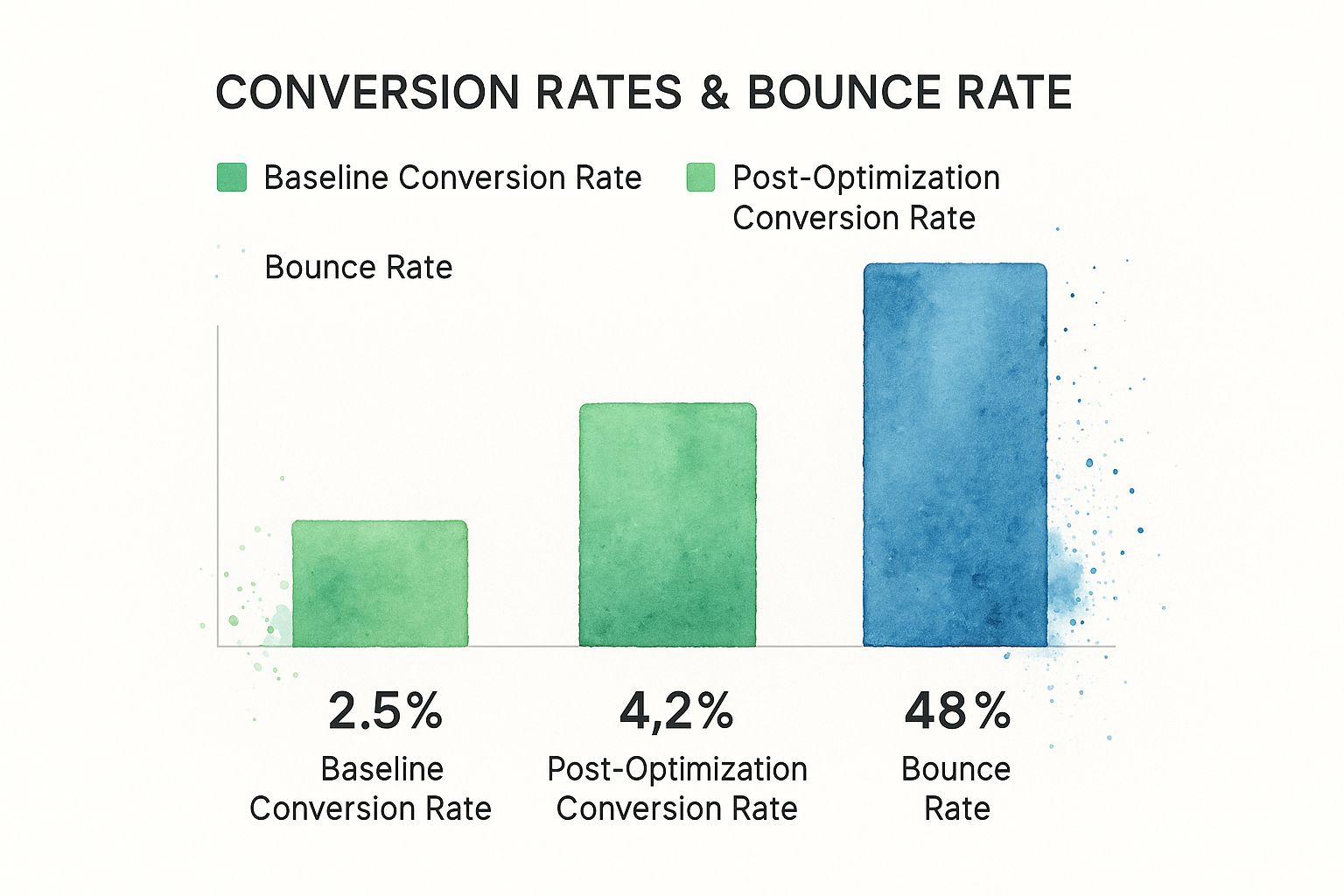
As you can see, a seemingly small jump from2.5%to4.2%can have a huge impact on your operating results.
The Role of Device Usage
Another crucial element to take into account is device usage. Traditionally, desktops convert better than mobile phones. That makes sense: complex purchases or filling out extensive forms are simply easier on a large screen.
Nevertheless, an increasing portion of the customer journey takes place on mobile devices. A poor mobile experience immediately drives visitors away, before they even have the opportunity to convert later on their desktop.
A responsive mobile site is no longer a luxury, but an absolute necessity. Make sure your website not onlyworkson mobile devices, but is trulyoptimizedfor an intuitive experience. Consider the following:
- Fast loading times:Every second counts, especially on mobile devices.
- Simple navigation:Visitors should be able to find what they are looking for with minimal effort.
- Clear CTA buttons:Buttons should be large enough and easy to tap with a thumb.
- Short forms:Only ask for absolutely necessary information. Make it easy for your visitor.
The Psychology of Trust and Urgency
To increase yourwebsite conversion, we needto dig deeper than just the technology. We dive into the human psyche. As soon as a visitor lands on your site, two questions unconsciously pop into their head: "Can I trust this club?" and "Why should I do thisnow?". The answer to those questions is the key to better conversion.
You can have the flashiest website in the world, but without trust, nothing will happen. Trust is the foundation.
Build Trust Instantly with Social Proof
One of the most powerful psychological tricks issocial proof. People are herd animals. We constantly look to what others are doing to confirm our own choices. When we see that others have already had a good experience, it feels safer to take the same step.
How can you apply social proof effectively?
- Customer reviews and testimonials:Genuine, honest reviews are worth their weight in gold. Put them in a prominent place, such as your product pages, the homepage, and even at checkout.
- Quality marks and certificates:Logos from well-known parties (such as Thuiswinkel Waarborg or a trade association) act as a visual shortcut to reliability.
- Case Studies:Use concrete figures and stories to show how you have helped other customers. Results speak louder than vague promises.
By showing that others already trust you, you greatly lower the threshold for new visitors. This is a crucial step if you want to increase your website's conversion rate.
A visitor will only open his wallet if he feels that his investment – both in terms of money and trust – is safe.
Create a Sense of Urgency and Scarcity
Okay, you've gained their trust. Now what? The next step is to motivate visitors to take actionnow. People are masters at procrastinating. Without a good reason to decide immediately, they will leave your site with the vague promise of "I'll come back later" – which nine times out of ten they won't.
This is whereurgencyandscarcitycome into play. These techniques capitalize on our fear of missing out (also known as FOMO).
Practical ways to create urgency:
- Limited-time offers:Use a countdown clock for a discount promotion. "20%off for 2 more days" works much better than a general sale.
- Delivery deadline:"Order within 3 hours and receive your package tomorrow" creates a clear deadline and pushes people towards a quick decision.
And this is how you apply scarcity:
- Limited stock:Notifications such as "Only 3 left in stock" can help sway that hesitant buyer.
- Exclusive access:Offer a limited number of spots for a webinar or a limited edition of a product.
An important note: always use these techniques honestly. People can easily see through fabricated scarcity, which will damage the trust you have worked so hard to build.
Formulate a crystal-clear value proposition
The last, and perhaps most important, psychological pillar is clarity. What do you offer? For whom? And why are you better than the rest? That is yourvalue proposition.
A rock-solid value proposition provides a direct answer to the question: "What's in it for me?".
Consider Coolblue's slogan: "Everything for a smile." This communicates not only what they sell, but also the emotional promise of top-notch service. Or take a B2B software company that says: "Save10 hoursof administration every week." That's a concrete, tangible benefit.
Your value proposition must immediately jump out at visitors on your homepage and be repeated throughout your website. Use simple language, not marketing jargon. If a visitor doesn't understand what you do and how it benefits them within five seconds, you've lost them. That's the ultimate test in your mission toincrease website conversion.
A Frictionless User Experience Design
A visitor who has to search, think, or wait is a visitor who will leave. Any form of friction—whether it's a slow page, an unclear button, or a confusing menu—costs you money. Toincrease yourwebsite's conversion rate, you need to roll out the red carpet and ruthlessly remove every obstacle in the customer journey.
A smooth user experience (UX) is not a luxury; it is the absolute basis of a profitable website. It's all about making it as easy as possible for your visitor to say 'yes'. That starts with a deep dive into the entire user journey, from that very first click to the final conversion.

Simplify Your Navigation to the Extreme
Can your visitors find what they are looking for within three clicks? If the answer is no, you have some work to do. A complicated navigation structure is one of the biggest conversion killers there is. People are impatient and don't have time to solve a puzzle.
Your navigation should be so intuitive that no one has to think about it. Use clear, recognizable terms in your menu. Skip the creative jargon and choose words that your customers use themselves. Analyze behavior on your site with tools such as heat maps to see where people get stuck or click unnecessarily.
The best navigation is invisible. It takes users effortlessly from A to B without them consciously thinking about it.
Make Your Website Mobile-Perfect
For many of your customers, their mobile phone is the starting point of their search. A website that doesn't function perfectly on a small screen is like leaving the door of your physical store ajar. Technically accessible, but not particularly inviting.
Aperfect mobile experiencegoes far beyond just a responsive design. It means:
- Lightning-fast loading times:Every second of delay on mobile costs you a significant portion of your visitors. So optimize your images and code.
- Large, tap-friendly buttons:Ensure that CTAs and menu buttons are easy to operate with a thumb.
- Readable fonts:The text should be comfortably readable without anyone having to zoom in.
- Simple forms:Minimize the number of fields and make smart use of autofill options.
The first contact with a potential customer often takes place on a mobile device. If that experience is frustrating, they will definitely not return to their desktop later.
Optimize Your Charging Speed
Waiting is detrimental to conversions. A website that takes longer thanthree secondsto load loses almost half of its visitors. A slow site feels unprofessional and unreliable, which directly affects your results.
Use tools such as Google PageSpeed Insights to measure your site's performance. The recommendations that come out of this, such as compressing images and minimizing code, are concrete action points. Making your website faster is a technical job, but it is one of the most effective ways to give your conversion a significant boost.
Design Intuitive Forms and Powerful CTAs
The form is often the final hurdle before conversion. Your task is to make this hurdle as low as possible. Only ask for the information youabsolutely need. Every extra field is a new reason for someone to drop out.
Combine a short, clear form with a compelling Call-to-Action (CTA). A good CTA is:
- Action-oriented:Use verbs that encourage action, such as "Download now," "Request your quote," or "Start your free trial."
- Visually striking:Ensure that the button has a contrasting color and sufficient white space around it.
- Clear:The text on the button must describe exactly what happens after the click. No surprises.
Together, these elements determine whether a visitor takes that final, crucial step. A systematic approach to this is an essential part of every conversion optimization strategy.
It is important to realize that most visitors do not convert immediately. Research shows that only22%of new visitors to e-commerce sites make a purchase within the first month. This emphasizes how important a smooth experience is to make a great first impression, so that they will come back later.
A Practical Guide to A/B Testing
Stop guessing what works and what doesn't on your website and start knowing for sure. This is where A/B testing comes in. It may sound technical, but the concept is surprisingly simple: you show two versions of the same page to different groups of visitors to see which one performs better. This data-driven approach is the engine behind continuous improvement.
Think of it as an eye test at the optician. They show you two lenses and ask, "Which one is clearer, number one or number two?" Based on your answer, they adjust the lens. A/B testing does exactly the same thing for your website and helps youincrease website conversionthrough small, measurable adjustments.
Start with a Strong Hypothesis
Every successful A/B test starts not with a random idea, but with a solidhypothesis. This is nothing more than an educated guess about which change will lead to a better result, and more importantly,why. It's the difference between blindly changing a button color and having a strategic reason for doing so.
A good hypothesis follows a simple structure: "If I change [A] to [B], then [C] will happen, because [D]."
- [A]is the element you are modifying (e.g., the text on a button).
- [B]is the proposed change (e.g., from "Send" to "Receive your free quote").
- [C]is the expected outcome (e.g., more form submissions).
- [D]is the reason why you expect this result (e.g., the new text is more specific and value-oriented).
A concrete example: "If we change the button text from 'Read More' to 'Watch a 2-minute demo', we expect the click-through rate to increase, because visitors know exactly what to expect and how little time it will take." This approach forces you to think strategically about each test.
What Can You Test to Improve Conversion?
The possibilities for A/B testing are almost endless, but it's best to focus on elements with the greatest potential impact on user behavior. Start with the pages that get the most traffic or are crucial to your conversion funnel, such as your homepage, product pages, and checkout process.
Here are a few high-impact elements to consider:
- Headings and Subheadings:Does a heading that emphasizes a benefit perform better than one that focuses on a feature? Test different angles to see what grabs your audience's attention.
- Call-to-Action (CTA) Buttons:Experiment with the text, color, size, and placement of your CTAs. A simple change from "Buy Now" to "Add to Cart" can make a significant difference.
- Images and Videos:Test different visuals. Does a product video lead to more sales than static images? Does a photo of someone using your product build more trust?
- Page Layout and Design:You can also test larger changes, such as moving a form from the right side to the left, or using a single-column layout instead of multiple columns.
- Product descriptions:Try a different tone of voice or focus on other benefits. One version could emphasize technical specifications, while another focuses on how the product solves a specific problem.
Remember that the goal isn't just to find a "winner." The real goal is to learn what resonates with your audience so you can apply those insights to your entire website.
Tools to Get Started
You don't need a huge budget or a team of developers to get started with A/B testing. There are several user-friendly tools available that make setting up and running tests very easy.
- Google Optimize:Although this is being phased out, its features will be integrated into Google Analytics 4. For many companies, this is a powerful and free option.
- VWO (Visual Website Optimizer):A hugely popular and accessible platform with a visual editor that allows you to make changes without touching any code.
- Optimizely:A more advanced platform, suitable for larger companies that need more robust testing capabilities.
Many of these tools offer visual editors. This means you can click directly on elements on your page and adjust them to create a test variant. They take care of the technical side of splitting traffic and measuring results, so you can focus on the strategy.
Interpreting the Results Correctly
Once your test has run long enough to collect sufficient data, it's time to analyze the results. The tool shows which version—the original (the control) or the variant—performed better and by what percentage. But the most important number to look at is thestatistical significance.
Statistical significance tells you how confident you can be that the results are not simply due to chance. Most platforms calculate this for you and aim for a confidence level of95%. If your test reaches this level, you can be reasonably sure that the winning variant will also perform better in the long term.
Don't stop a test too early just because one version seems to be winning. Let it run for its full duration—at least one to two full business cycles—to account for daily and weekly fluctuations in visitor behavior. By testing patiently and implementing the winners, you'll gradually build a stronger, more effective website based on data rather than gut feeling.
The Customer Experience Personalize
Not all your website visitors are the same, so why treat them that way? A uniform approach for everyone is a missed opportunity. If youwant to increase website conversion, you need to personalize and segment the experience. It's the transition from shooting with buckshot to precision work.
The essence of personalization is actually quite simple: the right message, to the right person, at the right time. This creates a much more relevant and therefore more effective customer journey. After all, a visitor who already knows and trusts your brand needs something completely different from someone who is just discovering it for the first time.
The Difference Between Branded and Non-Branded Traffic
One of the most fundamental ways to segment your audience is by looking at how they found you. Did they arrive via a search query containing your brand name (branded traffic), or via a generic search term (non-branded traffic)? This small difference in search intent has enormous consequences for your strategy.
Visitors who search specifically for your brand name have a much higher intention to buy. They know you, probably already trust you, and are often already well into their decision-making process. For this group, you want to make the path to conversion as short and smooth as possible. Think clear product pages, a simple checkout process, and prominently displaying popular items.
Non-branded traffic, on the other hand, consists of people who have a problem or need but don't yet have a specific brand in mind. For example, they search for "sustainable running shoes" rather than "Nike Pegasus." You first need to convince and inform these visitors. They need confidence-building content, such as reviews, comparisons, and detailed product information. It is essential to optimize the content and customer journey for these different intentions in order to increase your conversion rate.
Implement Dynamic Content
Today's technology makes it possible to tailor your website content to visitors in real time. This is calleddynamic content. Think of it as a digital chameleon that changes color based on its environment. It allows you to offer a unique, personalized experience that significantly increases the chance of conversion.
What can you customize?
- Location:Display a special offer for visitors from Amsterdam or direct them to the nearest physical store.
- Behavior on the site:Has someone repeatedly viewed a specific product category? Then display a banner with products from that category on the homepage.
- Referral source:Is a visitor coming from a partner website? Greet them with a personalized welcome message such as: "Welcome, reader of [Partner name]! Here is your exclusive discount."
- Time:Display a different message in the morning ("Start your day right with...") than in the evening ("Order now, delivered tomorrow").
Personalization is no longer a "nice-to-have." It is the expectation of the modern consumer. A personalized experience shows that you understand and value your customer.
Bring Back Departed Visitors with Retargeting
What do you do with the majority of visitors who leave your website without converting? You don't just let them go. Withretargeting(or remarketing), you can reach this group again with targeted ads on other platforms, such as social media or other websites.
It's an extremely effective strategy because you're advertising to an audience that has already shown interest in your brand. You can also be very specific. Someone who has left a pair of shoes in their shopping cart can be shown an ad featuring those exact shoes, perhaps even with a small discount to seal the deal.
A smart retargeting strategy is an indispensable part of your efforts toincrease website conversion. It reminds people of your brand and gives them that gentle nudge to complete their action.
The key to successful personalization, both on-site and via retargeting, is strong content. Delivering the right message at the right time requires a thoughtful approach. Discover how we can help you with effective content marketing strategyBy personalizing the customer journey, you not only make your marketing more relevant, but also significantly more profitable.
Frequently Asked Questions About Increase Website Conversion
Here we dive into the questions we often hear from Dutch entrepreneurs and marketing managers. We provide quick, clear answers to help you with the next steps in thewebsite conversion optimizationprocess.

How quickly will I see results from conversion optimization?
This is the question everyone asks, and the honest answer is: it varies. There is simply no fixed timeline for results in conversion optimization.
With simple adjustments, such as an A/B test on a button text on a page with high traffic, you can sometimes see statistically relevant results within a few weeks. Larger strategic changes, such as a complete redesign of your checkout process, require more time to collect sufficient data. In that case, you can expect it to take several months.
The key is consistency. Don't view CRO as a one-time project, but as an ongoing process of testing, learning, and improving. It's the small, constant improvements that yield the greatest growth in the long term.
What is a good conversion rate for my industry?
Although you can find industry averages online, such as2.8%for Dutch e-commerce, it is dangerous to focus solely on these figures. A "good" conversion rate depends entirely on your unique situation.
Factors that play a role in this are:
- Industry and Product:A web store that sells consumer goods for a few tens of dollars will naturally have a higher conversion rate than a B2B company with complex software.
- Price:A luxury watch brand may be perfectly satisfied with a conversion rate of0.5%, while a fast-fashion retailer aims for3-5%.
- Traffic source:As we have already seen, direct traffic converts very differently from visitors who arrive via social media.
Focus less on general industry averages and more on improving your own performance. The real goal is to perform better this quarter than last. That's the only benchmark that really matters.
Do I Need Expensive Tools to Get Started with CRO?
Absolutely not. The myth that you immediately need expensive, complex software unnecessarily holds many entrepreneurs back. You can go a long way with free and very affordable tools that already give you powerful insights.
A good starter kit consists of:
- Google Analytics 4:Indispensable and completely free. It allows you to analyze where visitors come from, which pages they visit, and where they drop out of the conversion funnel.
- Heatmap & Session Recording Tools:Tools such as Hotjar or Microsoft Clarity offer generous free subscriptions. These allow you to see where users click and how far they scroll. This is invaluable for discovering friction points on your site.
Start by thoroughly understanding the data these tools provide you with. Only when you reach the limits of these free tools is it time to consider investing in more advanced software.
Also, keep in mind that visitors don't always convert immediately. A good follow-up strategy is crucial. Learn more about how to keep leads warm in our guide to effective email marketing.
Your online presence is the engine of your future growth. Waiting is not an option. By investing in a robust digital marketing and e-commerce strategy today, you lay the foundation for tomorrow's successes. Ready to take that step?Digitaliqueis your strategic partner.
Leave a message or ask your question. We would love to hear from you.
