It's no secret: a top position in Google is crucial for your business. Is your website invisible to potential customers? Are you struggling with low visitor numbers and unclear marketing results? This guide is specially designed for busy Dutch entrepreneurs and marketers like you. We'll show you exactly what it takes to get yourwebsite to the top of Google—from understanding your customer to building a website that Google fully trusts. No woolly theory, just concrete steps for sustainable online growth.
Your Guide to the Top of Google
As an entrepreneur, you know that online visibility is no longer a bonus; it is the driving force behind your business. When a potential customer is looking for a solution, the first step is almost always a Google search. The challenge is not just to have an online presence, but to be found atexactlythat moment. That is the essence of getting yourwebsite to the top of Google.
The digital marketplace is dominated by one player. In the Netherlands, Google has a staggering market share of around89%. That means that almost nine out of ten potential customers use Google to find products and services. Ranking high is therefore not an advantage, it is an absolute necessity to reach your target audience. Want more figures? Statista has an up-to-date overview of the Dutch search engine market.
The Four Pillars of Success
To achieve that coveted top position, we need a structured approach. Think of it as building a house: you start with a solid foundation, build strong walls, furnish it practically, and ensure you have a good reputation in the neighborhood. SEO works exactly the same way, based on a few core components that work together seamlessly. We break down the entire process into four clear pillars, without complex jargon.
SEO is not about outsmarting Google. It's about working with Google to deliver the best search results to users. Your success depends on how well you align your business goals with the needs of your customers.
This guide is structured around these four pillars and provides you with a clear roadmap. We delve into each section with practical advice that you can apply immediately.
Let's first take a quick look at the core components we cover in this guide.
The Four Pillars for Google Ranking Success
| Pillar | What Does This Mean for You? |
|---|---|
| Keyword strategy | Discover the exact words and phrases your ideal customers use when they are looking for a solution like yours. |
| Content creation | Create valuable, reliable content that answers your customers' questions and positions you as an expert. |
| On-Page Optimization | Structure your web pages so that Google understands exactly what they are about and why they are relevant to the searcher. |
| Building Authority | Prove to Google that your website is a credible and respected source within your industry. |
These four pillars together form the strategy that will take your website to the top. Let's start with the foundation: your keyword strategy.
Finding the Keywords that Your Customers Actually Use
To get yourwebsite to the top of Google, you need to think like your customers. This means going beyond guesswork and digging for the exact words and phrases they type into the search bar. This isn't just any step; it's the entire foundation of a winning SEO strategy.
It's not just aboutwhatpeople are looking for, butwhy. Are they just gathering information, or are they about to open their wallets? Answering that question is how you create content that hits the mark at exactly the right moment.
Understanding Search Intent
Every search query has a purpose. We call this thesearch intent. For entrepreneurs, these intents generally fall into a few main categories:
- Informative Intent:The user is looking for an answer. Think of searches such as "how do I open a business account" or "what is VAT." They simply want information.
- Commercial Intent:Here, the user is in the research phase, weighing options for a purchase. You see searches such as "best accounting software for freelancers" or "Digitalique vs competitor reviews."
- Transactional Intent:This is where the money is. The user is ready to actnow. These are highly specific searches such as "hire an accountant in Utrecht" or "sign up for Digitalique."
Understanding this difference is absolutely crucial. You wouldn't push a sales page to someone who just wants a simple definition, would you? By tailoring your content to the user's intent, you'll take a huge leap toward a top position in Google.
Looking Beyond Obvious Keywords
Most companies fall into the trap of focusing on broad, obvious keywords. For example, an accountant might go for "accountant." It seems logical, but the competition is fierce and often attracts an audience that is not yet ready to buy. The real gold is inlong-tail keywords.
These are longer, much more specific phrases that your ideal customers use. Sure, they have a lower search volume, but the people behind those searches are much, much closer to making a decision.
Think of it as fishing. A broad keyword is like casting a huge net into the open ocean—you might catch something, but you'll also get a lot of junk. Long-tail keywords are like using specific bait in a spot where you know your target fish are swimming.
Instead of just "accountant," a much more powerful long-tail keyword would be "accountant for freelancers in Utrecht." Anyone searching for that knowsexactlywhat they need and where. One visitor from that search query is worth more than a hundred people who are just looking for general information.
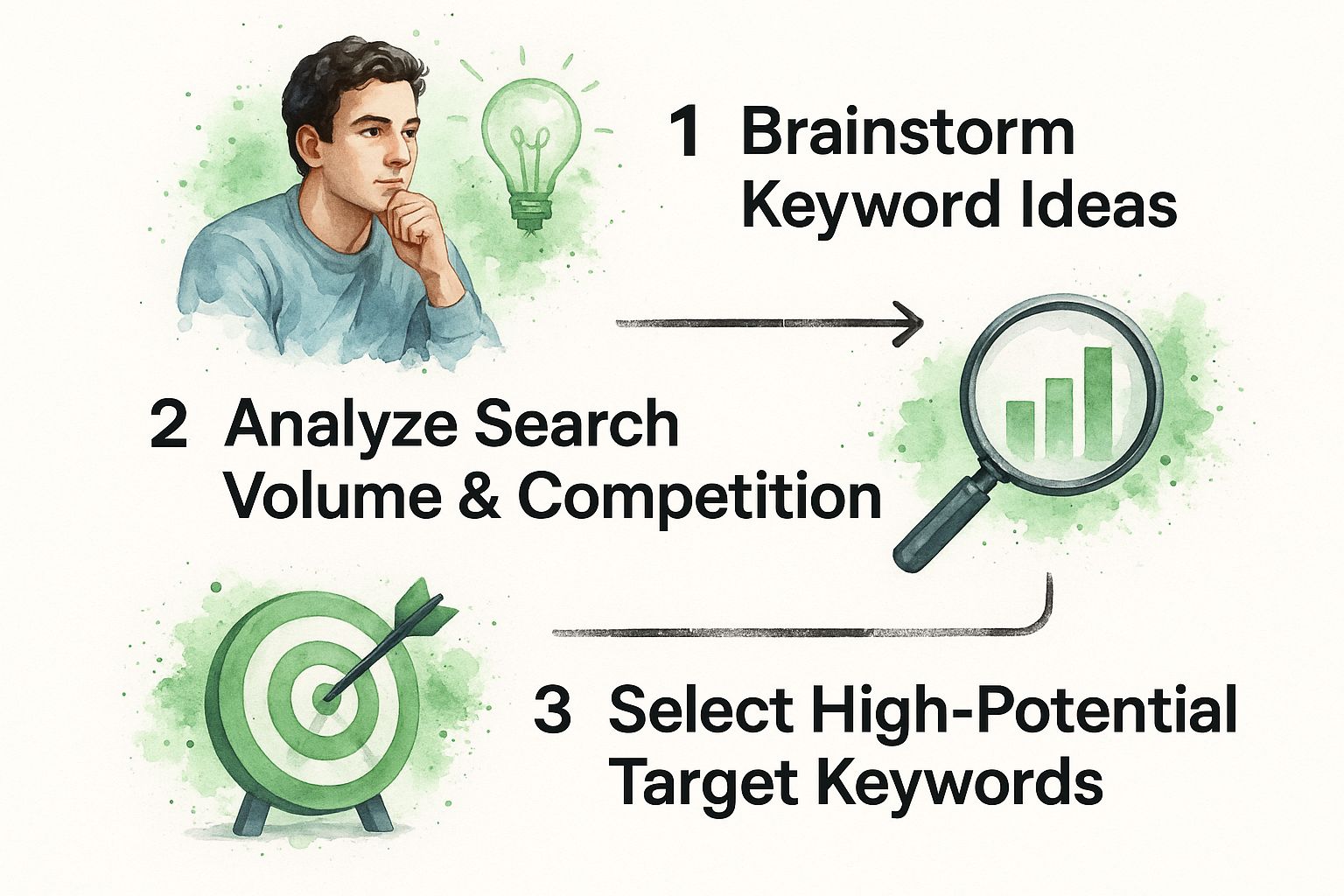
As this shows, good keyword research is not a one-time task. It is a continuous cycle of discovery, analysis, and refinement to find the terms that will actually grow your business.
Tools to Find Your Best Keywords
You don't need a huge budget to get started. One of the best tools is completely free and comes directly from Google: the Google Keyword Planner. It was built for advertisers, but it's an absolute gold mine for SEO. It helps you discover new keywords, see how many people are searching for them, and get a feel for the competition.
When diving into these types of tools, pay attention to a few key metrics:
- Search volume:How many people search for this keyword each month? Higher isn't always better, especially when competition is sky-high.
- Competition:How many other websites are competing for this term? The tool usually gives a "low," "medium," or "high" rating. Focus on the low-hanging fruit first.
- Relevance:How closely does this keyword match what you actually sell? Never chase a keyword just because it has a high volume; it must be a perfect fit for your business.
By focusing on relevant, long-tail keywords with low competition, you build your SEO strategy on a solid foundation. This targeted approach not only attracts traffic; it attracts therighttraffic. That means better leads and ultimately more revenue. This is the first real, practical step to getting yourwebsite to the top of Google.
Creating Content That Google and Customers Trust
Okay, you have your keywords. That's the blueprint. Now it's time to daTo truly build something: content that genuinely connects with people and wins their trust. Getting yourwebsite to the top of Googleisn't just about placing keywords on a page; it's about offering undeniable value.
This is where Google's E-E-A-T principle becomes your guiding star. This is an acronym forExperience, Expertise, Authoritativeness, and Trustworthiness. Think of it as Google's internal quality control. It wants to show content from sources that have proven themselves in practice, really know their subject matter, are seen as leaders in their field, and operate in a safe and reliable manner.
Your mission is to prove that you meet all these requirements. This isn't a trick to outsmart the algorithm. It's about demonstrating your value so clearly that both Google and your future customers see you as the only logical choice.
Go Beyond Keywords: Answer Questions
People don't just search with keywords; they search with questions. The number one task of your content should be to provide the most complete and useful answer available. That's the fastest way to build authority and trust.
Suppose you are an accountant who specializes in "accounting for freelancers." A potential client doesn't just type that in. What they are actually asking is:
- "What tax deductions can a self-employed person use?"
- "How do I invoice correctly as a freelancer?"
- Is a separate business bank account mandatory in the Netherlands?
When you create detailed guides that address these specific pain points, you are doing much more than just targeting a keyword. You are solving a real problem, which immediately creates a bond and demonstrates your expertise. It is a shift from selling to helping—and that is a much more powerful strategy in the long run.
Structure Your Content for People and Search Engines
The way you organize your content is just as crucial as the words themselves. No one wants to see a huge wall of text. It's intimidating. However, a well-structured page is a breeze to read and very easy for Google to search and understand.
Use headings and subheadings (H2s, H3s, etc.) to build a clear information hierarchy. Your main page title is your H1. Your main sections get H2s. Subtopics within those sections get H3s. It's that simple. This creates a logical path that guides your reader through the information.
For that article on accounting for freelancers, the structure could look like this:
- H1:The Ultimate Guide to Accounting for Freelancers in the Netherlands
- H2:Why Accurate Accounting Is Essential
- H2:Important Tax Deadlines You Can't Afford to Miss
- H3:The VAT return for the first quarter
- H3:The Annual Income Tax Return
- H2:Practical Tips for Flawless Administration
This structure not only makes your content easy to scan for busy people, but also gives Google clear indications about the content of your page, which enhances its relevance.
The Power of E-E-A-T in Practice
Let's get practical. How do you actively add Experience, Expertise, Authority, and Trustworthiness to your content? Mastering this is essential if you are serious about getting yourwebsite to the top of Google.
- Showcase your experience:Don't just list facts. Share practical examples, personal stories, or specific examples from customer projects. If you are a consultant, talk about a difficult problem you solved for a customer. That practical knowledge is worth its weight in gold.
- Prove Your Expertise:Go in-depth. Create comprehensive resources that cover a topic from every angle, rather than providing a superficial overview. Back up what you say with data and explain complex ideas in a simple and understandable way.
- Build Your Authority:Add author bios that highlight qualifications and practical experience. Actively encourage reviews and testimonials from satisfied customers. When other respected sites in your industry mention you or link to you, it's a huge vote of confidence.
- Establish Reliability:Make it easy for people to contact you. Provide a crystal-clear privacy policy and terms of service. If you work in a regulated industry, prominently display your certifications. A secure site (HTTPS) is also a huge confidence booster.
E-E-A-T is not a checklist that you complete once. It is the philosophy that should guide every piece of content you create. Every page should strive to be the most helpful, credible, and authoritative source on that topic online.
Understanding your audience is vital here. In the Netherlands, for example, Google's influence is immense. The YouTube platform alone reaches an estimated14.8 million users—that's more than81%of all Dutch internet users. This shows how deeply Dutch consumers are integrated into Google's ecosystem, making a top position even more crucial to tap into this huge, active audience. You can learn more about these trends in this detailed report on Dutch digital trends.
Optimizing Your Pages to Signal Relevance

You've created fantastic content. Great start. But now you need to make sure Google can actually understand it. This is where on-page SEO comes in.
Think of it as placing clear, helpful signposts on every page of your site. The goal is to make it very easy for search engines to see what a page is about and why it is a perfect match for what someone is searching for.
Properly implementing these elements is not optional for anyone serious about getting theirwebsite to the top of Google. It is the fundamental layer that supports your great content and ensures it gets the visibility it deserves. The best part? You have direct control over these factors, making them some of the fastest wins you can achieve.
Your Page Title: The First Impression
Your page's meta title (or title tag) is perhaps the most important on-page factor. It's that blue, clickable headline that people see in search results. It has one job: to convince someone to click onyourresult instead of the ten others on the page.
A strong title should be:
- Concise:Keep it under60 characters so that it is not awkwardly truncated.
- Descriptive:Tell people exactly what the page is about. No guesswork.
- Focus on the keyword:Include your most important keyword, preferably at the beginning.
A vague title such as "Services" is useless, for example. A much better title is "Expert Accounting Services for Freelancers | YourCompany." It is specific, has a clear keyword, and creates the right expectation.
The Meta Description: Your Sales Pitch
Directly below your title in the search results is the meta description. This is your short summary, usually up to150 characters, which further explains the title. Although it does not directly improve your rankings, a compelling description has a huge impact on your click-through rate (CTR).
Think of it as your mini ad on Google. A good meta description should:
- Provide more context and build on the title.
- Include your main keyword in a natural way.
- End with a clear call to action such as "Learn more," "Find out how," or "Get started today."
This is your chance to convince the searcher that your page has exactly what they need.
Structuring Content with Headings
Headings and subheadings not only make content easier for people to scan; they also give search engines a clear roadmap of your page's structure. UsingH1, H2, and H3 tagscorrectly creates a logical hierarchy that Google loves.
The main title of your page shouldalwaysbe yourH1 tag, and you should only have one per page. Divide the main sections withH2 tags, and then useH3 tagsfor subtopics within those sections. This clean structure helps Google understand the main and subtopics, which enhances the relevance of your page.
The Power of Internal Links
Internal links are simply links from one page on your website to another relevant page on the same site. It is an extremely powerful tactic that, for some reason, is overlooked by many people.
Strategic internal links are like creating a web of connections within your site. It guides both users and search engine crawlers to your most important content, spreads "link equity" or authority throughout your site, and improves the user experience.
When linking between your pages, always use descriptive anchor text. Instead of linking the generic phrase "click here," link something specific such as "discover our comprehensive SEO search engine optimization services." This gives both users and Google valuable context about the landing page.
Optimizing Your Images
Images are fantastic for engagement, but they are invisible to search engines if you don't optimize them correctly. Every image on your site needs descriptivealt text. This is a short, written description of an image that is read by screen readers and indexed by search engines.
Here is an example taken directly from Google's own SEO Starter Guide, which shows how a simple piece of code makes an image understandable to search bots.
The most important lesson is simple: using a descriptive, relevant file name and alt text—such as puppy-playing-with-a-stick.jpg—is infinitely more valuable than a generic one. It's a small step that makes your images accessible and gives Google an extra clue about the content of your page.
Building Authority Outside Your Website

So far, we've perfected everythingonyour website. But to really climb the rankings, Google needs to see that your company is a respected voice across theentireweb. This is where the real power of off-page SEO comes into play, particularly through link building and technical excellence.
Think of it as building a reputation in the real world. You can tell everyone you're an expert, but your credibility skyrockets when other respected people start recommending you. In the digital world, those recommendations arebacklinks.
A backlink is simply a link from another website to yours. When a reputable Dutch industry blog or a local business partner links to your site, they are essentially giving you a vote of confidence. Google sees these votes and starts to view your site as a reliable source, which is a huge factor in getting yourwebsite to the top of Google.
Powerful Voices of Trust Deserve
The point is: not all backlinks are created equal. A single link from a highly authoritative, relevant website is worth more than a hundred links from spammy, irrelevant sites. The goal is to earn quality links that stand the test of time, not just to accumulate numbers.
Here are a few practical ways to earn those valuable backlinks:
- Collaborate with Local Partners:Do you collaborate with other local businesses? Consider co-hosting an event, writing a guest article for their blog, or simply requesting a link from their partner page. These local signals are incredibly powerful.
- Create Shareable Content:Develop a resource that is so genuinely useful that other websiteswill want tolinktoit. This could be an in-depth guide, original data research, or an insightful infographic about your industry.
- Participate in Online Communities:Get active on relevant forums or in industry groups where your ideal customers are located. Offer genuine help and expertise, and you will naturally build a reputation that will lead others to refer to and link to your content.
A strong backlink profile is a marathon, not a sprint. It's about building genuine relationships and creating value that others want to recognize. Every quality link is a permanent asset that continuously increases your site's authority.
This process can be complex, but it is one of the most crucial investments for your online visibility. For a deeper look at how we approach this, check out our strategic link building services.
The Indispensable Technical Foundations
In addition to links, Google has a technical checklist that every high-quality website is expected to meet. This isn't just about pleasing search engines; it's about delivering a fantastic user experience, which is at the heart of modern SEO. If your site fails on these points, all your hard work on content and links may have been for nothing.
We call this technical essenceCore Web Vitals. These are Google's official statistics for measuring the actual user experience on your site.
Key Technical Pillars for Ranking Success
Let's outline what Google considers essential for any website that wants to reach the top.
- Site Speed (Largest Contentful Paint - LCP):This measures how quickly the main content of your page loads. In a world of short attention spans, a slow site is a turn-off. Google wants to see an LCP of2.5 seconds or less.
- Responsiveness (Interaction to Next Paint - INP):How quickly does your page respond when someone clicks on a button or menu item? A slow, unresponsive site simply feels broken. A good INP score is below200 milliseconds, which ensures a smooth, fluid experience.
- Visual Stability (Cumulative Layout Shift - CLS):Ever tried to click on a button, only to see an ad load that pushes everything down, causing you to missclick? That's layout shift. Google measures this to ensure that your site is stable and predictable.
- Mobile-friendliness:Since most searches now take place on mobile devices, your website must look and function perfectly on a smartphone. This is no longer optional; it is a fundamental requirement.
- Security (HTTPS):Your website URL must begin with https://. The 'S' stands for secure, which means that data shared between your site and visitors is encrypted. Google marks non-HTTPS sites as "not secure," which immediately undermines trust and damages rankings.
Mastering both the art of link building and the science of technical SEO creates a powerful combination. It tells Google that not only is your content valuable, but your website also offers a superior, reliable experience, making you the obvious choice for that coveted top position.
Frequently Asked Questions About Ranking High in Google
Over the years, we have helped countless Dutch companies increase their online visibility. What strikes us is that many of the same questions come up time and time again. That's why we've compiled a list of the most frequently asked questions about how to get yourwebsite to the top of Google.
These practical insights clarify the process and create realistic expectations about what it takes to achieve online success.
How Long Does It Take to Rank High in Google?
This is the question everyone asks, and the honest answer is:it depends. In general, you should expect to waitthree to six monthsbefore you see any serious results, especially with a new website or new pages. Existing, established websites with strong authority can sometimes rise faster.
Several factors play a role here:
- The competition:Ranking for "accountant Amsterdam" is a lot more difficult and takes longer than for "specialized accountant for tech startups in Haarlem."
- The authority of your website:A site with a good reputation and many high-quality backlinks has a significant advantage.
- The quality of your SEO efforts:Consistent, high-quality content, technical optimization, and smart link building significantly accelerate the entire process.
SEO is a marathon, not a sprint. Think of it as planting a tree: it takes time, patience, and attention. But once it's established, it will deliver sustainable results for years to come.
Should I hire an SEO expert?
Of course, you can learn the basics of SEO yourself and take on certain tasks. However, working with an expert can significantly speed up your journey to the top of Google. An expert has in-depth knowledge of Google's constantly changing algorithms, has professional tools at their disposal, and can build a complete strategy that you, as a busy entrepreneur, simply don't have time for.
Consider hiring an expert if you want to save time, avoid common mistakes, and achieve more efficient results to get yourwebsite to the top of Google.
Should I focus more on SEO or paid advertising?
SEO (organic traffic) and paid advertising (SEA) are not competitors;they are powerful partners.
- SEObuilds sustainable, long-term authority and trust. Once you rank highly, the traffic is essentially "free," which yields a huge ROI in the long run.
- Paid adsprovide immediate visibility and traffic. Perfect for testing keywords, promoting temporary promotions, and achieving quick results.
A smart strategy often combines both. You use paid ads to gather traffic and data in the short term, while building your long-term SEO success. This way, you get the best of both worlds and ensure both immediate and lasting online results.
For more detailed answers to your digital marketing questions, you can always take a look at our help page with frequently asked questions.
AtDigitalique, we believe in building tomorrow's successes today. Your online presence is the engine for future growth, and waiting is not an option.
Ready to turn your vision into online success? Let's build your digital future together. Visit us at https://digitalique.nl.
At Digitalique, we hope you found this article valuable! Your opinion is worth its weight in gold to us. Do you have any questions or golden tips you'd like to share? Let us know in the comments below. We read everything!
Start writing here...
