Are you getting too little return from your website traffic? You invest in SEO and advertising, but those visitors just don't become customers. You're not alone. This is exactly whereconversion rate optimization(CRO) makes the difference.
Consider your website as your most important salesperson. In this article, you will learn how to train this salesperson to deliver top performance. We will discuss how to truly understand your customers, analyze your website like a pro, and use A/B testing to make choices based on data, not gut feelings.
What Conversion Optimization Really Means for Your Business

Many entrepreneurs struggle with low conversion rates. They attract visitors, but they drop out before making a purchase or contacting the company. Conversion optimization, often abbreviated to CRO, is the process of improving your website so that more visitors do what you want them to do. Instead of constantly chasing new traffic, you simply get more value from the visitors you already have.
With a smart CRO strategy, you can ensure that your website does not cause confusion and frustration, but smoothly guides visitors toward making a purchase. This will turn your website into an efficient growth engine for your business.
More Than Just a Higher Conversion Rate
Of course, the ultimate goal of CRO is to boost your conversion rate, but the benefits go much further. A well-optimized website takes the entire user experience (UX) to the next level. Visitors find what they are looking for faster, build trust in your brand, and return more quickly.
A strong CRO strategy helps you to:
- Maximize your marketing ROI:Every visitor you attract through paid advertising or SEO is more likely to convert. This means your marketing budget delivers an immediate return on investment.
- Gather valuable customer insights:By analyzing behavior and conducting A/B testing, you can discover what drives your target audience, what objections they have, and how they make decisions.
- Build a sustainable competitive advantage:While your competitors continue to invest in more traffic, you are building a more efficient machine that gets more out of the traffic you already have.
Before we delve deeper into the methods, it is important to have a clear understanding of the basic principles of conversion optimization. Together, these elements form the foundation of every successful CRO strategy.
The Core Pillars of Conversion Optimization
| Pillar | Description | Example |
| Data-driven Analysis | The systematic collection and analysis of data to understand how users behave on your site. | Use heat maps to see where visitors click and scroll on a product page. |
| User experience (UX) | Designing an intuitive, frictionless, and enjoyable experience for the user. | Simplifying the checkout process by removing unnecessary fields. |
| Hypothesis & Testing | Formulating a testable hypothesis and validating it with A/B testing or multivariate testing. | Testing whether a green CTA button converts better than a blue button. |
| Persuasive Copywriting | Writing compelling and clear texts that encourage visitors to take action. | Rewrite a product description to focus on benefits rather than features. |
| Continuous Improvement | Realizing that CRO is an ongoing process of learning, adapting, and optimizing. | Use the results of a test as input for the next hypothesis. |
These pillars show that CRO is much more than just changing buttons; it is a strategic approach that touches the very core of your online business.
A Continuous Process of Improvement
It is crucial to understand that conversion optimization is not a one-time project. It is an ongoing cycle: analyze, formulate a hypothesis, test, and learn. The market and consumer behavior are constantly changing, so your website must evolve with them.
It is striking that the adoption of CRO technologies in the Netherlands is still relatively modest, which offers a huge opportunity for companies that are at the forefront. In 2025,onlyabout 2.1% of Dutch websiteswill use specific tools for conversion optimization. Within this niche,Elfsightis the market leader with a24.3% share. This shows that companies that invest in CRO now can gain a significant head start.Discover more insights about the use of conversion optimization in the Netherlands.
At Digitalique.nl, we see CRO as the bridge between what your company offers and what your customer really needs. It's not about tricks, but about creating a seamless and compelling online experience that drives sustainable growth.
Understand Your Customer for Higher Conversions
Before you even think about changing a button color, the very first step inwebsite conversion optimizationis to truly understand your visitors. Making changes based on gut feeling is like driving blindfolded; you probably won't get where you want to be. Real, effective optimization starts with data.
Get inside your visitor's head. What are theyreallytrying to achieve on your site? What questions do they have? And, crucially, what is stopping them from taking the final step? Answering these questions is what separates a strategic plan from random guesswork.
Digging into Quantitative Data
Let's first look at the information you already have. Quantitative data tells youwhatis happening on your website. Tools such asGoogle Analyticsare brilliant for spotting behavioral patterns.
Here, you look for red flags and hidden opportunities. Are people leaving your site en masse from one specific page? Is your mobile conversion rate much lower than that of desktop? These figures don't tell youwhyit's happening, but they do point you directly to the problem areas.
This screenshot from Google Analytics shows a typical dashboard that allows you to track user acquisition and engagement.
By diving into these reports, you can easily find pages with high traffic and alarmingly high bounce rates. That's a clear sign of friction in the customer journey and a perfect place to start your investigation.
Qualitative Insights for the Whole Story
While the numbers show youwhat, qualitative data tells youwhy. Here you discover the human stories behind the clicks. It's about feeling the frustration, understanding the motivation, and seeing your site through the eyes of your visitors.
Some powerful ways to gain this context are:
- Heatmaps and Session Recordings:Tools such asHotjarorClarityare fantastic. They visually show where users click, how far they scroll, and where their mouse hovers. Session recordings are even better—it's like watching someone use your site, so you can see exactly where they get stuck or confused.
- Customer Surveys and Feedback Polls:Sometimes the simplest solution is the best: just ask. A small, polite pop-up survey on a page with a high bounce rate asking, "What prevented you from completing your purchase today?" can provide valuable insights.
- User testing:Here, you ask real people from your target audience to perform tasks on your site while thinking aloud. Their live, unfiltered feedback is invaluable for identifying usability issues that you may have become blind to.
Combining the "what" from quantitative data with the "why" from qualitative feedback is the magic formula. Data may show a70%dropout rate on the shipping page, but a survey may reveal that unexpected shipping costs are the direct cause.
Create Actionable Customer Personas
The final piece of the puzzle is to bring all your research together in customer personas. We're not talking about generic personas full of demographic data that end up in a drawer. For CRO, your personas need to be built for action.
Your personas should provide clear answers to questions such as:
- What is their primarygoalwhen they land on your site?
- What are their biggestfrustrationsor pain points with your type of product or service?
- What are their mainmotivationsfor buying?
- What specific information do theyneedto feel confident enough to convert?
By the entire customer journey , you can tailor every part of your website to their needs. Our guide to mapping the customer journey provides a framework for visualizing each touchpoint. This complete picture is essential for a website that not only attracts traffic but consistently converts visitors into loyal customers.
How to Analyze Your Website Like a Pro

Data is the engine of effectivewebsite conversion optimization, but you can also get hopelessly lost in it. To make truly smart decisions, you need a sharp focus. It's not about endlessly clicking through reports, but about asking the right questions and knowing exactly where to find the answers.
You really don't need to become a data scientist. It's all about learning to listen to the signals your website gives you. This way, you can move away from guesswork and form strong, testable ideas based on real user behavior.
Gaining insights from Google Analytics 4
Google Analytics 4 (GA4) is your most important tool for understanding the customer journey. However, its real power lies not in the standard dashboard, but in specific, targeted reports that show you exactly where your opportunities lie. Forget superficial figures such as the total number of visits; dive into the reports that show you the paths and stumbling blocks of your users.
Two reports you absolutely must familiarize yourself with are:
- Conversion paths:This report shows you the exact sequence of channels a visitor encounters before a conversion takes place. You may discover that social media does not directly generate sales, but plays an indispensable role in the initial phase of the customer journey.
- User analysis (User Explorer):Here you can analyze the anonymized behavior of individual users. You follow their entire journey, step by step, from the first visit to the last action. Perfect for detecting confusing navigation or endless click loops.
Want to dig deeper and really make GA4 work for you? Read more about ourGoogle Analytics servicesand discover how we turn data into action.
Data tells a story. A high bounce rate on your contact form isn't just a number; it's the story of a visitor who becomes frustrated, confused, or uncertain at the last minute.
Taking a Closer Look at the Conversion Funnel
Analyzing your conversion funnel is like detective work at the scene of the crime—the crime of a missed sale or lead. You visually map out the steps a user takes, for example, from the homepage to a product page, to the shopping cart, and finally to the thank-you page.
By mapping out this journey, you can immediately see at which stage the largest percentage of users 'leak away'. Does this happen when they see the shipping costs? Or is there an unclear step in the registration process? Identifying this bottleneck ishalf the battle.
For Dutch e-commerce sites, it is important to know where you stand. In the last quarter of 2023, the average conversion rate was around2.8%. Knowing that direct traffic converts the highest (3.3%) and paid search traffic is at3.2%helps you set realistic goals. This gives you a benchmark against which to compare your own performance.
Don't forget the Technical Audit
All your customer journey analyses are useless if your website is technically flawed. A technical audit is a fundamental part ofwebsite conversion optimization, because it has a direct impact on the user experience and therefore also on your conversions.
A few crucial technical factors to check:
- Speed:Every second counts. A slow page is an absolute conversion killer, especially on mobile devices where users' patience is even shorter. Use tools such as Google's PageSpeed Insights to see where the brakes are.
- Mobile-friendliness:Your website should provide a seamless experience on any device. Having to zoom in to tap a button is a sure way to lose a customer.
- Browser compatibility:Does your site work perfectly on Chrome, Safari, Firefox, and Edge? Small bugs on a single browser can add up to take a big bite out of your revenue.
A technical audit ensures that your website's foundation is rock solid. Without it, you're basically trying to fill a leaky bucket. Combine these three approaches—in-depth GA4 analyses, funnel analysis, and a technical audit—and you'll get a complete picture of your website's performance and the best opportunities for growth.
The Art of Testing: A/B Testing and AI Personalization
Your analysis has yielded a strong hypothesis. Perhaps something like: "We believe that changing our vague 'Submit' button to a specific 'Receive Your Free Quote' will increase the number of form submissions." Now what?
It is tempting to simply implement the change and hope for the best, but guesswork has no place in effectivewebsite conversion optimization. To be sure that your idea works, you need to test it scientifically. This allows real user behavior to settle the debate, rather than opinions in the office.
The gold standard for this is A/B testing. Think of it as a direct competition between two versions of your web page. You show50%of your visitors Version A (the original, also called the "control") and the other50%get Version B (your new version, the "variant"). By tracking which version generates more conversions, you get a clear, data-driven winner.
Mastering the A/B Testing Process
A successful A/B test is more than just launching two pages. You need a disciplined process to get reliable results that really make an impact.
Where do you start? Focus on elements with the greatest potential to influence user decisions. We always recommend looking at:
- Headlines:Does a headline focused on benefits attract more readers than a headline that poses a question?
- Call-to-Action (CTA) Buttons:Test everything—the text, color, size, and even the position on the page. Small adjustments can yield surprisingly large gains here.
- Page layouts:Could a simple, single-column layout on an important landing page perform better than your current design?
- Images and Videos:Does a product video really convert better than a gallery of static images? Let the data decide.
To conduct these experiments, you need the right tools.Google Optimizewas a popular free option, but it has since been discontinued. Today, platforms such asVWOandOptimizelyare the market leaders.
Remember this: a "failed" test is not a failure. If your new version doesn't win, you've still gained valuable insight into whatdoesn'twork for your audience. That knowledge is just as important for your next hypothesis.
Interpret Your Results Correctly
Once your test is complete, you need to critically analyze the results. A common mistake is to declare a winner after just a few days. You absolutely must wait until the test reachesstatistical significance—usually a confidence level of95%or higher. This is your proof that the result is due to your changes, not random chance.
The Next Step: AI and Geo-Personalization
While A/B testing is fantastic for optimizing for the "average" user, personalization goes one step further. The goal is to create a unique experience foreachvisitor. This is where modern technology, particularly Artificial Intelligence (AI), really comes into its own.
Consider these scenarios:
- GEO-Targeting:A visitor from Amsterdam lands on your homepage and sees a banner highlighting your Amsterdam office or local case studies. This immediately builds a connection.
- Behavioral personalization:AI can track a user's browsing behavior on your site. If they have repeatedly viewed your SEO services, you can dynamically change the CTA on the homepage to "Discover Our SEO Packages" on their next visit.
- Dynamic Content:An e-commerce site can use AI to display product recommendations based on what similar users have purchased.
This level of personalization used to be reserved for large companies. Now, AI-driven tools are making it accessible to many more businesses. This is the future ofwebsite conversion optimization: a journey that feels like a personal consultation.
Essential Elements of a High-Converting Website
Once you've dived into the data and come up with a few solid hypotheses, it's time to focus on the tangible parts of your website. Effectivewebsite conversion optimizationisn't just about endless testing; it's about building a solid foundation with elements that have been proven to guide, convince, and reassure visitors.
Think of your website as a physical store. Is it well lit and easy to navigate? Are the signs clear? Is the staff helpful? Every element on your site plays a similar role.
The Psychology of High-Converting Design
Good web design is much more than just making things look pretty—it's about strategically directing your visitor's attention. A visually chaotic page creates mental friction, leading to confusion and ultimately to them leaving the site. A clean, strategic design, on the other hand, makes the path you want them to take intuitive and effortless.
Some important design principles that directly influence conversions:
- Visual Hierarchy:This is how you tell visitors what is most important without saying a word. Use size, color, and placement to make your core message and call-to-action (CTA) indispensable.
- White Space (Negative Space):Don't be afraid of empty space. It's a powerful tool that reduces clutter, improves readability, and draws attention to crucial content.
- Strategic Use of Color:Color triggers emotion and can influence behavior. For example, use one bright accent coloronlyfor your clickable elements (such as buttons and links).
This infographic shows the impact of different optimization approaches. See how elements such as personalized CTAs can perform dramatically better than a standard setup.
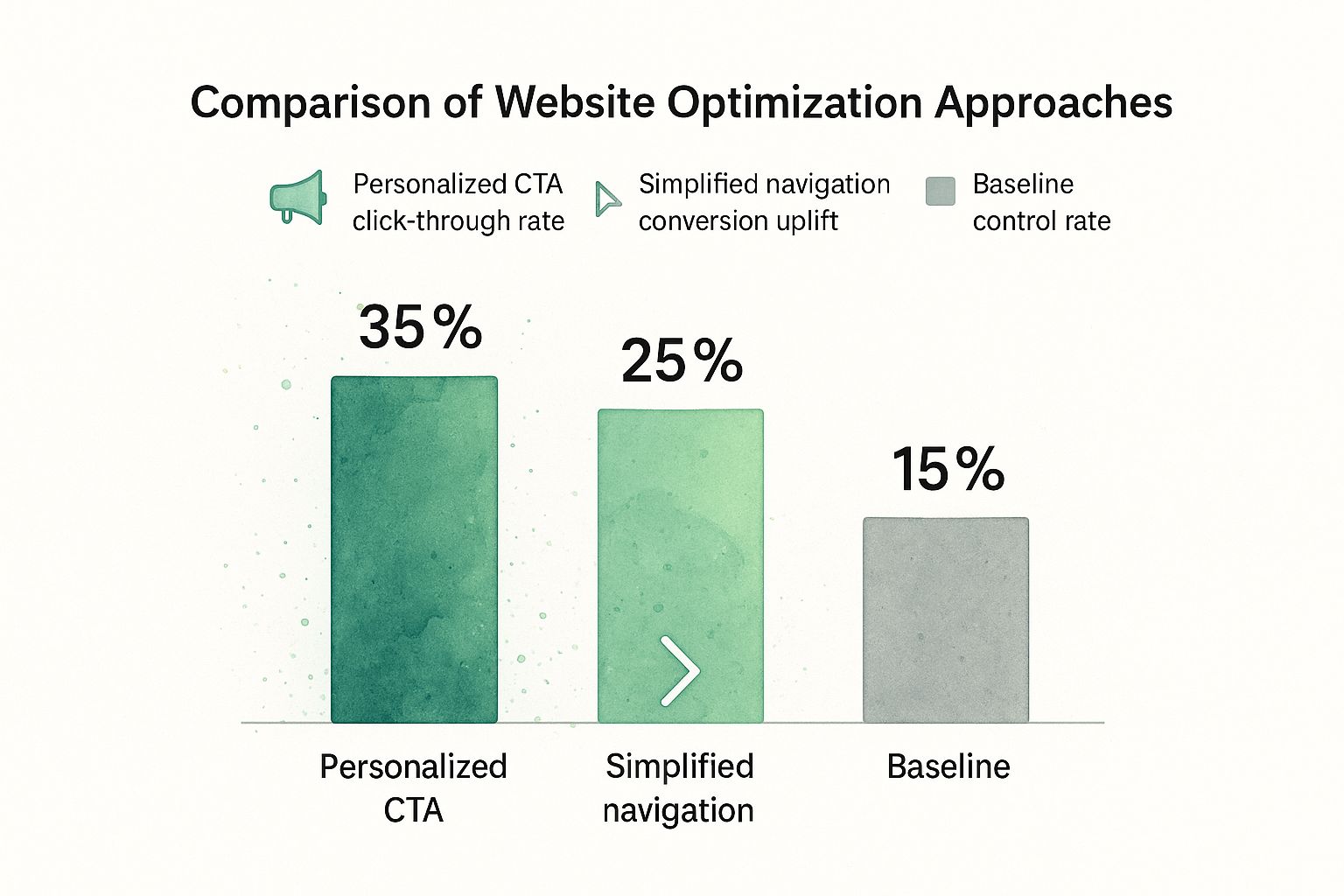
The data is clear: personalizing the user experience, even with something as simple as a personalized CTA, can more than double your click-through rate.
Compelling Texts that Drive Action
Your words are your digital salesperson. Generic, feature-focused texts do not inspire people to take action. Truly compelling copywriting addresses your visitor's problems on a personal level and positions your solution as the only logical answer.
Your text should always be:
- Benefit-oriented:Instead of "Our software has a new dashboard," try "Manage all your tasks in one place and save hours per week." Always focus on theresultfor the customer.
- Clear and concise:Avoid jargon. Use short sentences and simple language.
- Action-oriented:Use strong, active verbs and tell peopleexactlywhat you want them to do.
Create Irresistible Calls-to-Action (CTAs)
Your Call-to-Action is the final gateway to conversion. A weak, generic CTA such as "Submit" or "Click Here" is a conversion killer because it creates uncertainty. What happens when I click?
A powerful CTA, on the other hand, is specific, persuasive, and creates crystal-clear expectations.
- Instead of "Download," try"Get Your Free Marketing Guide."
- Instead of "Subscribe," try"Join 10,000+ Smart Marketers."
For complex landing pages, a perfectly optimized CTA can be the most important factor. If you really want to perfect an important page, our landing page optimization guide provides a targeted framework for doing this effectively.
A great CTA removes the last trace of doubt from a visitor's mind. It clarifies the value they will receive immediately after clicking, making the decision to convert feel both easy and confident.
Minimize Friction in Forms and Checkouts
Nothing kills conversions faster than a long, complicated form. Every field you ask a visitor to fill out is an extra point of friction—an extra chance for them to give up and leave.
- Only ask for what you absolutely need.Do youreallyneed their phone number for a newsletter sign-up? Probably not.
- Use smart defaults and auto-fill.Make the process as painless as possible.
- Show progress.For multi-step forms or checkouts, a simple progress bar shows users how close they are to the finish line.
Build Trust with Social Proof
People trust other people much more than they trust brands. Social proof is the powerful psychological principle that we look to the actions and experiences of others to guide our own behavior.
You can incorporate this into your site by displaying:
- Customer Reviews and Testimonials:Authentic reviews, especially those with names and photos, are incredibly persuasive.
- Trust badges:Displaying security seals (such as SSL certificates) and well-known payment logos (iDEAL, Visa, PayPal) immediately reassures visitors.
- Case studies and customer logos:Showing that other respected companies already trust you is a powerful recommendation.
Your Questions About Conversion Optimization Answered

Diving intowebsite conversion optimizationcan feel overwhelming. We understand that. Over the years, we have guided countless entrepreneurs through this process and we have noticed that the same questions come up time and time again.
To give you real clarity, we have collected the most frequently asked questions we hear from customers and answered them directly. This is not theory; these are practical, straightforward answers based on our practical experience.
How Much Does Conversion Optimization Cost?
This is almost always the first question, and the honest answer is: it depends. The cost of a CRO project is directly linked to the scope and complexity of the work.
Think of it as building a house. A simple renovation has a different price tag than designing a custom villa. Similarly, a one-time project to modify a single landing page costs less than an ongoing CRO program with in-depth analysis, user research, and continuous A/B testing across your entire website.
In general, the pricing structures are as follows:
- Project basis:You pay a fixed price for a specific result, such as a complete website audit or a series of A/B tests on your checkout process.
- Monthly Retainers:For ongoing optimization, you pay a monthly fee. This is perfect for companies that see CRO as a continuous growth strategy, not a one-time solution.
- Performance-based:In some cases, an agency may link part of their fee to the results they deliver, such as a measurable increase in revenue or leads.
The key is to stop viewing CRO as an expense and start viewing it as aninvestment. A successful optimization program pays for itself many times over by simply increasing the value of your existing visitors.
How Long Will It Take Before I See Results?
When it comes to conversion optimization, patience is a virtue. Although some "quick wins"—such as fixing a broken contact form—can show results almost immediately, a good CRO process is a long-term game.
Here is a realistic timeline you can expect:
- Data collection & analysis (2-4 weeks):This first phase revolves around collecting sufficient solid data to form strong hypotheses. You absolutely cannot rush this part.
- Conducting A/B testing (2-6 weeks per test):An A/B test must run long enough to achievestatistical significance. This means that you have collected enough data to be sure that the result is not a fluke.
- See tangible ROI (3-6 months):You will likely see small, incremental improvements along the way, but the significant, business-critical results often only become apparent after a few test and implementation cycles.
The goal ofwebsite conversion optimizationis sustainable growth, not magical quick fixes. It's about building an increasingly smarter, more effective sales machine, one data-driven improvement at a time.
What are the first steps I need to take?
Feeling a little overwhelmed by all the possibilities? There's no need to be. The best way to start is by focusing on the "low-hanging fruit"—the areas where you can make the biggest impact with the least effort.
Your very first step should be to identifythe biggest leaksin your conversion funnel. Dive into your Google Analytics data and find the pages with the highest exit rates. Where are you losing the most potential customers?
Once you've found the problem page, install a heatmap tool such asHotjaror Microsoft Clarity. Watch a few session recordings of real users on that specific page. You'll be amazed at how quickly you can see what's causing the friction.
This simple, two-step process—find the leak, then see what users actually do—gives you your first, most impactful hypothesis to test.
Are you ready to stop guessing and start building a website that works as hard as you do? AtDigitalique.nl, we combine data-driven analysis with proven strategies to convert more of your visitors into valuable customers. Let's start the conversation and unlock the true potential of your website.Schedule your free strategy session with us today.
