Advertising with Facebook is a powerful way to directly address your target audience, generate leads, and give your sales a significant boost. With millions of active users in the Netherlands, the platform offers an unprecedented opportunity to get your message across to exactly the right people. But, and this is important, success depends on a smart, well-thought-out approach.
Are you wondering how you can use Facebook ads to grow your business? Or are you struggling with low conversions and unclear ROI? In this guide, we'll show you exactly how to set up a successful strategy that delivers results.
Why Advertise with Facebook Is Still a Smart Move
Are you wondering whether Facebook ads are worthwhile for your business? With all the new platforms and changing algorithms, that's a logical question. Let's take a realistic look at it: Facebook is and remains a huge platform where your customers can be found every day. Ignoring it is simply missing out on a huge opportunity.
The golden days of free, easy reach are over. Organic visibility on Facebook has plummeted, making a paid strategy indispensable if you want to achieve predictable growth. Without investing in advertising, it is almost impossible to build a consistent and relevant audience.
Unmatched Reach and Precise Targeting
The real power ofadvertising with Facebooklies in two things: its enormous scale and its hyper-specific targeting capabilities. You can show your ads to a very precisely defined group of people, based on:
- Demographics:Think about age, gender, place of residence, and language.
- Interests:Hobbies, pages they like, and topics they actively follow.
- Behavior:Their online purchasing behavior, the devices they use, and even their travel patterns.
This precision is worth its weight in gold. Your marketing budget is not wasted on people who are not interested in what you have to offer. Instead, you directly address potential customers, which dramatically increases the chance of conversion. For Dutch entrepreneurs, this means that you can effortlessly find the perfect target group, whether you operate locally, regionally, or nationally.
A persistent misconception is that Facebook is only for young people. The reality is different. A large proportion of users with the most purchasing power—from millennials to baby boomers—are still active on the platform every day.
A Platform That Continues to Evolve
Facebook is constantly evolving and continues to provide marketers with increasingly sophisticated tools. The enormous amount of data collected by the platform enables the AI-driven algorithm to display your advertisements to the individuals most likely to take action. This self-learning system is continuously improving in its ability to identify your ideal customer.
In addition, the reach is enormous. At the beginning of 2025, advertisements on Facebook in the Netherlands reached approximately8.05 million users. Although this number fluctuates, it does show the enormous scale on which you can work. This dynamic underscores how important it is to keep up with the latest trends to keep your campaigns sharp. Want to dive deeper into the numbers? Then check out the latest Dutch report at DataReportal.
Facebook is simply an indispensable piece of the puzzle in a complete digital strategy. At Digitalique.nl, we integrate this seamlessly into our social media marketing approach. By using Facebook strategically, we build sustainable growth and a stronger bond with your customers.
Laying a Strong Foundation for Your Advertising Campaign
A winning campaign doesn't start in Facebook Ads Manager. The real work begins long before you open that dashboard. A successful campaign needs a rock-solid foundation; if you skip these crucial preparatory steps, you're building a house on quicksand.
Determine your campaign goal
Before you spend a single euro, you need to ask yourself the most important question:what exactly do I want to achieve?A vague goal such as "more online visibility" is not enough. You need a specific, measurable goal that directly aligns with your business objectives.
Think in terms of concrete results:
- Brand awareness:Do you want more people in your region to recognize your brand name?
- Traffic:Is your goal to drive more relevant visitors to a specific blog or product page?
- Engagement:Are you trying to get more comments, likes, and shares on your posts?
- Leads:Do you want potential customers to sign up for a newsletter or download an e-book?
- Sales:Is the ultimate goal to sell more products directly through your online store?
Your answer to this question determines which campaign type you select in Facebook. The platform's algorithm is smart and optimizes your ad display based on the chosen goal. A "Traffic" campaign always yields different results than a "Conversions" campaign.
Ensure that your campaign goal is always linked to a tangible business result. A successful advertising campaign is not the one with the most likes; it is the one that has the greatest impact on your revenue.
Get Your Technology in Order
Without the right technical setup, you're flying blind. It's essential to be able to accurately measure the results of your efforts. Otherwise, you'll never know what really works and where you're wasting your budget. These are the absolute must-haves.
Install the Meta Pixel
The Meta Pixel is a small piece of code that you place on your website. Think of it as a smart assistant that keeps track of exactly what visitors do after they click on your ad. Who adds a product to their shopping cart? Who fills out a contact form? Who actually completes a purchase?
Without the Pixel:
- You cannot calculate theROI (Return on Investment)of your advertisements.
- Missing out on retargeting, the powerful opportunity to advertise again to people who have already shown interest.
- Facebook's algorithm cannot learn who your ideal customer is, which means that your ads will become much less effective over time.
Properly installing Pixel isnon-negotiablefor anyone who wants to advertise seriously with Facebook.
Verify Your Domain
Another crucial step is to verify your domain name within the Meta Business SuiteThis proves to Facebook that you are the legitimate owner of the website you are sending people to.
This is important because it gives you complete control over how your links are displayed and allows you to prioritize which conversion events are most important for tracking. It's a small task that will save you a lot of headaches.
With a clear goal and a solid technical foundation, you are ready for the next step: reaching the right people.
Reach Your Ideal Customer with Precise Targeting
This is where the real magic of advertising with Facebook. Launching an ad without thinking about who will see it is like shouting in a crowded room hoping that the right person will hear you. It's a waste of breath and money. Getting your ad in front of therightpeople is the most important part of seeing a real return on investment.
To do this effectively, you need to familiarize yourself with the three main audience types that Facebook offers. Each plays a different role and helps you guide people from complete strangers to your best customers. Think of them as three different tools: one for broad reach, one for reconnecting with familiar faces, and one for finding new people who resemble your existing fans.
Effectively Reaching Core Target Groups
Core Audiences are your foundation. This is where you build your target audience from the ground up, based on who youthinkyour ideal customer is. This goes far beyond just age and location. The real power lies in combining interests and behaviors to create a razor-sharp profile.
Suppose you have a local yoga studio in Amsterdam. You don't just target "women between 25 and 45." A much smarter approach would be:
- Women between the ages of 25 and 45who live within a10 kmradius of your studio.
- Who have shown interest in things likemindfulness or organic food.
- And whose online behavior marks them as"Engaged Shoppers"(active online buyers).
These kinds of details ensure that your advertising budget is spent on people who are genuinely interested, not on random people in the neighborhood.
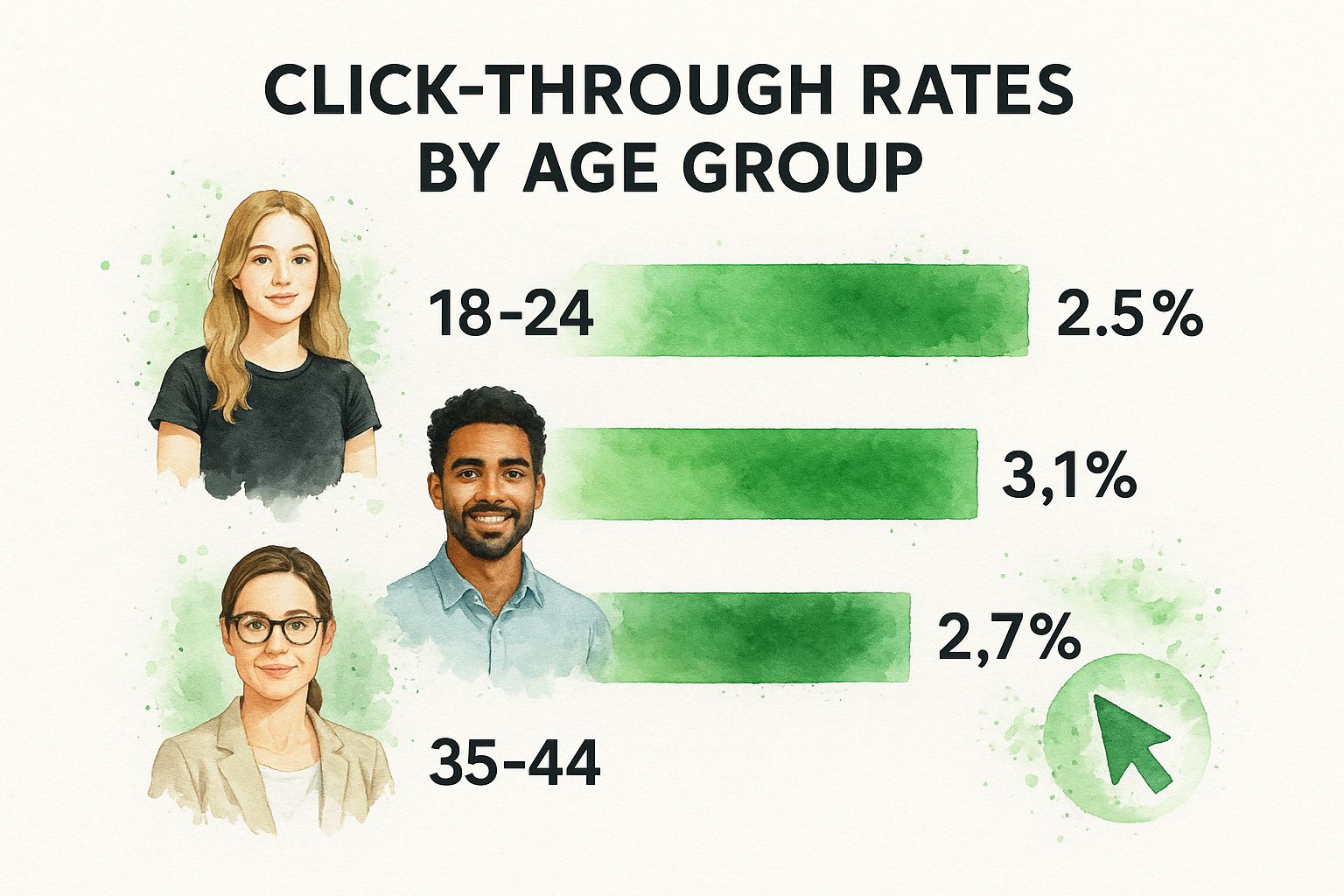
As you can see from the data, the 25-34 age group often clicks the most, making them a solid starting point for many campaigns.
Unlocking the Power of Custom Audiences
This is where it gets personal. With Custom Audiences, you can talk to people who already know you. These are your "warm leads"—people who have visited your website, signed up for your newsletter, or interacted with your Facebook page. It's one of the most cost-effective strategies because you're not starting from scratch.
You can build these powerful audiences from various sources:
- Website visitors:Target anyone who has visited your site in the last 30 days. You can even be super specific and only target those who have viewed your pricing page but haven't signed up.
- Email list:Easily upload your customer or newsletter list to show them special offers they won't find anywhere else.
- Facebook page interactions:Reconnect with the people who have liked, commented on, or shared your posts. They have already raised their hands and shown interest.
Important tip:Retargeting with Custom Audiences is indispensable. It's your second chance to close the deal with someone who left an item in their shopping cart or viewed your services. This is often where you'll see the highest ROI.
Find New Customers with Similar Audiences
Once you have a solid Custom Audience (such as a list of your very best customers), you can create a Lookalike Audience. Here, you let Facebook's algorithm do the heavy lifting. You give it a source audience—say, your top 100 customers—and the system finds millions of new people who share similar characteristics, interests, and online behaviors.
This is an absolute game-changer for scaling your business. It takes the guesswork out of finding new customers by using your own data as a blueprint. A good place to start is a1% Lookalike, which finds the top 1% of users in the Netherlands who most closely resemble your source audience.
The potential here is enormous. In January 2025, Facebook had approximately12.87 million usersin the Netherlands, representing around73.5% of the entire Dutch population. The largest group is aged 25 to 34, with women forming a slight majority at54%.This huge, diverse user group is the perfect pool for creating powerful Lookalike Audiences. You can read the full research on these demographic insights to get an even clearer picture.
Facebook Audience Options at a Glance
Choosing the right target audience type can seem overwhelming, so here's a quick summary to help you decide which one best suits your goals.
| Target group Type | What it is | Best for | Example |
|---|---|---|---|
| Core Target Group | A new target group that you build based on demographics, interests, and behavior. | Brand awareness, reaching entirely new audiences, top-of-funnel campaigns. | A new online store targeting users aged 25-40 who are interested in sustainable fashion and ethical shopping. |
| Customized Target Group | A target group of people who have already interacted with your company. | Retargeting, re-engaging previous customers, generating conversions from warm leads. | Remind someone via an ad about a pair of shoes left behind in the online shopping cart. |
| Similar Target Group | A new target group that Facebook's AI algorithm finds based on the characteristics of your best customers. | Scale your business, find high-quality new leads, prospect with precision. | Use a list of your top 100 customers to find thousands of new people with similar profiles. |
Ultimately, a strong Facebook advertising strategy utilizes all three. You use Core and Lookalike Audiences to fill the top of your funnel with new prospects, and then Custom Audiences to nurture those leads and convert them into loyal customers.
Create Ads that Really Convert
You can have the most accurate targeting in the world, but if your ad itself doesn't stop someone in their tracks while they're scrolling, you're throwing your money away. Getting your ad in front of the right people is the first hurdle; the creative execution—your images and your words—is what convinces them to really care. This is where art and science come together to achieve real results.

In a fast-paced feed, you may only havethree secondsto make an impression. That's all. Your visuals are your first handshake, so they need to be strong, clear, and immediately relevant to your audience.
Choose the Right Visual Format
Facebook provides you with a whole toolbox of ad formats, each with its own strengths. The "best" one is simply the one that tells your story most effectively for a specific campaign goal.
- Single Image:These are the workhorses of Facebook advertising. They are clean, simple, and perfect for showcasing one powerful product or communicating one core idea. Make sure the image is high quality and not cluttered with text.
- Video ads:Nothing grabs attention like motion. Video is fantastic for showing a product in action, sharing a quick customer testimonial, or telling a compelling brand story. A well-made15-secondvideo can easily outperform a static image.
- Carousel ads:This format allows you to display up totenimages or videos in a single ad, each with its own link. Carousels are ideal for e-commerce brands that want to showcase a product line or for service providers that want to explain different features or benefits.
Write Texts that Connect and Persuade
Once your visuals have done their job and stopped the scrolling, your text needs to close the deal. It needs to hook them, highlight a problem, present your solution, and then tell them exactly what to do. Our advice? Drop the jargon and write as if you were talking to one person.
A simple but incredibly effective formula that we always use is thePAS framework: Problem, Agitate, Solution.
- Problem:Start by identifying a pain point that your ideal customer experiences. (e.g., "Having trouble keeping your social media up to date?")
- Stirring things up:Dig deeper into that problem. Remind them of the frustration. (e.g., "Does it feel like you're shouting into a vacuum with no interaction?")
- Solution:This is where you come in and present your service as the perfect solution. (e.g., "Our management packages take all that stress off your shoulders, so you can focus on running your business again.")
This structure works. It directly appeals to the reader's emotions and positions your brand as the hero they were looking for. It is a fundamental part of how we content marketing approach, where every word has a purpose.
Our Pro Tip:Always focuson benefits, not features. No one buys a drill because they want a drill; they buy it because they want a hole in the wall. Don't list what your productdoes; explain how it makes your customer's life better.
The Crucial Call to Action (CTA)
Every ad you run needs a clear, compelling call to action. You've done all the work to get their attention—now you need to tell them exactly what to do. "Learn more" is often too vague and passive. Be specific and action-oriented.
Consider the one thing you really want them to do:
- "Shop Now"is immediate and perfect for e-commerce.
- "Book a Free Consultation"offers an accessible next step for service providers.
- "Download Your Free Guide"is a classic for lead generation.
- "Request a Quote"works great for users who are further down the funnel and ready to buy.
Your CTA is the final command that turns a passive viewer into an active lead. Make sure it counts. When you combine a powerful visual, compelling text, and a crystal-clear CTA, you've built an ad that not only gets seen, but also delivers results.
Smart Budgeting and Bidding for a Better ROI
Okay, so you've got your ad and your perfect target audience. Now for the million-dollar question—or maybe just the $50 question: how much should you actually spend? Determining your budget and bidding strategy can feel like reading tea leaves, but getting this right is what separates a bottomless pit from a profit machine. The goal isn't just to spend; it's to make every dollar work hard for you.

This is where many companies stumble. They start too small to get meaningful data, or they throw a huge budget at a campaign without a clear plan, which usually ends in frustration. Let's approach this smartly, so that your investment really fuels your growth.
Daily budget vs. Lifetime budget
First, you need to tell Facebookhowto spend your money. You have two main options, and the best choice depends on your campaign goals and timeline.
- Daily budget:This sets the average amount you want to spend per day. It's perfect for ongoing, "always-on" campaigns where you want to maintain a consistent presence. Think of a local café that promotes its brand to the neighborhood with a fixed budget of€10per day. The great thing is the flexibility; you can adjust it at any time.
- Duration budget:This allows you to set a total budget for the entire duration of the campaign. This is your choice for promotions with a fixed start and end date, such as a Black Friday sale or a push for webinar registrations. Facebook's algorithm gets a little smarter here and spends more on days when it predicts the best results.
There is no "best" choice. A daily budget gives you control for long-term brand building, while a lifetime budget is brilliant for short, powerful campaigns.
Deciphering Bidding Strategies
Your bidding strategy is essentially your way of telling Facebook what matters most to you. You're not just buying ad space; you're bidding on a specific outcome. Meta offers a few options, but a few of them do the heavy lifting for most businesses.
The most common starting point is theHighest Volume strategy. This tells Facebook: "Just get the most results you can for my budget." It's an excellent choice when launching a new campaign, as the algorithm can learn quickly and find the cheapest opportunities for clicks, leads, or sales.
Another powerful option is theCost per Result Goal. This puts you back in control. You tell Facebook the average cost you are willing to pay for an action, such as a purchase or a lead. This is fantastic once you know your figures and need to keep your cost per acquisition profitable.
Tip:Think of bidding as giving instructions to a taxi driver. Highest Volume is like saying, "take the fastest route," while a Cost per Result Target is like saying, "take me there, but don't go over this fare." Both get you to your destination, but optimize for different priorities.
Start Small and Scale Smart
One of the biggest mistakes we see is going all-in on an unproven campaign. A much better approach is to start with a modest test budget—something like$10 to $20 per dayis usually sufficient. That's enough to gather crucial data without taking a big risk.
During this testing phase, your goal is not to make a profit, but to learn. You discover which target group clicks, which ad works, and what your initial costs per result are. Once you find a winning combination that delivers a positive return,that'syour green light to scale up your budget responsibly. This data-driven approach takes all the guesswork out ofadvertising with Facebook.
Advertising costs in the Netherlands can vary, but with more than70% of the Dutch populationon the platform, you have a huge pool to work with. It's all about balancing your budget with that incredible reach to make smart investment decisions. This is especially true when you're reconnecting with interested parties. Our remarketing services show how you can focus part of your budget on these warm leads, which almost always yields a much higher return on ad spend.
Questions about Facebook Ads? We Have the Answers
Diving intoadvertising with Facebookcan feel like learning a new language. Many questions arise, and that is perfectly normal. To provide clarity, we have compiled simple answers to the questions we hear most often from Dutch entrepreneurs and marketing managers like you.
How Long Will It Take Before I See Results?
This is the big question, isn't it? The honest answer is, "it depends," but you will see activity almost immediately. You can expect the first data, such as impressions, reach, and clicks, to come in within the first24 to 48 hours. This early feedback is the first sign that everything is running correctly.
But for the results that really make a difference—leads, sales, and new customers—you need to give it a little more time. We always advise our clients to run a new campaign for at least7 to 14 daysbefore considering any major changes.
Why? Because this gives Facebook's AI algorithm enough time to get out of the "learning phase." During this crucial period, the system is figuring out who in your target audience is most likely to take action. Pulling the plug too soon is a classic beginner's mistake. After a few weeks, you will have much clearer data about what works and what your actual return on ad spend (ROAS) is.
What is a good start-up budget for a small business?
There is no magic number, but we have a rule of thumb that works well. For a small business just starting out, a budget between€10 and €20 per day, per ad setis a great starting point.
This amount is the sweet spot. It's enough for the algorithm to collect data without emptying your pockets. It also gives you enough leeway to test important variables, such as different target groups or advertisements.
Your initial budget is not about making immediate profits. Think of it as an investment in data. Start small, learn what works, and then double down on what works by increasing the budget for your proven winners..
Ultimately, the focus should not be on the budget itself, but on thereturn on ad spend (ROAS)it generates. A budget of €1,000 that generates €5,000 in revenue is a huge win, while a budget of €100 that generates nothing is a waste of money.
My Ads Are Getting Clicks but No Conversions. What's Going Wrong?
It's one of the most frustrating things: lots of clicks, but no sales or leads. When this happens, it's rarely just one problem. We always recommend checking your campaign by looking at these four areas, in this order:
- The Offer:Let's be honest. Is what you're selling really compelling? A brilliant ad can't save a weak offer. If your discount is meager or your product isn't something people really want, they won't convert.
- The Target Audience:Are yousureyou're talking to the right people? Showing an ad for high-end accounting software to students is a waste of money. Go back and analyze your targeting to ensure it perfectly matches your ideal customer.
- The Ad:Does your ad stop someone in their tracks while they're scrolling? Is the text clear and focused on the benefits for the customer? A boring or confusing ad will be ignored, even if your targeting is perfect.
- The Landing Page:This is the most common culprit and is often overlooked. What happensafterthe click is just as important. If your landing page is slow, looks bad on a phone, or has a clunky checkout process, you're losing people. The experience on your site should be a seamless continuation of the ad.
Go through this checklist and we guarantee you will find the bottleneck.
Should I advertise on Instagram too?
Yes, almost certainly. When you set up a campaign in Meta Ads Manager, the default setting is "Advantage+ placements," and with good reason. Our advice is to keep this setting for most of your campaigns.
This setting automatically places your ads across Meta's entire network, includingFacebook, Instagram, Messenger, and the Audience Network. The AI algorithm is incredibly advanced; it will figure out where your budget can be best spent to get you the most conversions at the lowest cost.
Instagram is a visual playground, which makes it a powerhouse for e-commerce, fashion, food, travel—anything with strong visual appeal. A large part of the Dutch market is active on both platforms every day. By excluding Instagram, you are cutting yourself off from a huge, engaged audience. Unless you have a very specific, data-driven reason not to, letting Meta manage your placements is the smartest and most efficient way to achieve results.
Ready to turn these insights into a powerful growth strategy for your business? AtDigitalique.com, we combine data-driven tactics with creative expertise to build Facebook ad campaigns that deliver real, measurable results. Let's build your success story together.
Start Growing with DigitaliqueYou can also leave a comment or idea below.
