Conversion Rate Optimization, often abbreviated toCRO, is the art and science of converting more of your website visitors into actual customers. It's not about chasing more traffic; it's about getting more value from the traffic you already have.
Your website is a leaky bucket. CRO is the solution.

Does this sound familiar? You've invested money in SEO and advertising, your visitor numbers are rising, but your sales and leads are lagging behind. It's a common and incredibly frustrating problem for many entrepreneurs.
The harsh reality is that traffic alone does not pay the bills. If your website is not designed to lead visitors to a purchase or inquiry, you are essentially pouring water into a leaky bucket. Every visitor who leaves without taking action is a missed opportunity and wasted marketing expenditure. This is precisely the problem thatCROwas developed to address.
Beyond guesswork: a data-driven approach
CRO isn't about randomly trying out ideas to see what works. It's a methodical process that combines data analysis, a deep understanding of user psychology, and rigorous A/B testing to figure outwhypeople aren't converting. Think of us as detectives for your website.
Instead of implementing changes based on gut feeling, the CRO process looks like this:
- Understanding user behavior:First, we dive into the data. We use tools to see where people click, how far they scroll, and where they drop off. This shows us exactly where the bottlenecks are.
- Formulate a hypothesis:Armed with that data, we form a substantiated assumption. For example: "We believe that changing the button text from 'Send' to 'Receive your free quote' will increase the number of completed forms, because it emphasizes the value for the user."
- Testing and measuring:We then test the new version (the "challenger") against the original (the "control") to see which performs better. This data-driven validation ensures that every change actually improves the user experience and ultimately your conversion rate.
Plug the leaks and maximize your ROI
The whole purpose of CRO is to systematically find and plug the leaks in your conversion funnel. By identifying and removing these barriers, we create a much smoother and more intuitive journey for your customers. This may mean simplifying your checkout process, rewriting a confusing headline, or making your call-to-action buttons indispensable.
CRO is fundamentally about maximizing the return on your existing investments. It makes your SEO more profitable, your paid ads more effective, and your entire digital marketing strategy more efficient.
Ultimately, a solid CRO strategy transforms your website from a simple online brochure into your most powerful, 24/7 salesperson. It is a continuous cycle of improvement that ensures you get every drop of value out of every visitor. By converting more browsers into buyers, you build a sustainable growth engine and make your marketing budget work smarter, not just harder.
Why CRO is the growth engine for your business
Look, attracting people to your website through SEO and paid advertising is great work. It fills the top of your funnel with potential customers. But that's only half the job. Getting visitors is one thing; getting themtoactuallydosomething valuable is a whole different ball game. This is exactly where a solidCRO strategy comes into play and becomes the real engine for your business growth.
When you invest in CRO, you shift your focus from superficial metrics such as raw traffic numbers to what really makes a difference: building a more efficient, profitable business. It's all about maximizing the value of every visitor you've worked so hard to attract.
The powerful ROI of a dedicated strategy
Think of your website as your star salesperson—one that never sleeps and works 24/7. CRO is simply the process of training that salesperson to be more persuasive, helpful, and effective at closing deals. Even a small improvement in your conversion rate can have a huge impact on your bottom line, without spending a single extra dollar on advertising.
A dedicated CRO strategy delivers real value in several key ways:
- Increased revenue per visitor:By streamlining the user journey and making it easy for people to achieve their goals, you automatically convert more visitors into customers. This directly increases revenue from the traffic you already have.
- Lower customer acquisition costs (CAC):When a higher percentage of your visitors convert, the cost of acquiring each new customer decreases. This immediately makes your entire marketing budget, from our SEO services to your advertising campaigns, much more profitable.
- Improved user experience:At its core, CRO is all about the user. By removing bottlenecks and making your site intuitive, you create a better experience that builds trust and keeps people coming back.
Gaining invaluable customer insights
One of the most underrated benefits of CRO is the gold mine of customer insights you discover along the way. The process of testing, adjusting, and analyzing user behavior not only tells youwhatchanges to make; it revealswhyyour customers behave the way they do.
These insights are pure gold. They reveal your customers' motivations, their hesitations, and what they truly value. This information can—and should—inform everything from product development to your overall marketing message, giving you a serious edge over the competition.
Ultimately, focusing onCROis about making your marketing work smarter, not just harder. It transforms your website from a static digital brochure into a dynamic, high-performing business asset that consistently converts browsers into buyers and interest into real, tangible revenue.
Impact of CRO on key business metrics
This table shows how implementing CRO strategies directly contributes to your company's key performance indicators. It clearly illustrates how small website improvements translate into measurable, bottom-line growth.
| Business objective | Influenced metric | Direct impact of CRO |
| Increase sales | Conversion rate, Revenue per visitor | Optimizing checkout processes and calls to action directly leads to more completed purchases. |
| Generate more leads | Lead form submission rate | Simplifying forms and clarifying the value proposition encourages more users to leave their details. |
| Improving profitability | Customer acquisition costs (CAC) | By converting more existing traffic, the cost of acquiring each new customer decreases significantly. |
| Building brand loyalty | Customer Lifetime Value (CLV) | A smooth user experience builds trust and satisfaction, which encourages repeat purchases and loyalty. |
As you can see, CRO isn't just about tweaking buttons; it's a strategic approach that strengthens the financial health and customer relationships of your entire business.
The core pillars of effective conversion optimization
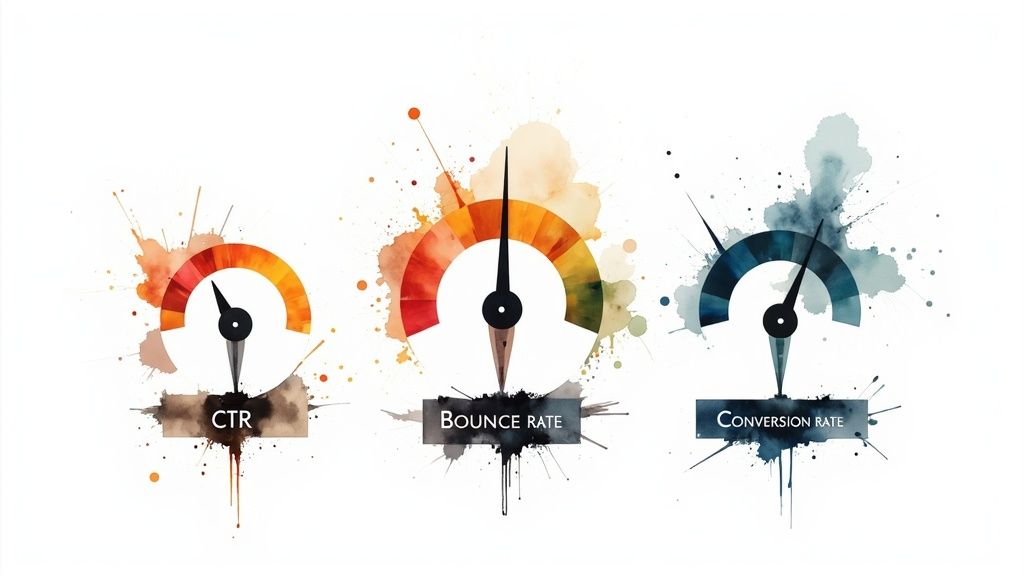
SuccessfulCROis not guesswork, nor is it blindly copying your competitors. It is a structured, methodical process built on four fundamental pillars that work together harmoniously. Understanding these pillars is the key to moving from random adjustments to a reliable system for growth.
Think of these pillars as the legs of a sturdy table. If one is wobbly, the whole thing wobbles. But if all four are solid, you have a stable platform for making smart, data-driven decisions that really make a difference.
User Experience (UX) Design: the smooth journey
At its core, CRO is about making things easier for your visitors. That's the essence ofUser Experience (UX) design—the art and science of creating a website that justfeels right. It should be intuitive, logical, and effortless to navigate.
Good UX means that your visitors don't have to think. They can find what they need, understand what you offer, and achieve their goals without encountering frustrating dead ends or confusing obstacles. Even minor points of friction, such as a page that takes an extra second to load, can be enough to cause a potential customer to abandon your site. We offer expert advice onhow to make your WordPress website fasterfor a smooth experience.
The goal is simple: remove every obstacle between a visitor's arrival and the "thank you" page. This includes:
- Intuitive navigation:A logical site structure and menus that make perfect sense.
- Mobile optimization:A seamless experience for users on smartphones and tablets, where most of your audience is likely to be found.
- Page speed:Ensure your pages load quickly, as delays are notorious conversion killers.
- Clear layouts:Use design to guide the user's eye to what is most important, such as your call-to-action buttons.
Copywriting and value proposition: your compelling message
Once your website is easy to use, you need to give people a compelling reason to take action. This is where persuasive copywriting and a crystal-clearvalue propositioncome into play. Your words are your 24/7 salesperson.
Your value proposition must immediately answer the visitor's most important question: "What's in it for me?" It must clearly communicate the unique benefits you offer and why they should choose you over someone else. This core message must shine through in your headlines, product descriptions, and calls to action.
A strong value proposition is not just a catchy slogan; it is a promise. It is the message that directly connects your customer's problem with your solution, making the decision to convert seem like the most logical next step.
Effective copywriting then takes that promise and makes it resonate. It speaks your customer's language, addresses their pain points, and builds trust, turning passive visitors into genuinely interested buyers.
A/B testing: the scientific method
How can you be sure that the new header or button color will really work better? You test it.A/B testing(also known as split testing) is the driving force behind CRO and provides you with a scientific way to validate your ideas with real user data.
The process itself is fairly simple. You create two versions of a web page: the original (Version A, the "control") and one with a change (Version B, the "variation"). Then you randomly split your website traffic between the two. By measuring which version generates more conversions, you get irrefutable proof of what your audience really prefers.
This data-driven approach removes guesswork and personal opinions from the equation. It enables you to make small, evidence-based improvements that add up over time, leading to serious, sustainable growth.
Analysis and user research: the guiding compass
With all these possibilities, where do you start? The answer lies inanalysis and user research. This pillar is the compass that points you in the right direction and guides every decision in your CRO process.
Analytics tools, such as Google Analytics, tell youwhatis happening on your site. They can show you which pages have a high bounce rate, where your users come from, and the typical paths they take. This quantitative data is fantastic for detecting problems and identifying areas with the greatest potential for improvement.
User research, on the other hand, tells youwhyit happens. Methods and tools such as heat maps, session recordings, and user surveys give you qualitative insights directly from the source. They show you exactly where people get stuck, confused, or frustrated, giving you the context you need to form smart hypotheses for your A/B tests.
Your step-by-step guide to a CRO process
The transition from theory to action is where real growth takes place. A structured Conversion Rate Optimization (CRO) process distinguishes the professionals from the amateurs. It takes the guesswork out of improving your website's performance and replaces it with a reliable, repeatable framework.
Consider it a cycle of learning and refinement. Every change you make becomes a calculated step forward. Let's go through the exact methodology that professional optimization specialists use to convert more visitors into loyal customers, step by step.
Step 1: Research and analysis
This is the detective phase. Seriously. Before you touch a single button on your site, you need to understand exactly how people are using your website right now. The goal here is to find the bottlenecks—the "leaks" in your bucket where potential customers are dropping off.
To get the full picture, we combine two types of data:
- Quantitative data (the "What"):These are the hard numbers. Tools such as Google Analytics tell youwhatis happening on your site. You can see which pages have an alarmingly high bounce rate or where exactly people are leaving your checkout process.
- Qualitative data (the "Why"):This data provides you with the crucial context behind the numbers. Heatmaps show where users click (or attempt to click), session recordings show you real user journeys, and simple surveys can give you direct feedback on what is confusing or frustrating.
When you combine these two, you can identify the greatest opportunities for improvement.
Step 2: Formulate a hypothesis
Once you have identified a problem area, the next step is to formulate a clear, testable hypothesis. This is not just a wild guess; it is a substantiated statement based on your research. It should outline the specific change you want to make, what you expect to happen, andwhyyou think it will happen.
A solid hypothesis always follows this simple structure:
If we[implement this specific change],then[this specific resultwilloccur],because[this reasoning is based on our research].
For example: "If we simplify our checkout form from six to three fields, we will increase the number of completed purchases, because our research shows that users drop out at this complex point." See? It's specific, measurable, and directly linked to a business goal.
Step 3: Prioritize
Let's be honest—you'll come up with dozens of great ideas for tests. The key is to prioritize them so you put your time and energy where they'll have the biggest impact. Not all tests are created equal.
A classic framework for this is thePIE model:
- Potential:How much improvement can we realistically expect from this change? Is it a minor adjustment or a potential game changer?
- Impact:How valuable is the traffic to this page? A change to your product page with the most traffic is much more important than one to an old, forgotten blog post.
- Simplicity:How easy will it be to design, build, and launch this test?
By scoring each idea based on these criteria, you create a smart, prioritized roadmap. You will ultimately focus on the tests with the highest impact and the least effort.
Step 4: Testing and analysis
This is where your hypothesis meets reality. Using A/B testing software, you create a new version of your page (the "challenger") and pit it against the original (the "control"). Your website traffic is split between the two versions, and you measure which one performs better against your primary goal, such as a sale or a form submission.
It is absolutely crucial to run the test long enough to achievestatistical significance. This is a fancy way of saying that you can be sure the results are not just a fluke. Once the test is complete, you will have hard data showing what really works best for your audience.
This flowchart perfectly visualizes the core cycle of CRO: analyze behavior, conduct tests, and implement what works.
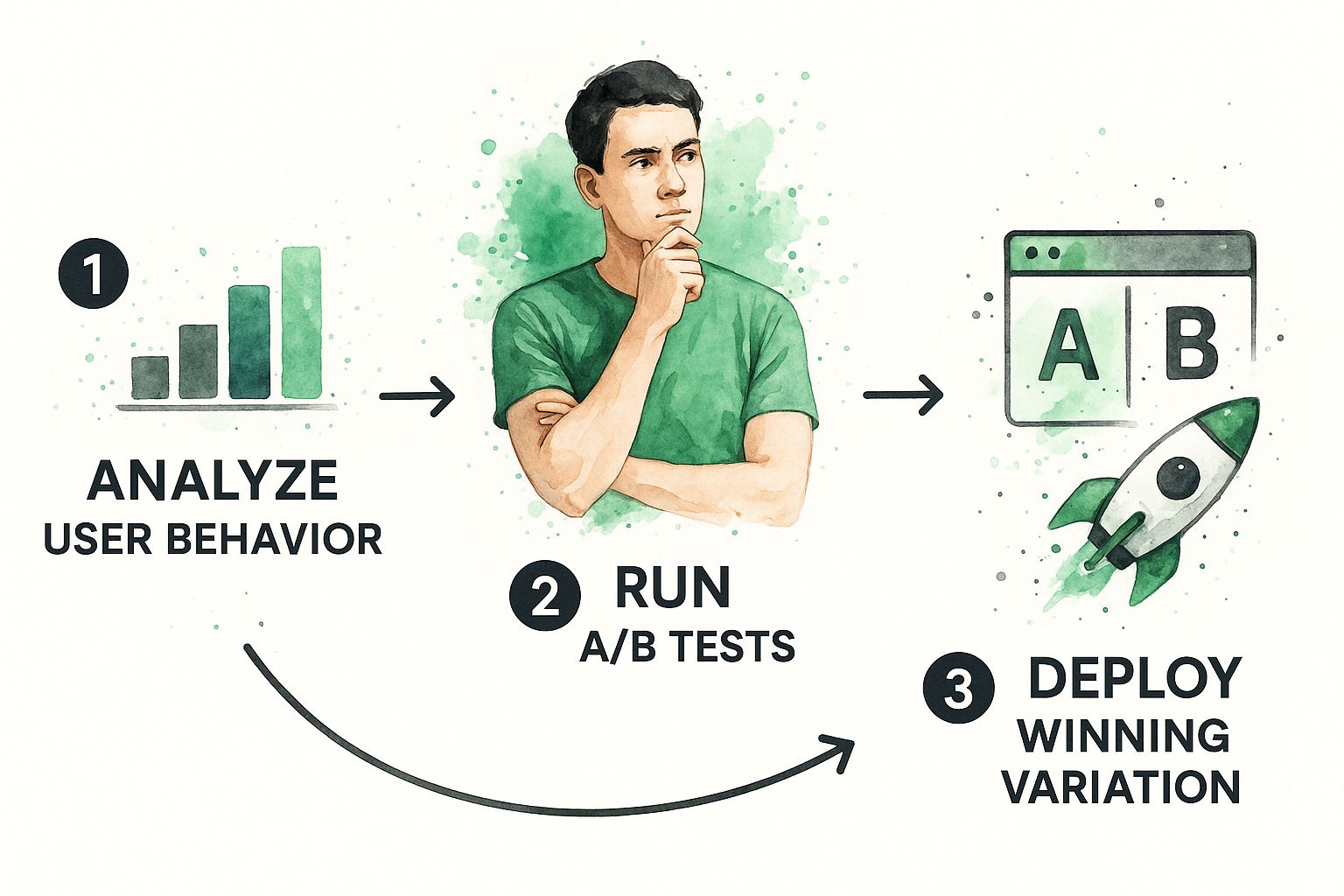
This simple loop is the engine of continuous improvement, transforming raw insights into measurable business growth.
Step 5: Learning and implementation
The final step is to act on what you have discovered. If your challenger version has won, great! Roll it out as the new standard for everyone. But the process doesn't end there. Whether you win, lose, or draw, every test gives you valuable insights into your customers' behavior.
An unsuccessful test is never a failure; it is a learning opportunity. It tells you whatdoes notwork, which is just as important as knowing what does work. Document everything you learn and use those insights to inform your next set of hypotheses. This continuous feedback loop is what makesCROsuch a powerful driver of sustainable growth.
Optimizing your most important pages is a crucial first step. If you need expert support to get started, ourlanding page optimization servicecan help you turn insights into results.
Essential CRO metrics you need to track
"To measure is to know." It's an old saying, but in the world of Conversion Rate Optimization (CRO), it's the absolute truth. To truly understand the impact of your changes, you need to track the right Key Performance Indicators (KPIs). Looking beyond just the final conversion rate gives you the full story about user behavior and website performance.
Consider the right data as a roadmap for your website. It shows exactly where users are engaged, where they get stuck, and where your greatest growth opportunities lie. Without this data, you're just guessing in the dark.
Looking beyond the basic conversion rate
Of course, theconversion rateitself is the star of the show. It's the percentage of visitors who do what you want them to do—whether that's buying a product or filling out a form. It's the ultimate scorecard for any CRO campaign.
But stopping there is a mistake. A reasonable overall conversion rate can easily hide a landing page that loses visitors or a broken step in your checkout process. To truly optimize, you need to dig deeper into the statistics that tell thestorybehind that final figure.
Discover how users interact
These statistics help you figure out how visitors interact with your sitebeforethey even reach the point of conversion. They are the early warning signs that can signal problems with engagement, clarity, or the overall user experience.
- Bounce rate:This is the percentage of people who land on a page and leave without doing anything else—no clicks, no scrolling, nothing. A high bounce rate often means there is a mismatch between what the user expected and what they found. For landing pages, this is a huge warning sign that requires your immediate attention.
- Average session duration:This one is simple: how long do people stay on your site during a single visit? A longer session usually means that your content is engaging and keeping them interested. If they leave quickly, your content may not be compelling enough, or your site may be difficult to navigate.
By keeping an eye on these engagement statistics, you can identify problems early on in the process. You can see which pages attract attention and which cause visitors to lose interest and leave the site.
Before we dive deeper into the details of tracking, let's break down some of the key metrics you'll be looking at. Each one tells a different part of your user's story.
Key CRO metrics and their significance
| Statistics | What it measures | Why it is important for CRO |
| Conversion rate | The percentage of visitors who complete a desired goal (e.g., purchase, registration). | The ultimate measure of success. It directly reflects how effective your site is at convincing users. |
| Bounce rate | The percentage of visitors who leave after viewing only one page. | High bounce rates indicate problems with page relevance, design, or user experience. |
| Average session duration | The average time visitors spend on your site during a single session. | Longer duration often indicates engaging content and good user flow. |
| Shopping cart abandonment rate | The percentage of shoppers who add items to a shopping cart but do not complete the purchase. | A crucial e-commerce metric that indicates friction in the checkout process. |
| Lead form abandonment | The percentage of users who start filling out a form but do not submit it. | For B2B, this highlights issues such as form length, complexity, or trust issues. |
| Click-Through Rate (CTR) | The percentage of users who click on a specific link or call-to-action (CTA). | Measure the effectiveness of your CTAs, headlines, and ad copy. |
Understanding these statistics is the first step. The next step is to use them to pinpoint exactly where you should focus your optimization efforts to achieve the greatest gains.
Critical e-commerce and lead generation statistics
For companies that depend on sales or leads, a few specific figures are indispensable. They indicate the exact moments when you lose potential revenue, giving you clear goals for improvement.
Theshopping cart abandonment rateis a crucial metric for any e-commerce site. It measures how many people add products to their shopping cart but leave before paying. A high percentage is often a symptom of friction in your checkout process—think unexpected shipping costs, a confusing form, or a lack of trusted payment options. Even a small improvement here can mean a serious increase in sales.
In the B2B world, thelead form abandonment rateis just as crucial. How many people start your "Request a demo" form but never click submit? This often tells you that the form is too long, asks for too much sensitive information up front, or simply has technical bugs. Simply shortening the form or adding trust signals such as testimonials can make a world of difference.
Having all these statistics in one place is essential for making smart decisions. To get a handle on your data, check out our comprehensive guide to Google Analytics. A tool like this enables you to diagnose problems, spot high-impact opportunities, and ultimately prove the financial ROI of your entire CRO strategy.
Start small, win big: real-life CRO examples
The most powerful wins inCROrarely come from a complete website overhaul. It's the small, smart adjustments that often have the biggest impact. Here, we move from theory to practice and look at real examples that prove how consistent, data-driven improvements can unlock serious growth.
Let's look at a few mini case studies. They perfectly illustrate how optimizing something as simple as a headline, simplifying a form, or adding a little social proof can make all the difference to your conversion rates.
The power of a better call to action
An e-commerce store selling digital products felt that their landing page was underperforming. The main call-to-action (CTA) button was a lazy "Submit." Sure, it was functional, but it was completely uninspiring and told the user nothing about what they would get in return.
After hearing from users who were confused about what exactly they were signing up for, the team had a clear hypothesis: a more specific, value-driven CTA would boost downloads. Time for an A/B test.
- Version A (Control):The button simply said "Send."
- Version B (Variation):The button text was changed to "Get your free guide now."
The result? Version B led to a24% increase in conversions. That small change in wording immediately clarified the benefit to the user, removed all doubt, and made clicking an easy decision. It's a classic case of how a few words can have a huge impact on the bottom line.
How social proof stimulated demo requests
A B2B software company was getting a lot of traffic to its demo request page, but the number of form submissions was disappointingly low. A quick look at their analytics showed that users were hesitating just before they started typing. The team's gut feeling was that a lack of trust was the culprit.
They decided to tackle this with a dose of social proof. The hypothesis was simple: adding customer testimonials right next to the form would increase credibility and reassure prospects at that critical moment of decision.
They implemented a rotating carousel of short, impactful quotes from satisfied customers right next to the form fields. These testimonials not only added a layer of trust; they highlighted specific results and praised the company's support.
This single change led to an18% increase in demo requestsin the first month alone. It is solid proof that reminding users of your achievements when they are hesitant is an incredibly effective CRO tactic.
Simplifying the path to purchase
Another e-commerce retailer struggled with a high percentage of abandoned shopping carts. An in-depth analysis of heat maps and session recordings revealed a clear bottleneck: the checkout page was long and confusing. It was filled with too many fields, many of which were not even necessary.
The team's hypothesis was simple: a shorter, cleaner checkout process would reduce friction and close more sales. They went back to the drawing board with a focus on minimalism.
This is what they did:
- Fewer form fields:They ruthlessly eliminated optional fields and combined "First name" and "Last name" into a single "Full name" field.
- Progress indicators added:A simple visual bar was added to show users exactly where they were in the three-step process.
- Guest checkout option:They made the guest checkout option more prominent, removing the pressure on users to create an account immediately.
These changes drastically reduced friction at checkout, resulting in a31% decrease in abandoned carts. It's a powerful reminder that sometimes the best thing you can do for your conversion rate is simply to get out of your customer's way.
Questions about CRO? We have the answers.
Even with a solid plan, getting started with Conversion Rate Optimization (CRO) can feel a little daunting. Let's address some of the most common questions we hear from entrepreneurs so you can move forward with clarity.
How long does it take to see CRO results?
We get this question all the time. Although a well-designed A/B test can sometimes reveal a clear winner within a few weeks, the real magic of CRO isn't in one quick win.
True value comes from continuous improvement. Your first test may give you a nice little boost, but it's the cumulative effect of ongoing, data-driven changes that builds serious, long-term growth.Think of it as a marathon, not a sprint.
What is a good conversion rate?
Ah, the classic "it depends" question. The truth is that a "good" conversion rate varies greatly. It depends enormously on your industry, where your traffic comes from, and what you are actually trying to achieve.
An e-commerce shop might be happy with2-3%, while a page that generates high-quality B2B leads could celebrate a conversion rate of5%. The best approach? Compare your performance with yourownpast and focus on making steady improvements, rather than chasing some arbitrary industry average.
Is CRO the same as SEO?
No, but they are definitely a power couple. Think of it this way:SEO brings people to your website; CRO convinces them to stay and actually do something.
A site that ranks number 1 in Google but doesn't convert is a waste of a good ranking. On the other hand, a perfectly optimized page is useless if no one can find it. Every strong digital strategy needs both to truly succeed.
Ready to convert your website traffic into real, measurable results? AtDigitalique.nl, we combine data-driven insights with expert execution to build a powerful CRO strategy that works for your business.
Start optimizing your conversions with us today! As always, your feedback is welcome.
