Are you wondering, "How much does advertising on Google actually cost?" You're not alone. The short answer is: there is no fixed price tag. Thecost of Google advertisingdepends entirely on your industry, the competition, and what exactly you want to achieve.
Don't think of it as a product with a fixed price, but rather as an auction where you are in control. You bid for the attention of a potential customer, and the great thing is: you decide how to spend every dollar. In this guide, we explain exactly how it works and how you can use your budget wisely to achieve maximum results.
The Factors That Affect Your Determining Google Ads Costs
The finalcosts for Google advertisingare a dynamic mix of various factors. It is crucial to understand that you are in control. Unlike traditional advertising, with Google Ads you usually only pay when someone actually clicks on your ad. We call this model Pay-Per-Click (PPC).
This gives you a tremendous amount of control, but success depends on how well you manage the key variables. A smart strategy is much more than just placing the highest bid. It's about using your budget efficiently for maximum impact. This is the key to success. search engine advertising.
Before we dive deeper into the specific elements, we will give you a quick overview of the most important buttons you can use.
Key Factors That Influence Your Google Ads Costs
| Factor | Impact on Costs | Your Control |
|---|---|---|
| Competition in your industry | Increased competition leads to higher click prices (CPCs). | Low |
| Quality score | A high score lowers your CPC and improves your ad position. | High |
| Geographic targeting | Costs vary greatly between cities and rural areas. | High |
| Bidding strategy | Immediately determines how much you are willing to pay per click or conversion. | High |
As you can see, you are in control in most areas. Now let's take a look at what these factors mean for you in practice.

What Affects Your Budget?
Each of the following elements plays a direct role in what you spend and what return you can expect. Mastering these will lay the foundation for a profitable campaign.
- Competition in the industry:This is a big one. In popular markets, such as the legal sector or financial services, many companies are competing for the same keywords. This drives up the cost per click (CPC) significantly.
- Quality Score:Google rewards relevance. A high Quality Score, which Google assigns based on the quality of your ad, keyword, and landing page, leads tolower costsand a better ad position. This is your secret weapon.
- Geographic targeting:Advertising in a busy city like Amsterdam is almost always more expensive than in a rural area. The reason is simple: more competition in a smaller area.
- Your bidding strategy:How much you are willing to pay for a click has a direct impact. However, the smartest strategies focus not only on clicks, but on conversions. This makes your spending much more efficient.
So it really is a combination of these factors. A well-thought-out strategy ensures that your budget is not simply spent, but used optimally to generate leads and sales.
How Does the Google Ads Auction Real?
Many entrepreneurs think that Google Ads is a simple auction: whoever bids the most gets the top position. That is a common misconception that can cost you a lot of money. The truth is more nuanced. Google's priority is to keep its users happy, which means they want to show the most relevant ads.
Because Google puts the user first, the auction is not just about who is willing to pay the most. It is more of a competition in which Google looks at two things:how much you are willing to payandhow good your ad is. This is where the real opportunity lies. It allows you to beat larger competitors without spending more.
Ad Rank: Your Ticket to the Top Position
Where your ad appears on the page depends on a metric calledAd Rank. And no, it's not just about your bid. Ad Rank is a simple calculation that multiplies your maximum bid by your Quality Score.
Ad Rank = Maximum Bid x Quality Score
This formula is the driving force behind the entire Google Ads auction. It means that an advertiser with a fantastic Quality Score can easily outbid a competitor with a higher bid. This is the key to efficiently managing yourGoogle advertising costs. A better Ad Rank not only gives you a higher position, but often also results in lower costs per click.
Quality Score: Your Secret Weapon
So, what is this importantQuality Score? Think of it as Google's official report card for your advertising efforts. It's a rating from1 to 10that assesses the relevance and quality of your keywords, ad text, and landing page.
A high Quality Score is your way of signaling to Google that your ad is a perfect match for a user's search query. Focusing on this is one of the most powerful ways to reduce your advertising costs. Our entire approach to search engine marketing is built on creating a rock-solid Quality Score from day one.
Google uses three main factors to calculate your score:
- Expected click-through rate (CTR):Based on past performance, how likely are people to click on your ad?
- Ad relevance:Does your ad text directly relate to the keyword someone has typed in? The connection must be clear.
- Landing page experience:When someone clicks on your ad, does the page deliver what the ad promised? The page should be relevant, user-friendly, and valuable.
Master these elements and you will no longer be just another participant in the auction; you will be able to control the auction.
What Does It Cost? Google Ad in My Industry?
It's one of the first questions every entrepreneur asks: "How much does a typical click cost inmyspecific industry?" And it's the right question to ask. Although the world of Google Ads is constantly changing, knowing the benchmarks for your industry is the basis for a smart budget.
Let's take a look at the average Cost-Per-Click (CPC) you can expect in different industries in the Netherlands. You will quickly notice that some sectors are much more expensive than others. This is usually due to two things: intense competition and the high lifetime value of a customer. If one new customer can generate thousands of euros, companies are willing to pay more to attract their attention.
This image gives you a good idea of the competitive landscape and shows how much the price of a single click can vary by industry.
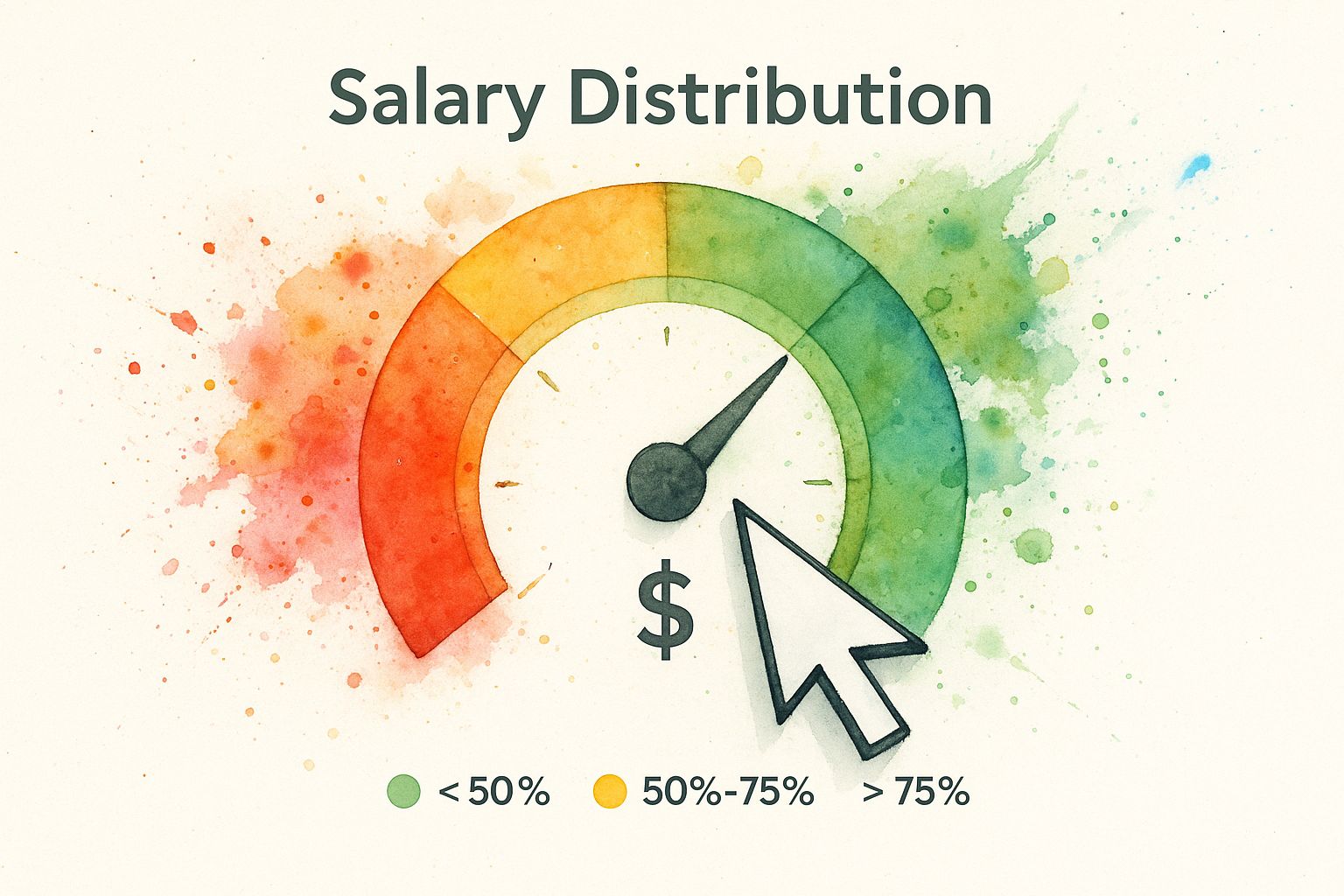
As you can see, industries such as law and financial services often have the highest click costs, while sectors such as e-commerce and travel are more moderate. This context helps you set realistic expectations for your advertising budget from the outset.
Estimated Average CPC per Industry in the Netherlands
To give you a clearer picture, we have broken down some of the most common sectors in the Dutch market. This table outlines the typical CPC ranges you can expect to encounter in the Google Search Network, along with the general level of competition.
| Industry | Average CPC range (€) | Level of competition |
|---|---|---|
| Legal services | €6.00 – €8.00+ | High |
| Finance & Insurance | $3.00 – $5.00 | High |
| B2B Technology & Services | $3.00 – $6.00 | High |
| E-commerce (Retail) | $1.00 – $2.50 | Average to High |
These figures are not set in stone, but they provide a solid starting point for planning your campaigns.
Why such large price differences?
The digital advertising space in the Netherlands is incredibly active. This creates a highly competitive environment that has a direct impact on Google Ads costs.
Let's take a look at why some industries are more expensive:
- Legal services (€6 - €8+ per click):The value of a single new client for a law firm can be enormous. That's why firms are willing to bid very aggressively on top keywords, driving up the price for everyone in that space.
- Finance & Insurance (€3 - €5 per click):As in the legal sector, the long-term value of a new customer who takes out a mortgage, loan, or insurance policy is considerable. This justifies the higher bids.
- B2B Technology & Services (€3 - €6 per click):In the B2B world, sales often involve large contracts and long-term customer relationships. A single qualified lead can be worth tens of thousands of euros, making a higher CPC worth the investment.
- E-commerce (€1 - €2.50 per click):This is a different game. CPCs are generally lower, but success depends on high sales volume. The goal here is not one high-value conversion, but a profitable Return on Ad Spend (ROAS) across hundreds or thousands of transactions.
At Digitalique, we have developed specialized strategies to address the unique challenges of different sectors. You can see how we tailor our approach to your specific industry.
The purpose of understanding these benchmarks is not to scare you away with high costs. It's about arming yourself with the right information to build a smarter, more cost-effective advertising strategy from day one.
A Smart Google Ads Budget Set up for Your Business
Determining your Google Ads budget can feel like shooting in the dark. How much is enough? Where is the line between smart investing and burning money?
The secret is to stop gambling and start calculating. A solid budget is not a random number; it is a strategic amount that is directly linked to what you want to achieve.
The best way to do this isto work backwards from your revenue goals. Don't start with the question, "How much can I spend?" Instead, ask yourself, "How much am I willing topayto acquire a new customer?" This simple change in perspective transforms advertising from an expense into a calculated investment.
Calculate Your Target CPA
Yourtarget Cost Per Acquisition (CPA)is the magic number. It is the absolute maximum you can spend to acquire a new customer and still make a profit. Once you have this clear, the rest of your budget will fall into place.
Consider what a customer is worth to you over their lifetime. If a new customer generates an average of $1,000 in revenue and your profit margin is 30% ($300), you can decide how much of that profit you want to reinvest to acquire thenextcustomer. This calculation is the basis of every sustainable campaign.
A well-defined budget transforms advertising from a gamble into a predictable engine for business growth.
From Goals to a Daily Budget
With your target CPA in hand, you can set a logical starting budget. Let's walk through a quick, practical example.
Suppose you have a B2B consulting firm and your goal is to generate10 qualified leadsper month.
- Define your Target CPA:From experience, you know that approximately one in five leads becomes a paying customer, and each customer is worth around €2,000. To keep the business healthy, you are willing to pay up to€150 per lead.
- Calculate your monthly budget:Simple math. To get those 10 leads, you invest 10 leads x $150 per lead =$1,500 per month.
- Determine your daily budget:Google Ads works with a daily budget. So you divide your monthly total by the average number of days in a month (approximately 30.4). That's €1,500 / 30.4, which gives you a daily budget of approximately€49.
Suddenly, you have a starting point based on data, not on a wild guess.
The Two Phases of Budgeting
Remember that your budget is not fixed. It must evolve. We always think in two phases: the test phase and the scale phase.
- Test budget (Learning phase):In the beginning, your main goal is to collect data. You need to spend enough to run meaningful tests, discover which keywords convert, and which ad texts are effective. This phase is all about learning.
- Growth budget (Scale phase):Once you have winning campaigns that are delivering a positive return, it's time to step on the gas. Now you can confidently invest more money in what already works, knowing that every dollar you put in will deliver a predictable return.
Practical Ways to Improve Your Reducing Advertising Costs
Once your budget is set, the real work begins. The goal is not just to spend money, but to invest it wisely to reduce yourGoogle advertising costswhile achieving better results. Let's look at five powerful, practical strategies you can apply right away.
Manage Your Quality Score
We cannot emphasize this enough: yourQuality Scoreis the most powerful lever for reducing your advertising expenditure. A higher score tells Google that your ads are relevant, and as a reward, you get a lower Cost-Per-Click (CPC) and better positions.
Focus on the perfect triangle: keywords, ad text, and landing page. If someone searches for "handmade leather boots," your ad should be about "handmade leather boots," and the landing page... you guessed it, about handmade leather boots. This tight alignment is exactly what Google's algorithm wants to see.
Prevent Waste with Negative Keywords
You don't want to pay for a click when someone searches for "free advice" while you sell premium services. That's exactly whatnegative keywordsare for. They filter out irrelevant searches that will never convert.
Regularly check your "Search Terms" report in Google AdsThis report is a gold mine because it shows theexactsearch terms people used. Do you see terms that have nothing to do with your offering? Add them directly to your list of negative keywords. This will save you a surprising amount of money in the long run.
Increase Clicks with Ad Extensions
Ad extensions are fantastic. They are additional pieces of information—such as your phone number, address, or links to specific pages—that you can add to your ads for free. They make your ad bigger, provide more information, and increase the likelihood of clicks.
Using extensions can significantly improve yourclick-through rate (CTR). A higher CTR contributes to a better Quality Score, which is the key to lower costs.
Let Smart Bidding Do the Heavy Lifting
Don't just set your bids and forget about them. Google'sSmart Bidding strategies use machine learning to automatically optimize for conversions. Strategies such as "Target CPA" or "Maximize conversions" adjust your bids in real time to get the most leads or sales for your budget.
These systems analyze thousands of signals to set the perfect bid, something no human can match. It gives you the power of Google's data to make smarter decisions.
Optimize Your Landing Pages
Your work isn't done after the click. The landing page is where the conversion needs to happen. A slow, confusing, or mobile-unfriendly page will tank your conversion rates, no matter how brilliant your ad is.
Ensure your landing pages load quickly, have a crystal-clear call-to-action (CTA), and deliver exactly what your ad promised. A smooth user experience is the crucial final step in converting expensive clicks into valuable customers.
Look Beyond the Click and Find Your True ROI
It's easy to focus on a low cost per click. But low costs are a false victory if those clicks don't generate revenue. The figure that really matters is yourReturn on Investment (ROI). Here, the focus shifts from cost to value.

Don't view thecost of Google advertisingas an expense, but as a direct investment in the predictable, sustainable growth of your business. That mindset is the first step toward long-term success.
From Cost to Value
To truly determine your ROI, you need to track conversions. A "conversion" is any valuable action after a click: a completed contact form, a newsletter sign-up, or a phone call.
When you set up conversion tracking correctly in Google Ads, you draw a direct line from your advertising expenditure to tangible results. The basic formula for ROI is simple:
ROI = (Revenue from Ads - Cost of Ads) / Cost of Ads
This comparison transforms your advertisements from a cost item into a profit generator. It tells you exactly how much revenue you generate for every dollar you invest.
Understand Customer Lifetime Value
Let's take it one step further with an even more powerful concept:Customer Lifetime Value (CLV). The customer you bring in today may not just buy once, but become a loyal customer for years to come.
For example, spending$50to acquire a customer who makes a$70purchase seems like a small profit. But what if that same customer returns every year for the next five years and spends another$70? Suddenly, that initial$50investment looks incredibly smart.
The Dutch market has long understood the power of search engine advertising. Back in 2016, total online advertising expenditure in the Netherlands amounted to approximately€1.683 billion. Search ads accounted for the largest share, at45%, or around€755 million. You can dive deeper into the figures by reading the full report on advertising expenditure in 2016.
Ultimately, smart, data-driven advertising is the engine that drives your business forward.
Frequently Asked Questions about The Cost of Google Ads
When you start looking into thecosts of Google advertising, a few questions almost always come up. It's perfectly normal to wonder about timelines, budgets, and whether you should do it yourself. Let's address three of the most common questions we hear from entrepreneurs.
How quickly can I expect results?
This is the big question. Although your ads can send traffic to your website almost immediately, it takes time to convert that traffic into profitable business.
Consider the first1-3 monthsas an essential learning phase. We don't just spend money; we buy data. During this period, we test everything—different ad texts, keywords, and target groups—to find out what works. It's all about continuous adjustment and refinement.
Should I Do Google Ads Myself or Hire an Agency?
This is a classic "cost versus expertise" dilemma. Managing your campaigns yourself saves you agency fees, which is tempting. But be prepared for a steep learning curve. Google Ads is complex, and it's incredibly easy for beginners to make costly mistakes that eat up your budget without results.
By hiring a specialized agency such as Digitalique, you gain expertise from day one. We have already made the mistakes and learned the lessons at someone else's expense. Our job is to avoid the pitfalls, maximize your return on investment, and give you the freedom to do what you do best: run your business.
What is a realistic starting budget?
Google accepts any amount you give them, but too small a budget is often a waste of money. It simply doesn't generate enough data to make smart, informed decisions. For most SMEs, we recommend a starting budget of at least€15-€20 per day.
This gives your campaigns enough fuel to run consistently and collect the click and conversion data we need to optimize. Your ideal starting point depends on your industry and goals, of course, but this budget provides a solid foundation for learning and growth.
Ready to turn your advertising spend into a predictable engine for growth? TheDigitaliqueteam is here to help you build a strategy that delivers real, measurable results. Discover how we can help you.
