Are you spending your marketing budget effectively, or are you mainly guessing which channels really generate revenue? This is a question that many Dutch entrepreneurs and marketing managers struggle with.Marketing Mix Modelling (MMM)is the data-driven solution that provides clear answers to this question. It looks beyond simple metrics and shows you the true return on investment (ROI) of every euro invested.
In this guide, you will learn:
- What marketing mix modeling is exactly and why it is essential for your business.
- What data you need for a successful analysis.
- A practical step-by-step plan for implementing MMM.
- How to translate the results into smarter, profitable decisions.
What is Marketing Mix? Modeling Now, Actually?

Imagine you are a chef perfecting a signature dish. You use all kinds of ingredients—spices, vegetables, proteins—but you don't know exactly what quantities will produce the best flavor. Is it the paprika, the fresh herbs, or the cooking time that makes the difference?
Marketing Mix Modeling (MMM)works in a similar way for your business. It is a powerful statistical analysis technique that treats each of your marketing activities as an "ingredient." It analyzes all your efforts, from Google Ads and social media campaigns to TV commercials and in-store promotions, to determine how each component contributes to your total revenue.
Instead of viewing channels separately, MMM gives you a holistic view of your overall marketing performance.
Looking Beyond Simple Metrics
Most marketing platforms provide you with basic statistics such as clicks, impressions, or likes. While these are useful, they don't tell the whole story. A Facebook campaign may generate thousands of likes, but did it actually lead to more sales in your online store? This is exactly where MMM excels.
It establishes the connection between your marketing expenditure and actual business results, such as revenue or market share. The analysis also takes into account external factors that can influence sales, giving you a much more accurate picture. These factors include:
- Seasonal influences:The impact of holidays such as Christmas or Sinterklaas on your sales.
- Economic trends:How consumer confidence or inflation influences purchasing behavior.
- Competitor actions:The effect of a large-scale promotion by a competitor on your performance.
- Price changes:How your own price adjustments influence demand.
By taking these variables into account, marketing mix modeling isolates the true impact of your marketing and filters out external "noise."
Why This Is Important for Your Business
In a world with countless marketing channels, from Bol.com advertisements to the strategic use of influencer marketing, it's easy to lose track. You have a limited budget and you want every dollar to count.
MMM is not just about measuring past performance; it is a strategic tool for planning the future. It enables you to confidently answer crucial business questions, such as: "If I have an extra $10,000 to spend next quarter, where can I best invest it for the highest return?"
This data-driven approach takes the guesswork out of your strategy. It allows you to shift budget from underperforming channels to those that deliver proven results, systematically improving your ROI. This insight is the foundation for sustainable growth and smarter, more profitable marketing decisions.
The Building Blocks of a Powerful Marketing Mix Modeling Strategy

To gain truly valuable, game-changing insights frommarketing mix modeling, you need to build on a rock-solid foundation. Think of it like a house: if the foundation is weak, the entire structure will be unstable. This means you need to start with clear goals and—most importantly—high-quality data.
A successful MMM project isn't just about entering numbers into a system; it's about asking the right questions from the outset. What business challenges are you trying to solve? Do you want to understand the overall ROI, or do you need to know how to allocate your budget for the next quarter? By clearly defining these goals, we ensure that your model delivers answers that really matter to your bottom line.
Data: The Fuel for Your MMM Engine
High-quality, well-organized data is simply indispensable for an effective model. Think of it as the fuel for your MMM engine—if you use contaminated fuel, you can't expect top performance. The accuracy of your model depends directly on the consistency and completeness of the data you provide.
The "garbage in, garbage out" principle is a well-known saying in data science for good reason. Before you even think about modeling, you need to collect and clean up different types of data.
"A modern MMM relies on Bayesian causal inference, which allows you to combine your prior knowledge with real-world data and reveal the true incremental impact of your marketing." This insight from Google emphasizes that MMM is not just about historical data; it's about creating a model that learns and adapts. Read more about their approach at the official Google blog.
To get a complete picture, you need to gather information from different corners of your business. Each dataset provides a crucial piece of the puzzle.
Essential Data Categories for Your Model
For a robust analysis, you need to collect data on sales, marketing activities, and external factors. This holistic approach enables the model to distinguish the impact of your campaigns from other forces in the market.
These are the core types of data yourmarketing mix modelingproject needs:
- Sales and Conversion Data:This is your most important performance indicator. It includes historical information such as daily or weekly revenue, units sold, new customer signups, or any other KPI that defines success for your business. The more detailed, the better.
- Marketing Expenditures and Activity Data:You need detailed overviews of your investments across all channels. Consider your expenditures for Google Ads, social media campaigns, email marketing, offline advertising such as radio or print, and even PR activities. Track not only expenditures, but also activity metrics such as impressions or reach.
- Website and Digital Analytics:Data from tools such as Google Analytics provide crucial context. Statistics such as website traffic, session duration, and channel-specific conversion rates help the model understand how digital touchpoints contribute to the final sale.
- External Factors and Contextual Data:What else was happening while your campaigns were running? This data helps the model take external "noise" into account. Think of holidays (such as Sinterklaas, Christmas), economic trends, competitor promotions, product price changes, and even weather patterns if they are relevant to your business.
The most important preparatory step is to ensure that this data is clean, consistent, and available over a sufficiently long period (usually at least two years). It is an investment of time that pays off handsomely in the form of reliable and useful insights that really help your strategy move forward.
A Practical Step-by-Step Plan for Marketing Mix Modeling Implementation
So, you're convinced of the power ofmarketing mix modelingand ready to dive in. But where do you actually start? Implementing MMM may sound like a huge, data-intensive project best left to statisticians, but we've broken it down into a clear, practical step-by-step plan. Think of this less as a technical manual and more as a strategic guide for busy managers like you.
The entire process boils down to four logical phases. Each phase builds on the previous one, taking you from raw, unorganized data to concrete insights that can truly improve your business performance. Our goal here is to demystify the process and show you how MMM can be an accessible and powerful tool for any business that is serious about growth.
This infographic provides an overview of the MMM process, from data collection to final optimization.
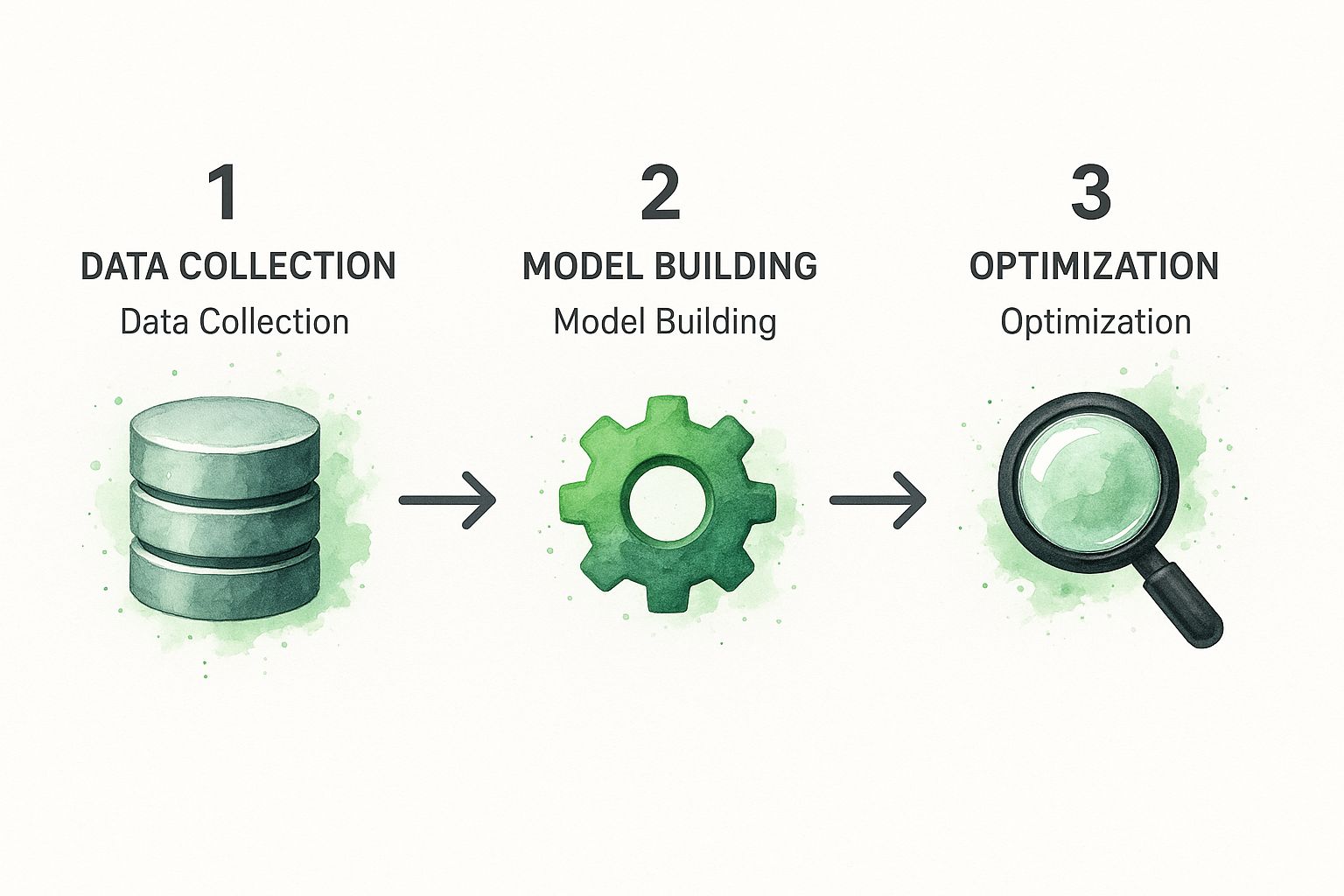
As you can see, success starts with solid data, continues with rigorous model building, and ends with strategic optimization. It is a cycle of continuous improvement.
To give you a clearer picture, here is a simplified explanation of what you can expect at each stage.
Your MMM Implementation Roadmap
| Phase | Main objective | Key Activities |
|---|---|---|
| 1. Data Collection & Preparation | Creating a single, reliable dataset | Collect sales data, marketing expenditures, and external factors. Clean up and standardize all information. |
| 2. Model Building & Testing | Developing a statistically and commercially relevant model | Select variables, perform regressions, and test different model configurations. Backtest and validate results. |
| 3. Results analysis | Translating statistical output into clear business insights | Analyze channel contributions, calculate ROI, and identify the law of diminishing returns. |
| 4. Action & Strategy | Using insights for future marketing decisions | Reallocate budgets, simulate future scenarios, and optimize the marketing mix for maximum impact. |
Let's take a closer look at what each phase entails in practice.
Phase 1: Data Collection and Preparation
This is the most critical and, frankly, often the most time-consuming phase. As we mentioned earlier, the quality of your insights depends entirely on the quality of your data. Your main goal here is to collect all the necessary information, clean it up, and merge it into a single, usable dataset.
First, you need to identify all your data sources. These include sales data from your CRM or e-commerce platform, marketing expenditure from platforms such as Google Ads and Meta, and website traffic from Google Analytics. Don't forget to take external factors into account, such as public holidays, competitor campaigns, or major economic shifts that may have affected your sales.
Crucial Tip:Make sure you have at leasttwo to three yearsof historical data. A longer period gives the model sufficient context to accurately recognize seasonal patterns and long-term trends, leading to much more reliable results.
Once you have everything, the data must be thoroughly cleaned up. This includes correcting errors, filling in missing values, and ensuring that everything is formatted consistently (for example, all dates in the same structure). This step is absolutely essential if you want to build a model you can rely on.
Phase 2: Building and Testing the Model
With your clean dataset ready to use, it's time for the exciting part: building the actual model. This is where statistical techniques come into play to uncover the relationships between your marketing efforts and your sales. Although it can get technical, the concept is simple: you learn to understand the model that drives your business.
The process involves selecting the right variables and testing different model configurations to see which one best explains your historical sales patterns. An experienced data analyst or a specialized agency usually does the heavy lifting here, but it is essential that you understand the logic behind it.
A large part of this phase is model validation. This includes:
- Back-testing:Using the model to "predict" past results to see how well the output matches what actually happened.
- Plausibility checks:Ensuring that the results make business sense. For example, does the model show a positive impact from that campaign that you know was a great success?
These rigorous tests ensure that the model is not only statistically sound, but also reflects the reality of your business.
Phase 3: Interpreting the Results
Once your model has been built and validated, you will receive a wealth of information. The challenge now is to translate those complex statistical outputs into clear, actionable business insights. This is where the true value ofmarketing mix modelingreally comes into its own.
The results typically provide you with a "contribution analysis," which breaks down your total sales and assigns a percentage to each marketing channel and external factor. For example, it may show that30% of your salescome from Google Ads,15% from social media, 10% from brand awareness, and so on.
You also get a clear picture of the ROI for each channel and, crucially, the point of diminishing returns—the moment when spending more on a channel no longer yields proportional returns.
Phase 4: Converting Insights into an Action-Oriented Strategy
The final and most important phase is putting all this new knowledge into practice. The insights from your MMM should directly shape your future marketing strategy and budget allocation. This is not a one-off report that you file away; it is a dynamic tool for continuous improvement.
For example, if the model reveals that your email marketing has a surprisingly high ROI while your print ads are lagging behind, you can confidently shift your budget. You can also use the model to run simulations. Ask questions such as: "What would happen to our revenue if we increased our social media budget by20%and reduced our display advertising spend by10%?"
By integrating these data-driven insights, you can shift from reactive decisions to proactive, strategic planning. This phase often benefits from an automated approach; explore how ourmarketing automation servicescan help you implement these strategic shifts efficiently. This creates a powerful feedback loop in which you continuously refine your marketing mix for maximum impact.
MMM data Translate to Smarter Marketing Decisions

This is when your hard work inmarketing mix modelingreally pays off. After all the data collection and model building, you have a wealth of information. The key, however, is knowing how to translate this output into confident, profitable decisions that actually drive growth.
The results of the model are not just a pile of statistics; they form a strategic roadmap. This roadmap shows you exactly what works, what doesn't, and where your hidden opportunities lie. By understanding a few key concepts, you can convert complex data into clear, actionable steps for your business.
Understanding Contribution Analysis
The first and most powerful insight from your MMM is thecontribution analysis. Think of it as a detailed breakdown of your revenue pie. It shows you exactly how much each of your marketing channels—and other factors—contributed to your total revenue over a given period.
For example, your model may reveal that:
- 35%of your revenue is driven by your baseline—things like brand strength and overall market presence.
- 25%comes directly from your Google Ads campaigns.
- 15%can be attributed to your social media efforts on platforms such as Instagram and LinkedIn.
- 10%is generated by email marketing.
- The remaining15%is influenced by external factors such as seasonal promotions or a major sale by a competitor.
This kind of insight is invaluable. It takes the guesswork out of the equation and shows you which channels are your heavy hitters, allowing you to justify every dollar of your marketing budget with solid data.
Identifying the Law of Diminishing Returns
Have you ever had that nagging feeling that you might be spending too much on a specific channel? That's where the concept ofdiminishing returnscomes in. Your MMM can plot a response curve for each channel, showing exactly when spending more money no longer yields a proportional increase in results.
Imagine your ads on Bol.com. The first €5,000 you spend could generate incredible returns. But if you increase your budget to €10,000, you may have already reached most of your target audience. That next €5,000 may only yield a fraction of the initial results.
Your model identifies this saturation point for each channel. This is a crucial insight that prevents you from wasting your budget on channels that have already reached their performance ceiling, freeing up money to reinvest for a much higher overall return on investment.
Knowing this point is the secret to maximum efficiency. It helps you finally answer that critical question: "How much is enough?"
Discovering the Halo Effect
Marketing channels rarely operate in a vacuum. A powerful TV or YouTube campaign can build brand awareness, which in turn leads people to search for your company on Google a week later. This phenomenon, whereby activity in one channel indirectly improves the performance of another channel, is known as thehalo effect.
In this scenario, a standard last-click attribution model would incorrectly give all the credit to Google Search. However, an advanced marketing mix model is smart enough to detect these cross-channel influences. For example, it can show you how your investment in top-of-funnel video ads causes a tangible lift in organic search traffic and brand-related search conversions.
Understanding these halo effects is essential for building a truly holistic strategy. It prevents you from cutting the budget of a channel that appears to be underperforming on its own, but is actually fueling the success of other channels. This is a common pitfall that MMM helps to solve, allowing you to see the full picture of your marketing ecosystem. The impact is significant; recent data shows that Dutch e-commerce brands using MMM achieved an averagerevenue increase of 2.9%purely by optimizing their channel mix. You can discover more about market trends at Statista's media overview.
Your Path to Choosing Marketing Mix Modeling
So, you're ready to get started withmarketing mix modeling. The good news is that you don't have to become a data scientist overnight. The key is to find a path that fits your company's resources, goals, and existing expertise.
You have three main routes to choose from. Each has its own advantages and challenges. Understanding these options is the first step toward making a smart decision that actually delivers value. The right choice really depends on your budget, your team's current skills, and how much direct control you want.
Software platforms
Off-the-shelf software has made marketing mix modeling much more accessible. These platforms have user-friendly interfaces that can be connected directly to your data sources, automating much of the heavy statistical work.
- Advantages:They are often the most budget-friendly option and can provide insights relatively quickly. This makes them an excellent starting point for companies that are just getting started with MMM.
- Disadvantages:The models can sometimes feel like a "black box," with limited customization options. You may find that they do not fully capture the unique characteristics of your business or market.
In-house Team
For larger companies with serious data capabilities, building an in-house team can be a powerful long-term strategy. This means hiring dedicated data scientists and analysts to build and maintain a customized MMM specifically for you.
This route gives you the ultimate level of control and customization. Demand for this type of talent has skyrocketed in the Netherlands, as more companies rely on data to refine their marketing.
The In-House Advantage:A dedicated team can tailor the model perfectly to your specific business needs. They can continuously refine it and weave the insights directly into daily operations, making your marketing incredibly agile.
Of course, this is also the most expensive and time-consuming route. It requires a significant investment in salaries, training, and technology, which makes it unattainable for many small to medium-sized businesses.
Specialized Agencies and Partners
Working with a specialized agency, such as Digitalique, offers an excellent balance. You gain access to a team of experts who live and breathe data analysis, but without the overhead of hiring a full-time in-house team. For many, this is the most practical solution.
A good partner brings more than just technical skills; they bring strategic marketing knowledge. We understand the unique consumer behavior and media landscape of the Dutch market, which ensures that the model's output is relevant and actionable. A partner can also connect MMM insights to other strategic efforts, such as optimizing your content marketing strategy to focus fully on channels that deliver the best ROI. It is a clear, transparent path to data-driven growth, combining advanced analytics with practical implementation.
Your Questions About Marketing Mix Modeling Answered
Taking the step toward something as powerful asmarketing mix modelingundoubtedly raises questions. That's a good sign. It means you're seriously thinking about how to change your budget and strategy for the better. We've seen this many times before and heard the most common questions from entrepreneurs and marketers like you.
So let's dispel any doubts. Our goal is to give you the confidence to take the next step with MMM in your own organization.
How long will it take before I see results from MMM?
This is always one of the first questions, and rightly so—you want to know when the investment will start to pay off. A typicalmarketing mix modelingproject, from data collection to a validated model, usually takes a few weeks. But the good news is that the first useful insights often emerge quickly enough to help you shape your budget for the next quarter.
It is important to remember that MMM is not a one-time solution. It is an ongoing strategic tool. Its true value builds up over time, as you feed more data into the model and see how new campaigns perform.
Think of it as tuning a high-performance engine. The initial adjustments give you a noticeable boost, but it's the ongoing fine-tuning that keeps you ahead of the competition season after season. Insights accumulate as your understanding deepens.
Is MMM only for large companies?
Not anymore. It's true thatmarketing mix modelingused to be the domain of huge companies with massive budgets and in-house data science teams. They were the only ones who could really afford the complex software and specialized skills.
Fortunately, that world has changed completely. With the emergence of more user-friendly software, open-source tools such as Google's Meridian, and specialized agencies, MMM is now within everyone's reach. This means that SMEs can finally participate.
Smaller companies don't have to want everything at once. They can start with a targeted model that analyzes just a few key marketing channels. This makes it a surprisingly cost-effective way to gain a real competitive advantage without a huge upfront investment.
How does MMM deal with new channels such as TikTok?
Excellent and very relevant question. It is a well-known challenge to model newer channels such as TikTok, because they simply do not have the years of historical data that traditional channels such as TV or print have.
But modern MMM techniques are designed precisely for these kinds of problems. Here's how a good analyst approaches this:
- Use of proxy data:We can use data from similar, more established channels as a starting point to estimate the potential impact. It's not perfect, but it's a smart start.
- Integration of digital metrics:Although historical sales data may be scarce, we can include digital engagement metrics such as views, shares, and follower growth to give the model more context.
- Advanced statistical methods:Techniques such as Bayesian modeling are perfect for this. They enable analysts to integrate expert assumptions and then update them as real data comes in.
It's all about making smart use of the data you have, rather than waiting years for a perfect dataset. A well-built model can provide solid, guiding insights even with limited history.
What is the difference between MMM and attribution modeling?
This is a crucial distinction. Both are measuring instruments, but they do very different things. The best way to view them is as partners, not competitors.
Imagine that your marketing efforts are a soccer team trying to score a goal.
- Attribution modelingis like giving all the credit to the player who scored the goal, or perhaps to the one who made the final pass. It focuses on the last few digital touchpoints (such as clicks) in the customer journey, giving you a detailed, micro-level view.
- Marketing Mix Modelingis the coach's post-season analysis. It looks at the performance of theentire team—offense, defense, midfield—and how they worked together. It also takes into account external factors such as weather, opponent strategy, and even ticket sales. It gives you the strategic, macro-level overview.
An attribution model can tell you that a specific Google Ad converted a customer. But an MMM will tell you that your YouTube brand campaign caused that customer to search for your brand in the first place, leading to that final, conversion-driving click. You need both perspectives to get the full picture and connect the small details to the big-picture strategy.
Ready to stop gambling and start making data-driven decisions that increase your ROI? AtDigitalique, we combine specialist knowledge with practical implementation to make advanced techniques such as marketing mix modeling accessible to your business. Let's build a smarter marketing strategy together.
Discover how we can help you grow at digitalique.nl
Do you have any questions or valuable tips you would like to share? Please let us know in the comments below. We read everything!
