Are you struggling with a jumble of software tools for your sales, inventory, and marketing? It's a common problem for growing businesses, leading to wasted time and fragmented data.Odoo cuts through that chaos and acts as the central operating system for your entire business, bringing all your business processes together on one smart platform.
In this article, you will discover what Odoo is, how it can increase your online visibility and sales, and why it is the perfect foundation for sustainable growth.
What is Odoo and why is it Relevant for your company?
Imagine every part of your business—from a customer's first email to the final invoice—working together seamlessly within a single system. It's not just about adding another app; it's about creating a single source of truth for your entire organization. That clarity is worth its weight in gold. It enables you to make smarter, data-driven decisions and truly streamline your work processes.
At its core,Odoois a comprehensive suite of open-source business applications. The best way to think of it is as a set of LEGO blocks. You can start small, perhaps with just a CRM app for your sales team, and then add more blocks as your business grows and your needs change. This modular approach is one of its greatest strengths.
The power of an all-in-one platform
Many companies are caught in the "software silo" problem. You know how it goes: your accounting software refuses to communicate with your inventory system, and neither of them syncs well with your e-commerce platform. This is a recipe for inefficiency, low conversion rates, and unnecessary manual errors.
Odoo is designed to break down those silos. By connecting everything together, you suddenly get a complete 360-degree view of your business operations.
- Increased Efficiency:When your sales team closes a deal, the system can automatically generate an invoice, update your inventory levels, and notify the warehouse team—all without anyone having to lift a finger.
- Better Customer Experience:With a single overview of every customer interaction, everyone from sales to support can see the complete history. This leads to more personalized and effective conversations.
- Data that is truly meaningful:Instead of piecing together reports from three different systems, you get real-time dashboards that show how the entire company is performing. Spotting trends, identifying bottlenecks, and understanding the ROI of your marketing becomes infinitely easier.
Odoo's philosophy is built on providing a single, cost-effective, and modular solution for running a business. It removes the technical and financial barriers that prevent companies from embracing truly integrated business software.
More than just an ERP system
Although Odoo is often placed in the Enterprise Resource Planning (ERP) category, it does much more than that label suggests. A traditional ERP system focuses primarily on back-office processes such as finance and manufacturing. Odoo covers all of that, but also integrates all your front-office needs.
Odoo has powerful modules for building websites, managing online stores, managing your social media, and sending email marketing campaigns.
This unique blend makes it a serious tool for any business striving for real, sustainable growth. It gives you the operational backbone of a classic ERP, while also providing you with the marketing and sales tools you need to generate leads and retain customers. For us at Digitalique, who live and breathe digital marketing and e-commerce, that integration is invaluable.
By directly linking your marketing efforts to your sales and operational data, you can finally see the entire customer journey clearly. This enables incredibly precise optimization, improving everything from your lead generation to your final conversion rates. It's all about building a solid, scalable foundation for what's to come.
The evolution of Odoo: From TinyERP to global player
To truly understand what makesOdooso powerful today, it helps to look back at where it came from. This platform was not an overnight success; it is the result of years of hard work, community collaboration, and a crystal-clear vision. For Dutch entrepreneurs, this story is more than just background information—it is proof of the platform's stability and innovative spirit.
The journey began in2005. Founder Fabien Pinckaers launched a small open-source project calledTinyERP. The mission was simple but ambitious: to give smaller businesses access to the powerful management tools that had previously only been available to large companies with deep pockets. That core idea—making enterprise-level business software accessible—is still in Odoo's DNA.
The choice to go open source was a game changer. It opened the door for a global community of developers to join in, fix bugs, build new features, and advance the software at a rapid pace.
From TinyERP to OpenERP
As the software became more capable, the name "TinyERP" no longer fit. It was anything but tiny. In2009, it was renamedOpenERP, a name that better reflected its open-source roots and growing range of business apps.
This period was characterized by growth and professionalization. The platform became more robust, attracted larger companies, and built a network of official partners for implementation and customization. The focus shifted from a collection of useful tools to a fully integrated business management solution.
The birth of Odoo
In2014, the platform had evolved once again. It was no longer just an ERP system. It now offered a complete spectrum of business tools, from website builders and e-commerce to marketing automation. To reflect this all-in-one scope, it underwent its latest name change: OpenERP becameOdoo.
The name Odoo, short for "On-Demand Open Object," marked a complete transformation. It was now a comprehensive suite of apps that could run an entire business from a single unified platform. This step cemented its unique position in the market, combining the operational power of an ERP with the customer-focused tools of a modern sales and marketing platform.
This journey from TinyERP to Odoo is not just a series of name changes. It represents a constant commitment to adaptation and innovation, guided by the real needs of its users.
Why is this history important to you as an entrepreneur? It shows that you are not investing in a fleeting tech trend. You are investing in a mature, reliable platform that is built for the long term. This is a system that has proven its ability to grow, adapt, and support companies on their journey.
Discover the core modules Odoo for business growth
The real magic ofOdoolies in its modular approach. Instead of forcing you into a rigid, one-size-fits-all system, you can choose the 'apps' or modules that your business currently needs. As you grow, you simply add more modules. This flexibility makes Odoo an excellent choice for both small startups and large multinationals.
Let's break down the essential modules for Dutch companies, grouped based on the problems they solve.
This diagram shows how Odoo's core apps for sales, inventory, and accounting are connected and form the central nervous system of your business.
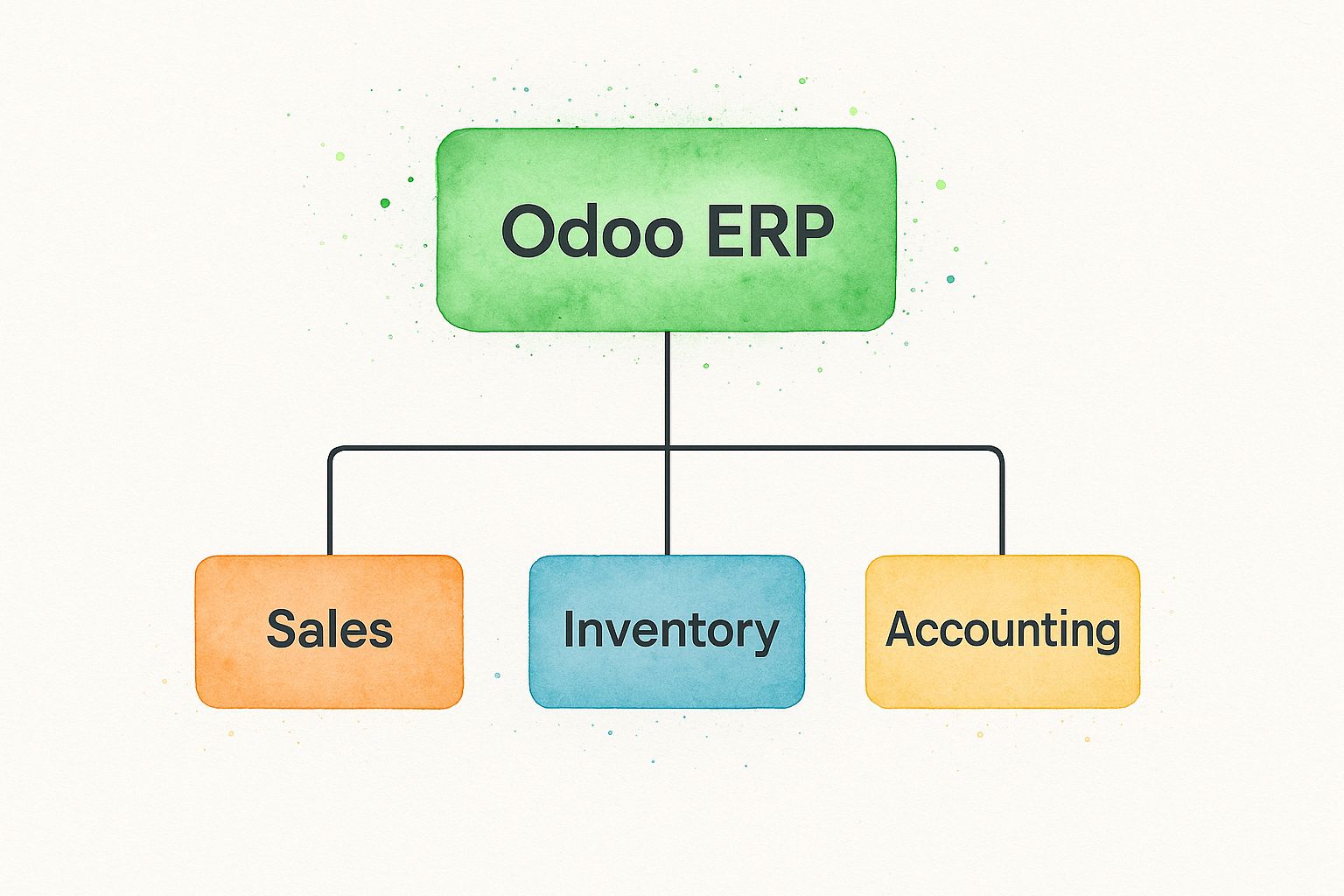
You can see how integrating these key areas creates a smooth flow of information, breaking down the data silos that so often stand in the way of growth.
Boost sales and customer relationships
Let's be honest: managing customer interactions is crucial for every business. A messy sales process and poor lead management directly lead to lost revenue. Odoo offers you powerful tools to tackle this.
TheCRM (Customer Relationship Management)module is the heart of your entire sales operation. Think of it as your digital command center for every lead and customer. It enables you to:
- Visualize your sales pipeline:Track every lead from initial contact to closed deal in a clear, customizable pipeline. You'll know immediately where each opportunity stands.
- Automate follow-ups:Set reminders and activities so that no lead slips through the cracks. Consistency is key to converting prospects into customers.
- Analyze performance:Get live reports on your team's performance, check conversion rates, and predict future revenue with much more confidence.
Build your digital storefront
In today's market, you cannot survive without a professional web store. Many companies struggle with low website traffic and low conversion rates, often because their website is completely separate from their daily operations. Odoo's web modules solve this problem structurally.
TheWebsiteandeCommercemodules work together, allowing you to build a beautiful, functional online store without being a coding expert. The drag-and-drop editor is simple, but its real power lies in its seamless integration with everything that happens behind the scenes.
What does this integration mean for you? When a customer places an order on your Odoo website, your inventory is automatically updated, a sales order is created, and the accounting is prepared. This level of automation reduces manual work and eliminates costly human errors.
In addition, these modules have built-in tools to support yourSEO (Search Engine Optimization). You can easily customize meta titles, create SEO-friendly URLs, and manage all your content—all from the same platform where you manage your products.
Streamline your operational processes
Operational efficiency is what distinguishes a profitable business from one that is merely busy. Manual inventory counts, cumbersome production processes, and disjointed accounting are silent profit eaters. Odoo's operational modules are built to bring automation and clarity to these vital areas.
The rapid adoption of Odoo in the Netherlands demonstrates its effectiveness, particularly in rapidly changing sectors. In 2023,more than 65% of medium-sized Dutch food and beverage companiesreported using Odoo for their daily operations. This sector appreciates the platform's ability to manage everything from inventory to customer relationships, where speed and accuracy are crucial. You can discover more insights about Odoo's role in the Dutch food industry to see how its flexible nature helps companies adapt and grow.
A clear overview of the Odoo prices

Before committing to new software, you need to understand the costs involved. That's just smart business. When it comes toOdoo, the pricing is refreshingly flexible and designed to grow with you, which is fantastic news for ambitious companies. Let's break down the costs so you can make an informed decision that fits your budget and goals.
Odoo's pricing revolves around two main versions: Odoo Community and Odoo Enterprise. They serve different needs, and understanding the difference is the first step toward making the right choice for your business.
Odoo Community: The free and open-source option
First, there isOdoo Community. This is the completely free, open-source version of the platform. And no, it is not a limited trial version or stripped-down demo; it is a powerful set of business tools that you can download, install on your own server, and use forever without any license fees.
This option is a brilliant starting point for startups, small businesses, or any company with a solid in-house technical team that is comfortable managing its own hosting and maintenance.
But "free" always comes with a few trade-offs:
- Limited functionality:You get the core modules such as CRM, Sales, and Invoicing, but you miss out on some of the advanced features from the paid version, particularly in the areas of accounting and production.
- No official support:You are on your own for support. That means relying on community forums and your own technical expertise.
- Self-hosted:You are responsible for hosting, security, and updates.
Odoo Enterprise: The all-inclusive paid plan
Then there isOdoo Enterprise. This is the premium, paid version that unlocks every available app, offers professional support directly from Odoo, and delivers a more refined user experience. It is built for businesses that need a complete, turnkey solution with all the bells and whistles.
Pricing for Odoo Enterprise is surprisingly simple. It is based on a "pay for what you use" philosophy, determined by two factors:
- Number of users:You pay a fee for each person in your organization who needs access.
- The specific apps you choose:You select and payonlyfor the modules your company actually needs.
This modular approach is a huge advantage. You are not stuck with a bloated system full of features you will never use.
Odoo's pricing structure directly reflects its scalability. It allows a company to start small and grow into a comprehensive ERP system without a huge, unaffordable initial cost.
This model is also predictable, which makes budgeting a lot easier. For companies looking for clear, manageable costs, this is a huge plus. At Digitalique, we believe in the same transparency, which is reflected in our digital marketing subscriptions.
Odoo's financial stability and growth also inspire confidence. The company's global revenue surpassed€370 million in 2023, with bold projections to reach €1 billion by 2027. This impressive achievement, driven by its adaptable and cost-effective model, resonates strongly in the Dutch market where companies value scalable technology. You can explore the trends shaping Odoo's growth through 2025 to gain a better understanding of its rising market influence.
Is Odoo the right choice? for your Dutch company?
We come to the big question: isOdoothe right choice for your business? After exploring its history, features, and pricing, it's time to take stock. Let's weigh up the key benefits and be honest about where it might not be the perfect match.
Odoo's greatest strength is its all-in-one, integrated design. For an ambitious SMB drowning in a sea of disconnected systems, this is a real game-changer. If your team wastes hours manually syncing data between your sales software, inventory spreadsheets, and accounting tools, Odoo is built to solve exactly that problem.
Thanks to the modular approach, you only pay for what you need now, making it a system that grows with you and doesn't hold you back.
When Odoo excels
Odoo is an exceptional choice if you recognize yourself in these scenarios:
- You are scaling up:You have outgrown your basic tools and now need a professional, central hub to manage the growing complexity in sales, inventory, and customer relationships.
- You need one source of truth:Your decisions are slowed down by conflicting data from different apps. Odoo gives you a single, unified dashboard for a clear, real-time overview of your entire operation.
- Efficiency is a top priority:You want to automate repetitive tasks—such as invoicing, order processing, and marketing follow-ups—to free up your team for more valuable work.
When you need to reconsider
However, we believe in transparency. Odoo is not for everyone. If you are a freelancer who just needs a simple way to send invoices, the platform is probably overkill. Also, if your business has extremely niche, specialized software needs that don't fit neatly into standard modules, a fully customized solution may be more appropriate.
The platform is powerful, but it requires real dedication to set it up correctly.
Ultimately, the decision comes down to ambition and complexity. If you manage multiple processes and strive for serious, sustainable growth, Odoo is one of the strongest candidates on the market.
If you are still weighing your options and believe you need a more customized solution, we can help you define your requirements and map out the best way forward. You can learn more about ourcustomization servicesto see how we support companies in making these critical technology decisions.
Frequently Asked Questions About Odoo
We often hear the same questions from entrepreneurs consideringOdoo. It's a big step, so doubts are perfectly normal. Here we provide clear, honest answers to those frequently asked questions, giving you a good idea of what implementation and daily use will be like.
Is Odoo difficult for my team to learn?
Odoo is known for its clean, user-friendly interface, which is a huge relief compared to older, cumbersome ERP systems. It is designed to be intuitive.
But let's be honest: as with any powerful business software, there is a learning curve. Expecting your team to master it overnight is unrealistic. For a smooth transition, we always recommend a phased rollout, starting with one or two core modules. Combined with professional training, this approach ensures that your team feels confident and supported from day one.
Can Odoo integrate with our existing software?
Yes, definitely. Odoo was built from the ground up as a platform that can easily collaborate with other tools. It has a powerful API (Application Programming Interface), which you can think of as a universal power strip that allows it to connect to hundreds of other applications.
This means you can connect it to essential tools you already use, from payment providers such as Mollie to your favorite email marketing software. Many standard integrations are available immediately, and custom connections can be developed for unique or specialized software.
How does Odoo help with our SEO and online marketing?
This is where Odoo really stands out from traditional ERPs. TheWebsite and eCommerce moduleshave built-in SEO tools. These allow you to manage things like meta titles and descriptions directly within the platform, without needing a separate tool for the basics of your on-page SEO.
But more importantly, true SEO success revolves around an exceptional user experience. By integrating your website with theCRM and Marketing Automation modules, you create a seamless customer journey. This integrated approach increases engagement and keeps visitors on your site longer—both strong, positive signals for Google. A well-integrated system is the foundation for a powerful, data-driven marketing strategy.
If you ever encounter technical problems or need advice on optimizing your setup, our support team is here to help. You can read more about our commitment to excellent service at our customer care help desk.
Ready to see how an integrated platform can strengthen your business operations and marketing results?Digitaliqueis your strategic partner in digital growth. We help companies use powerful tools such as Odoo to build a solid foundation for the future.
Start growing today with DigitaliqueAs always, please leave a comment about what you thought of this article.
