Do you feel like your business is invisible online? If you're struggling to generate website traffic and reach new customers, you're certainly not alone.Social media advertisingis no longer just a "nice extra"; it's a powerful tool for predictable business growth. This article will help you regain control.
We will discuss why paid advertising is indispensable, how to choose the right channels for the Dutch market, and how to set up your first campaign that actually delivers results. You will learn how to tackle the frustration of low online visibility and unclear marketing ROI with a smart strategy.
Why Social Media Advertising Essential for Growth
In the past, a strong, organic presence on social media was worth its weight in gold. You posted something and your followers saw it. Simple. But unfortunately, those days are behind us. The organic (i.e., unpaid) reach of company pages has been plummeting for years. Even if you share the most valuable content, often only a fraction of your followers still see it.
This is exactly where paidsocial media advertisingmakes the difference. It is the most direct way to regain control and position your business where it really counts: right in front of potential customers who are actively looking for what you have to offer.
The Leap from Organic to Paid
The difference between an organic post and a paid advertisement is like the difference between hoping that someone happens to walk past your store and opening a store on the busiest shopping street in town. Organic posts are great for maintaining relationships with your existing followers. But with paid advertisements, you break through that bubble and appeal to a whole new, specific audience.
The advantages speak for themselves:
- Hyper-Targeting:Reach people based on location, age, interests, and even online behavior. Do you sell luxury coffee beans? Then you can target your ads to people in your region who have shown interest in "espresso" and "specialty coffee." It can be that specific.
- Measurable Results:Every dollar you spend is fully traceable. You can see exactly how many people saw your ad, clicked on it, and what action they took on your website afterwards. This makes the ROI (Return On Investment) crystal clear and addresses any uncertainty about marketing results.
- Predictable Growth:Once you've found a winning formula—the right ad, for the right audience, with the right message—you can scale up the results. This transforms your marketing from a game of chance into a predictable engine for leads and revenue.
A Growing Market Full of Opportunities
The growing investment insocial media advertisingin the Netherlands proves that more and more companies are recognizing its power. Total spending on social media advertising in the Netherlands is expectedto reach approximately $1.43 billion by 2025. And it doesn't stop there: the sector is expected to maintain an annual growth rate of10.56%until 2029. This underscores the enormous confidence that advertisers have in these channels. More details about these market trends can be found at Statista.
"Stopping advertising to save money is like stopping a clock to save time." – Henry Ford
This quote from Henry Ford is perhaps more relevant than ever. Investing in a smart advertising strategy is not an expense; it is a direct investment in the visibility and future of your business. It directly addresses the frustration of online invisibility and unclear marketing results by delivering targeted, measurable, and scalable results that help your business move forward.
Choosing the Right Platforms For the Dutch Market
Choosing the right place for yoursocial media advertisingis just as important as the ad itself, especially in the Dutch market. A classic mistake is to spread your budget too thinly across every platform that exists. That is a guaranteed way to exhaust your resources and achieve disappointing results. The key is to be strategic, not just to be present everywhere.
Think of it as choosing a location for a physical store. You wouldn't open a luxury boutique in an industrial area, would you? The same logic applies online. You need to place your ads where your ideal customers spend all their time.
Platforms Aligned with Your Business Goals
The type of business you run has a major impact on your choice. A B2B service provider that wants to reach decision-makers will find its audience in a very different online space than a B2C brand that sells lifestyle products to a younger audience.
This is where so many companies miss the mark: they chase trends instead of building a solid strategy. Just because a platform is popular doesn't mean it's the right fit for you. The first, most crucial step is knowing exactly who you're trying to talk to.
Your goal is not to be on every platform; it is to dominate the right ones. Focus your energy and budget on the places where you can make the biggest impact and connect with customers who are genuinely interested in what you have to offer.
The right platform strategy not only generates sales; it builds a strong foundation for your brand. This infographic shows the key benefits you can expect.
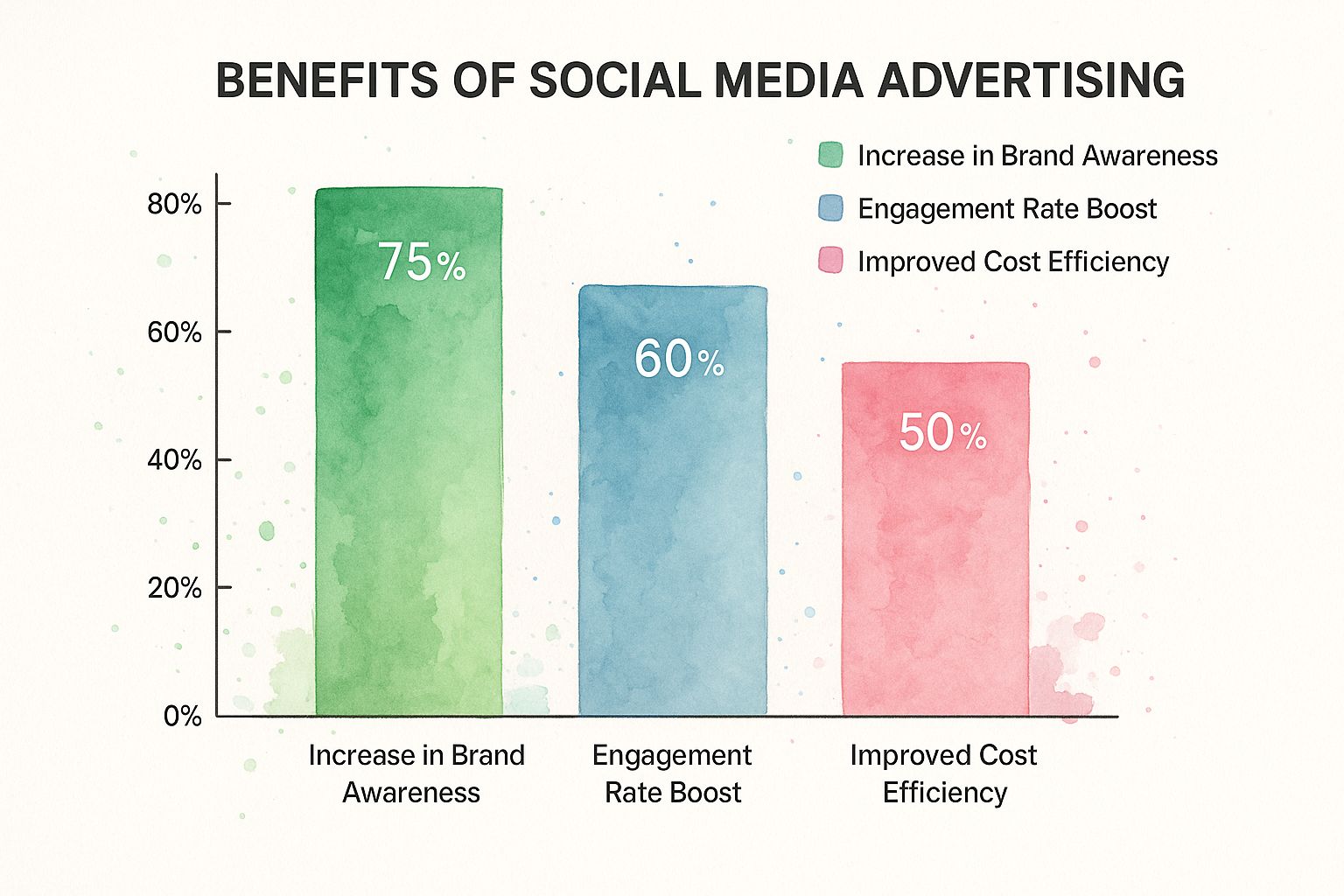
As you can see, a targeted approach delivers more than just clicks. It increases your brand's visibility and connection with your audience — two pillars of sustainable, long-term growth.
A Look at the Major Players in the Netherlands
The Dutch social media scene has its own dynamics. To create a message that really resonates, you need to understand the demographics and behavior of users on each platform. The landscape here is constantly shifting with consumer habits. In mid-2025, for example, Facebook still had a dominant position with72.75% of users, followed by Instagram with 10.63% and Pinterest with 4.02%. You can delve deeper into this social media trends to really refine your strategy.
To help you decide where to invest your advertising budget, here is a quick comparison of the most important platforms for Dutch companies.
Social Media Platform Comparison for Dutch Companies
| Platform | Primary Audience (NL) | Best Suitable For | Strong Ad Formats |
|---|---|---|---|
| Broad; 30-65+, diverse interests | Community building, website traffic, local business promotion | Detailed targeting, Lead Ads, Dynamic Ads | |
| 18-35, visually-driven consumers | Brand awareness, e-commerce, lifestyle products, influencer marketing | Stories, Reels, Carousels, Shoppable Posts | |
| Professionals, B2B decision-makers, job seekers | Lead generation, B2B marketing, thought leadership, recruitment | Sponsored Content, InMail, Lead Gen Forms | |
| TikTok | 13-24 (Gen Z), trend followers | Brand awareness, viral marketing, campaigns with user-generated content | Short video ads, Branded Hashtag Challenges |
This table provides a starting point, but the best choice always depends on your specific goals and audience.
Making the Right Choice for Your Business
So, how do you make the final decision? Start by asking yourself these three simple questions:
- Who is my ideal customer?Be specific. Think about their age, profession, and what they do.
- What are my business objectives?Are you trying to build brand awareness, generate leads, or drive direct sales? Each goal has a different path.
- What kind of content can I create?Do you have beautiful visuals that are perfect for Instagram, or are you better at writing in-depth articles for LinkedIn?
Answering these questions will point you in the direction of the platforms where your investment will work hardest for you. Of course, you don't have to figure this all out on your own. Our experts can help you develop a strategy tailored to your brand. Learn more about our comprehensive social media marketing services to see how we can help.
Ultimately, investing wisely in the right channels is the basis of successfulsocial media advertising.
Your First Powerful Advertising campaign Building
Ready to get started, but not sure where to begin? It's easy to get overwhelmed by all the options. We'll cut through the noise and give you a clear step-by-step plan to build your first campaign from the ground up.

Let's break this down into simple, manageable steps. We'll start by setting measurable goals, such as attracting more visitors to your website or finding qualified leads. Then we'll dive into the art of finding your audience, going beyond the basics to target people based on their real interests and online behavior.
Step 1: Start with Crystal Clear Objectives
Before you spend a single euro, you need to answer one simple question:what are you trying to achieve?Without a clear goal, your campaign is like a ship without a rudder. You spend money without knowing if it works and fail to address the problem of unclear marketing ROI.
For your firstsocial media advertisingcampaign, your objectives will likely fall into one of these categories:
- Brand awareness:Simply making your name known and ensuring that the right people see it.
- Website traffic:Direct potential customers to your website or a specific landing page.
- Lead generation:Collecting contact information, such as email addresses, from people who are genuinely interested.
- Selling:Encouraging people to make a purchase directly from your advertisement.
This initial decision shapes everything that follows, from the platform you use to the ad you create. For your very first campaign, it's often a good idea to focus onwebsite traffic or lead generation. These give you solid data right away that you can learn from.
Step 2: Define and Target Your Ideal Audience
This is where the real power ofsocial media advertisingcomes into play. Forget old-fashioned billboard ads that shout at everyone but connect with no one. Here, you can be incredibly specific.
Think beyond simple demographic data such as age and location. The real magic happens when you target:
- Interests:Which pages do they follow? What topics are they interested in? You can even target people who have shown interest in your competitors.
- Behavior:How do they shop online? Do they actually click on ads? These behavioral cues are worth their weight in gold because they indicate that someone is ready to take action.
- Custom Audiences:You can upload a list of your current customers to find "lookalike" audiences—new people who share similar characteristics with your best customers.
The trick is to build a detailed "buyer persona." Give this person a name, a job, and a list of problems they face. The more realistic you make them, the easier it is to create a message that really resonates.
Step 3: Structure Your Campaign for Success
Campaign structure may sound a bit technical, but it's just a logical way to organize your ads and budget. Think of it as a filing cabinet. TheCampaignis the entire cabinet, dedicated to a single purpose (such as website traffic). TheAd Setsare the drawers in it, each with its own specific audience and budget. TheAdsare the individual files in each drawer, with your different images and texts.
This setup is perfect for testing. For example, you can run one ad set targeting young professionals in Amsterdam and another targeting small business owners in Utrecht, both under the same "Lead Generation" campaign.
An organized approach is crucial to finding out what works. The Netherlands has a very active social media scene, with approximately14.8 million active usersat the beginning of 2025. Platforms are also growing rapidly; for example, Snapchat's potential advertising reach increased by 495,000 users (a 7.1% increase) between 2024 and 2025. A well-structured campaign is your key to effectively engaging this audience. You can do more social media statistics discover to refine your targeting.
Step 4: Set up a Smart Budget and Schedule
One of the biggest fears for new advertisers is letting their budget get out of hand. The good news? You're in complete control. You can set daily or lifetime budgets for each ad set, so you'll never spend more than you intend to.
For your first attempt,start with a small test budget—perhaps$15 to $25 per day. The goal here is not to make a million sales overnight; it's to collect data. You need to see which target groups respond and which ads get the clicks.
Let your campaigns run for at least 5-7 days before making any major changes. This gives the platform's algorithm enough time to learn and deliver your ads correctly. Once you have reliable data and discover a winning ad, you can confidently invest more money in it.
Creating Ad Content That Truly Converts
Perfectly targeting your audience is a great start, but it's only half the battle. If your ad creative is boring or confusing, even the most ideal prospect will scroll past without a second glance. This is where your creative strategy comes in—it's the spark that turns a passive scroller into an active customer. The goal is to create a message that is so compelling that it stops them in their tracks and inspires them to take action.
Your ad content should do more than just showcase your product. It should tell a story, solve a real problem, and directly address the hopes and frustrations of your audience. To achieve this, we rely on a classic framework that is incredibly effective in structuring a compelling ad.
The AIDA Framework: Your Guide to Persuasive Advertising
The AIDA model is a simple, four-step process for guiding a potential customer from awareness to action. Think of it as the storyline for your advertisement.
- Attention:First and foremost,your advertisement must grab attentionwithin seconds. You can do this with a striking image, a catchy headline, or a question that addresses a common pain point.
- Interest:Once you have their attention, you need to hold their interest. Briefly explain what your offer is about and why it is important tothem. Arouse just enough curiosity to make them want to know more.
- Desire: This is whereyou make the connection. Show them the "after" situation—how their life or business will be better with your product or service. Use testimonials or benefit-focused language to make your offer indispensable.
- Action:Finally,you need to tell them exactly what to do next. This is your Call-to-Action (CTA), and it must be impossible to misunderstand.
By structuring your text and visuals around these four phases, you create a logical and compelling flow that naturally guides the user toward your ultimate goal.
Visuals That Stop Scrolling
On visually driven platforms such as Instagram and Facebook, it's the image or video that gets you the click. Generic stock photos just don't work anymore. Your visuals need to feel authentic and fit the native vibe of the platform.
- Use High-Quality, Authentic Images:Show real people using your product or enjoying your service. Photos that evoke emotion and feel genuine consistently perform better than overly polished, corporate images.
- Embrace Video Content:Short videos are king, especially for formats such as Reels and Stories. A quick, engaging video that shows your product in action or shares a useful tip can be much more powerful than a static image.
- Optimize for Mobile:The vast majority of social media users are on their phones. Make sure your text is easy to read on a small screen and that your core message comes across, even with the sound off, as many people watch videos without sound.
Writing Texts That Connect and Sell
Your ad text provides context for your visuals and does the heavy lifting when it comes to persuasion. It should be clear, concise, and completely focused on the customer.
The most effective ad copy doesn't talk about features; it talks about transformations. Instead of saying, "Our software has an automated reporting feature," say, "Save hours every week with automated reports delivered directly to your inbox."
Focus on benefits, not just features. A feature is what somethingis; a benefit is what itdoes for the customer. Frame everything around solving their problems and helping them achieve their goals. Keep your language simple, direct, and free of jargon.
Creating a Clear Call-to-Action (CTA)
Your CTA is perhaps the most critical part of yoursocial media advertisingcontent. It is the final instruction that converts their interest into a tangible business result. A weak or vague CTA will definitely cause your conversion rate to plummet.
Your CTA should be:
- Specifically:"More Information" is fine, but "Download Your Free Guide" or "Shop the New Collection" is much better. It creates a clear expectation.
- Action-oriented:Start with a strong verb that encourages a click, such as "Receive," "Try," "Reserve," or "Start."
- Visually Prominent:Make sure the button or link is easy to see and even easier to tap.
Ultimately, a powerful CTA is the final piece of the puzzle that converts your advertising spend into measurable results. By making the desired action crystal clear, you significantly increase your chances of success. A well-crafted CTA is a key component in improving your website's performance, and you can learn more about this by tapping into our expertise in conversion rate optimization to explore.
Measuring What Matters and Prove Your ROI
How do you prove that yoursocial media advertisingis a smart investment and not just an expense? This is the key question. The answer to this question separates campaigns that fade away from campaigns that become a real growth engine. To get there, you need to look beyond vanity metrics (such as likes) and focus on the data that actually influences your business results.

It's easy to get lost in a sea of confusing acronyms, but don't worry. The key is knowing that each statistic only tells part of your campaign's story. Once you learn how to interpret them, you can confidently demonstrate the true value your ads generate.
Key Social Media Advertising Statistics Explained
To get a clear picture of your campaign performance, you need to track the right metrics. Think of these metrics as your car's dashboard—each gauge gives you crucial feedback to guide you smoothly to your destination. Here's a simple explanation of the most important metrics, what they mean, and why they matter to your business.
| Statistics | What It Measures | Why It Matters |
|---|---|---|
| Reach & Impressions | Reach is the number of unique people who see your ad. Impressions are the total number of times your ad is displayed (one person may see it multiple times). | This shows the extent of your ad's visibility. A high reach means that you are successfully bringing your brand to the attention of new eyes. |
| Click-Through Rate (CTR) | The percentage of people who saw your ad and then clicked on it. | This tells you how compelling your ad creation is. A low CTR often means that your image or headline is not attracting enough attention. |
| Cost Per Click (CPC) | The average amount you pay each time someone clicks on your ad. | This directly measures how cost-efficiently you generate traffic. The goal is to keep this low while attracting high-quality visitors. |
| Conversion rate | The percentage of clicks that result in a desired action, such as a purchase, download, or completed form. | This is the ultimate test of your ad's effectiveness. It shows whether you are attracting therightpeople who are ready to take action. |
| Return on Ad Spend (ROAS) | The total revenue generated for every dollar spent on advertising. A3:1 ROASmeans that you have earned$3for every$1you have invested. | This is the most crucial statistic for proving ROI. It directly links your advertising expenditure to revenue, demonstrating the true financial impact of your campaigns. |
By thoroughly understanding these figures, you can have a meaningful conversation about performance. It takes you beyond counting 'likes' and focuses the discussion on tangible business results.
Implementing Essential Tracking Tools
To collect all this vital data, you absolutely must have the right tracking tools installed. Without them, you're flying blind. For platforms such as Facebook and Instagram, the most fundamental tool is theMeta Pixel.
Think of the Meta Pixel as a small, invisible code on your website that is directly connected to your advertising account. It is a small piece of code that you place on your site and that then reports how users who clicked on your ad behave once they arrive. This tool helps you see which ads are delivering results.
This powerful tool allows you to see exactly which ads drive specific actions, such as:
- Website visits:Determine which campaigns are most effective in attracting people to your site.
- Lead submissions:Count exactly how many people fill out your contact form after clicking on an ad.
- Purchases:Link sales directly back to the specific ads that inspired them.
Honestly, implementing the Pixel is non-negotiable for anyone serious aboutsocial media advertising. It provides the hard evidence you need to justify your ad spend and make smarter decisions. As the HubSpot's analysis As emphasized, tracking clicks and conversions is essential to understanding what truly sparks curiosity and drives sales.
A Simple Framework for Analyzing Your Results
Once your data comes in, you need a simple framework to make sense of it. Don't get overwhelmed. Just focus on answering these three questions in order:
- Is the ad working?Start with yourCTR. Is it at or above the benchmark for your industry? If it's lagging behind, that's your first sign that the creative or text needs a refresh.
- Is the Audience Right?Next, look at yourconversion rate. If you have a high CTR but a very low conversion rate, you may be attracting the wrong crowd—people who are curious enough to click, but are not qualified leads or customers.
- Is it profitable?This is whereROAScomes into play. If your ROAS is positive and meets your business goals, you have a winner. If it is low or negative, it's time to diagnose the problem by going back to the first two questions.
By regularly evaluating your campaigns through this simple lens, you can stop guessing and start knowing. You can confidently focus on what works, eliminate what doesn't, and continuously improve your return on investment. This data-driven approach is the foundation of sustainable growth throughsocial media advertising.
How to Run Advertising Campaigns Optimizes and Scales Up
Launching yoursocial media advertisingcampaign is really just the beginning. The real work—and the real growth—comes from what you do next: smart, continuous optimization. That's how you turn a few good initial results into a powerful, predictable machine that consistently fuels your business.
This isn't about randomly trying things to see what works. It's about a systematic process of testing, analyzing, and intelligently reinvesting. If you do this right, you'll get the absolute maximum out of every dollar you spend and prevent your costs from spiraling out of control as you grow.
The Power of A/B Testing
Think of A/B testing as a direct competition between your ads. It's a simple but incredibly powerful way to find out exactly what appeals to your audience. The concept is straightforward: you create two slightly different versions of the same ad (Ad A and Ad B) and run them simultaneously to see which one delivers better results.
The golden rule here is totest onlyone variable at a time. If you change the headlineandthe image, you'll never know which change actually made the difference.
Here are a few common elements that are worth testing:
- Headlines:Does a direct question attract more attention than a bold statement?
- Visuals:Does a video perform better than a static image? And what about a sleek product photo versus a lifestyle photo of people using it?
- Advertisement text:Is short and powerful text more effective, or does a more detailed explanation win out?
- Call-to-Action (CTA):Does "Shop Now" convert better than "More Information"?
By methodically testing these elements, you stop guessing and start making decisions based on real data. This cycle of refining your ads is exactly how you improve crucial metrics such as your Click-Through Rate (CTR) and lower your Cost Per Click (CPC).
Reconnect and Convert with Retargeting
Have you ever looked at a product online, only to see ads for that exact item everywhere on the internet the following week? That's retargeting, and it's one of the most powerful strategies insocial media advertising. It gives you the ability to show specific ads to people who have already interacted with your brand in some way.
Retargeting is so effective because you're not trying to convince a cold audience. You're simply re-engaging people who have already shown interest by visiting your website, adding an item to their shopping cart, or liking your social media posts.
This "warm" audience is much more likely to convert. By showing them tailored ads that remind them of their initial interest, you can gently guide them back to complete their purchase or finish their application. It's an essential tactic for squeezing every drop of value out of your website traffic. We help companies build these powerful follow-up systems; you can learn more about our remarketing services to see how we help to capitalize on these otherwise lost opportunities.
Intelligently Scale Your Campaigns
Once you've found a winning formula—an ad that consistently delivers a great Return On Ad Spend (ROAS)—it's tempting to just increase the budget. But effective scaling requires a little more finesse than simply throwing more money at it.
Smart scaling is all about gradually increasing your spending while keeping a close eye on your key metrics. A sudden, massive budget increase can shock the platform's algorithm, often leading to less efficient spending. A much better approach is toincrease your budget by20-25% every few days, but only as long as performance remains stable.
This gives the system time to adapt and find new, high-quality people within your target group, allowing you to grow your reach and results without compromising your profitability.
Frequently Asked Questions about Social Media Advertising
Even with a solid plan, it's perfectly normal to have questions when you first dive intosocial media advertising. We understand that. To give you some extra clarity, we've compiled answers to the most common questions we hear from Dutch entrepreneurs like you.

How Much Should I Spend on Social Media Advertising?
There is no magic number, and the good news is that you don't need a huge budget to get started. The key is to start with a test budget that you feel comfortable with, perhaps€15 to €25 per day, purely to gather some initial data.
Your goal isn't just to spend money; it's to invest it wisely. Once you find a campaign that's clearly profitable with a positive Return On Ad Spend (ROAS), you can confidently scale up your budget. That way, you know every dollar is working hard for your business.
How Long Will It Take Before I See Results from My Ads?
You will see initial data such as clicks, impressions, and reach almost immediately—often within24 to 48 hours. This early feedback is great for determining whether your ad is attracting attention.
However, measuring real business results such as qualified leads and actual sales requires a little more patience. It typically takesseveral weeks to a monthto gather enough meaningful data to make smart, strategic decisions. Remember that consistency is much more important than striving for perfection overnight.
Should I Do This Myself or Hire an Agency?
Managing your own ads is certainly an option, especially if you have the time to really get to know the platforms and stay up to date with their constant updates. The world of digital advertising is changing rapidly, and what works today may not work tomorrow.
Working with a specialized agency like ours gives you immediate access to expertise, proven strategies, and years of practical experience. This usually leads to afaster and higher ROI, allowing you to focus on what you do best: running your business.
Navigating the world ofsocial media advertisingcan feel complex, but you don't have to figure it all out on your own.Digitaliqueis ready to be your strategic partner and turn your vision into measurable online success. Grow Tomorrow, Start Today. Share your vision or idea below.
