Do you consistently publish high-quality articles, but still don't see significant results in Google? This is a common frustration among ambitious entrepreneurs in the Netherlands.
Often, the problem isn't the quality of a single article, but the lack of a coherent strategy to showcase your expertise. That's wheretopical authoritycomes in.
The Solution For Low Rankings
Consider topical authority as the solid foundation that transforms your site into the most reliable, comprehensive source in your niche. Simply posting great content is no longer sufficient. Google wants to see evidence that you know your field inside and out and regularly share that in-depth knowledge.
When you do this right, Google rewards you with higher rankings,more organic traffic, and ultimatelymore qualified leads. It's not a quick fix; it's a long-term growth strategy. By building authority around your core topics, you elevate your site from just another voice to the go-to source that both search engines and potential customers trust.

What You Will Learn
In this guide, we break down topical authority and explain why it is indispensable for modern SEO. You will see how it directly ties in with Google's E-E-A-T principles (Experience, Expertise, Authoritativeness, Trustworthiness) and discover the strategies we use at Digitalique.nl to build, measure, and leverage authority.
Below is a brief summary of the core components of topical authority and their direct impact on your business.
Topical Authority At A Glance
| Component | Description | Business Impact |
|---|---|---|
| Content pillars | Demonstrate consistent, in-depth knowledge within your niche. | Improves visibility in search engines and positions you as the expert. |
| Content clusters | Identify and organize content pillars and clusters. | Leads to efficient content creation and increases thematic relevance. |
| Practical Implementation | Producing content that exudes expertise and trust. | Increases user engagement and reduces bounce rates. |
| Measuring Results | Use metrics to track performance and adjust strategy. | Maximizes ROI by focusing on high-impact topics. |
Use the details above to determine your approach before diving deeper into each section.
We cover:
- Core principles:What does it really mean to be an authority in your field, and how do you demonstrate that online?
- Strategic Planning:How do you choose the right topics (content pillars) and build clusters around them?
- Practical Implementation:Tips for creating content that not only informs, but also conveys expertise and trust.
- Measuring Results:Ways to check whether your efforts are paying off and how you can adjust for maximum impact.
Armed with these insights, you can transform your website into a powerful lead generation machine and lay the foundation for sustainable business growth. Let's get started.
Topical Authority Simply Explained
Let's leave the jargon aside. Imagine your website is a library. If you only have one book on web design, one on social media, and another on email marketing, your library isn't really an expert in anything. It's just a collection of separate topics.
But what happens if you build an entire wing dedicatedsolelyto e-commerce web design? This wing would be filled with everything from Shopify development and WooCommerce plugins to payment gateway security and user experience design.
Suddenly, your library becomes the definitive, leading authority on that one topic. That'stopical authorityin a nutshell.

It is the strategic process of creating a deep, interconnected web of content around a specific topic. This signals to search engines such as Google that you are a true expert, which directly strengthens your 'Expertise' and 'Authoritativeness'—two important pillars of Google's E-E-A-T guidelines.
Authority Versus Popularity
It's easy to confuse topical authority with other SEO metrics such as Domain Authority (DA). Think of DA as a measure of your website's overall popularity, mainly influenced by how many other sites link to you. A high DA is great, but it doesn't prove that you're an expert on a specific topic.
Topical authority, on the other hand, is all aboutcredibility and in-depth knowledgewithin a specific niche.
You may have a lower Domain Authority than a major competitor, but you can still beat them on specific topics where you have demonstrated superior expertise. Google values professional knowledge more than ever.
This is fantastic news for specialized companies. It means you don't need a huge link building budget to compete. Instead, you can focus on becoming the most comprehensive resource in your field—something that is entirely within your control.
Why It's More Important Now Than Ever
So, why has this become so crucial? In the past, you could perhaps score well by focusing on a single keyword with one strong article. Those days are over. Google's algorithms are now much more advanced; they understand context and the relationships between different concepts.
When you consistently publish high-quality content that covers a topic from every possible angle, you create a powerful "content hub." This proves to Google that your site is a reliable source of information.
This makes Google more inclined to:
- Rank your new content faster because it already trusts your site on that topic.
- Display your pages for a wider range of related searches, greatly increasing your visibility.
- Seeing your company as a credible leader builds trust with potential customers even before they consider contacting you.
Building topical authority is how you shift from simply answering a question to becomingthedefinitive answer. It's a fundamental change in strategy, where you no longer chase individual keywords, but dominate entire conversations in your industry. This approach not only wins the trust of algorithms; more importantly, it wins the trust of your future customers.
Laying the Foundation For A Strong Content Strategy
You don't just build realtopical authorityovernight. It's a conscious, structured process, similar to an architect carefully designing a skyscraper. You can't just start building; you need a rock-solid foundation. This fundamental work revolves around mapping out your content universe to strategically anchor your expertise.
The very first step is to identify your "content pillars." Think of these as the most important, supporting pillars of your expertise. They represent the core themes for which your company absolutelymustbe known. This isn't just a list of your services; these are the broad areas of knowledge where you can offer tremendous value to your audience.
Identifying Your Core Content Pillars
How do you figure out what your pillars should be? It starts with asking yourself a few honest, critical questions:
- What are our most important business goals?If you want to generate leads for e-commerce customers, then a pillar such as "E-commerce Growth Strategies" makes perfect sense.
- What keeps our customers awake at night?If they are constantly struggling with online visibility, 'Local SEO for SMEs' can be another powerful pillar.
- What are we truly experts in?You should choose topics that your team has real, practical experience with and can share unique insights that your competitors simply cannot match.
Once you have identified2-4core pillars, you have the blueprint for your entire content plan. Every piece of content you create from now on should directly support one of these fundamental topics, strengthening your authority in the eyes of both Google and your future customers.
Building Topic Clusters for Depth
With your pillars firmly in place, it's time to build "topic clusters" around each pillar. If a pillar is a supporting column, then topic clusters are the individual rooms and shelves attached to it. Each cluster is a focused collection of articles, guides, and resources that explore a subtopic from every possible angle.
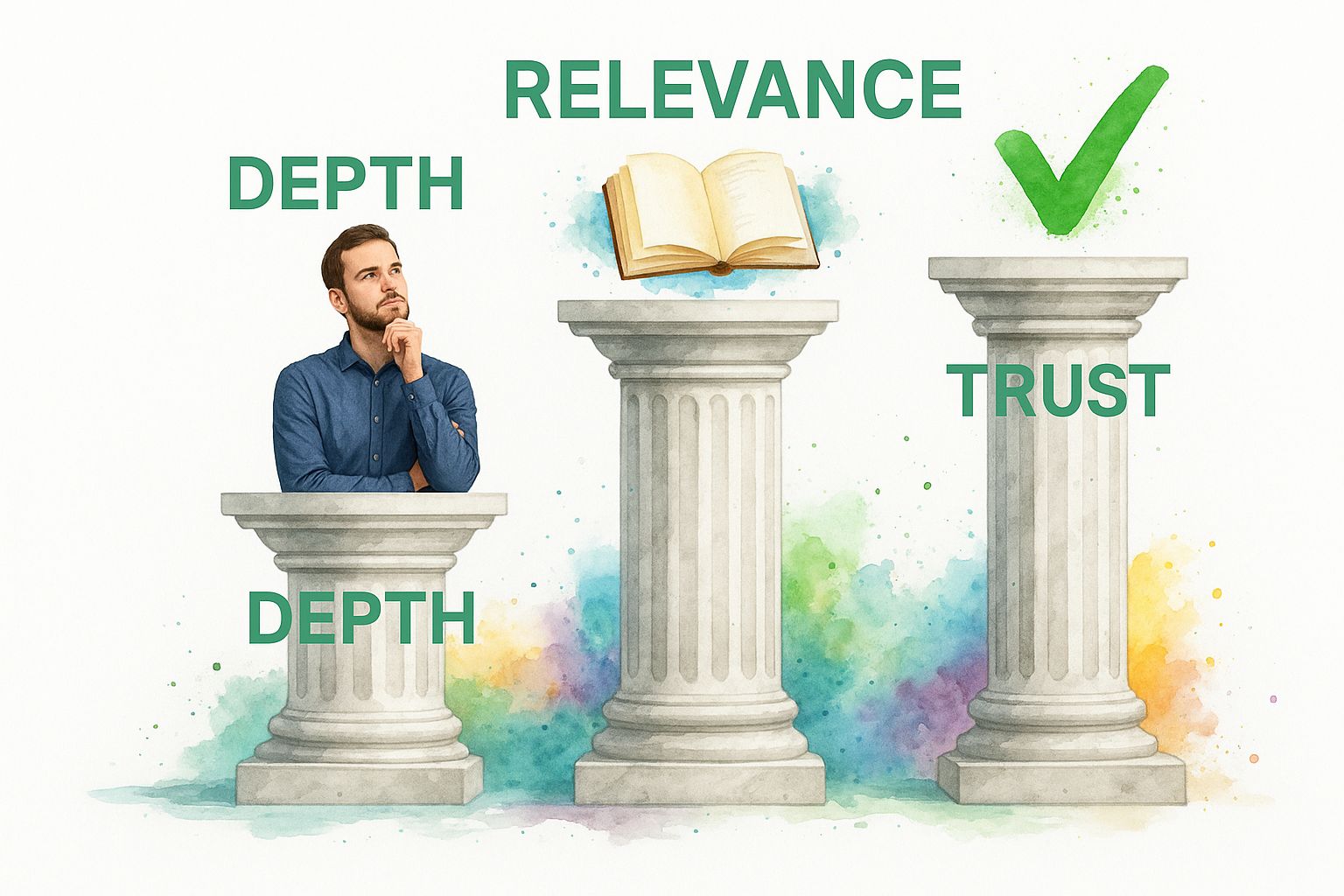
This structure revolves around demonstrating your depth. For example, if we at Digitalique.nl were to choose "Lead Generation" as our core pillar, we could build specific clusters around subtopics such as:
- Local SEO:This cluster would include articles on optimizing a Google Business Profile, conducting local keyword research, and the importance of citation building.
- PPC campaigns:Here, we would create guides on setting up Google Ads, maximizing your advertising budget, and writing ad copy that actually converts.
- Content Marketing Funnels:This would include content that explains how to tailor articles to the customer journey, from the initial awareness phase to the final decision.
This whole approach, which is an essential part of any solid content marketing plan ensures that you cover a topic so extensively that Google has no choice but to recognize you as the expert.
The Importance of Strategic Internal Links
The final, and perhaps most crucial, component of this foundation isstrategic internal linking. This is the cement that holds your pillars and clusters together. Think of these links as the corridors and doors that connect all the different sections of your expertise. They guide both users and search engine crawlers through your content and clearly show how everything is related.
Every time you publish a new article within a cluster, you should link it back to the main pillar page. It is equally important to link between related articleswithinthe same cluster. This creates a dense, interconnected web that proves you have covered the topic from A to Z, making your website an undeniable content hub.
This type of strategic investment is becoming increasingly important. Just look at the thriving startup scene here in the Netherlands. The scale-up ratio—that is, startups that successfully reach the growth phase—skyrocketed from13%in 2019 to an impressive21.5% in 2024. This growth is fueled by companies that invest early in building an authoritative digital presence through precisely this kind of smart content strategy. It helps them cut through the noise and build a sustainable business.
How to Create Content Proving Your Expertise
Now that your content pillars and clusters have been mapped out, it's time to move from planning to execution. This is where the real work begins: creating the high-quality content that will actually build yourtopical authority. The goal is simple but ambitious: make your article the very best, most helpful resource on the internet for every subtopic you cover.
Simply producing content is not enough. Each piece must be crafted with precision, demonstrating that you deeply understand what your audience—and search engines—are looking for. It means going far beyond the surface and proving your expertise with every word.
Reveal Every Question With In-Depth Keyword Research
The best expert content starts with understanding every question your audience asks. Standard keyword research only scratches the surface and finds only the most obvious terms. To build real authority, you need to dig much deeper. We're talking about discovering long-tail keywords—those longer, more specific questions that tell you exactly what your customers are struggling with.
Think of it this way: these are the follow-up questions someone would ask in a real conversation. So instead of just focusing on "local SEO," you need to find searches like "how to get backlinks for a local business" or "best schema markup for a plumber's website." Schema markup is a type of code you add to your website to help search engines better understand its content.
We have a few favorite methods for finding these golden opportunities:
- Google's "People also ask" section:This is a direct line to what users are curious about next. We analyze this to ensure that our content naturally answers their next logical question.
- Competitive analysis:We comb through the top-scoring articles for your topic to see which questions they answer well and, more importantly, which ones they have missed. That gap is where you can excel.
- Search Forums and Communities:Places like Reddit or niche industry forums are treasure troves of real user questions. Here, you can find out how your audienceactuallytalks about their problems.
By creating a master list of every conceivable question, you are essentially creating a blueprint for content that is undeniably complete. This sends a powerful signal to Google that you have covered the topic from every angle.
Creating Content Briefings for Flawless Execution
Before writing a single word, we draw up a detailed content briefing. Think of it as the blueprint for each article. It ensures that every piece of content is comprehensive, accurate, and perfectly aligned with your goal of buildingtopical authority.
A weak briefing leads to weak, generic content. A strong briefing, on the other hand, ensures that every article is a strategic asset.
Our content briefings are not suggestions; they are strategic roadmaps. They ensure that every writer understands the core purpose of the article, the target audience, the key questions to be answered, and their specific role within the topic cluster.
This careful planning takes all the guesswork out of it. It also ensures consistency across the board, which is crucial when you're producing a large volume of content to establish expertise. It's the difference between publishing a random collection of articles and building a cohesive library of expert knowledge.
Incorporating E-E-A-T into Your Writing Style
Google's E-E-A-T (Experience, Expertise, Authoritativeness, and Trustworthiness) principles are not just buzzwords; they are the standard of quality. To prove your expertise, you must incorporate these principles directly into your writing style.
This isn't aboutsayingyou're an expert. It's about showing your work and providing evidence to back it up.
How to demonstrate E-E-A-T in practice:
- Show First-Hand Experience:Don't just tell your readers what to do—show them. Use phrases such as: "In our experience with customers..." or "Here's a mistake we made and what we learned from it..." This shows that you have practical experience.
- Cite Credible Sources:When using statistics or data, link to high-quality, non-competitive sources. A link to a respected industry study or a Google Search Central Blog posts immediately build trust.
- Offer Unique Insights:Your content should offer more than just a repetition of what already scores well. Add your own unique perspective, analysis, or data. This is what distinguishes a true leader from a follower.
- Emphasize Author Expertise:Provide clear authorbiographies that highlight relevant experience and credentials. This tells both your readers and Google that the content comes from a qualified source.
By consistently applying these principles, you will stop simply writing articles. You will start creating business assets that prove your mastery, build real trust with your audience, and give Google every reason to see you as the definitive authority in your field.
Tracking Your Progress and Measure What Matters
So, you put in the work. But how do you know if it's actually paying off?Topical authoritycan feel a bit abstract, we understand that. The good news is that there are concrete performance indicators (KPIs) you can track to see your progress in black and white. This isn't about crossing your fingers and hoping for the best; it's about using data to confirm that Google is finally starting to see you as the expert in your field.
Building real authority is a marathon, not a sprint. But by keeping an eye on the right metrics, you'll see clear evidence of your progress long before you reach the finish line. It's all about gathering the insights you need to double down on what works and adjust your strategy for maximum impact.

Introducing Topic Share: Your Authority Benchmark
One of the most powerful ways to measure topical authority is by looking at your "Topic Share." Think of it as your slice of the pie for a specific online conversation. It is the percentage of total organic traffic your site receives from a carefully selected set of keywords that are all related to your main pillar.
Suppose your pillar is "Lead Generation." You would start by compiling a list of hundreds, perhaps thousands, of related keywords. With a tool such as Ahrefs or Semrush You can then track your visibility across this entire keyword universe and compare it directly with your competitors. When you see your Topic Share increase, it is a direct, powerful signal that your authority is growing.
This approach is particularly relevant for Dutch companies in specialized sectors. A site's Topic Share—the share of traffic it receives from keywords within a topic compared to competitors—is an important indicator of authority. For example, tech companies in the Netherlands that focus on e-commerce can measure their authority by adding up their traffic shares from relevant keyword sets. And since15%of daily Google searches are brand new, building strong topical authority helps you capture a larger share of that emerging traffic.
Tracking Growth in Keywords and Top Positions
In addition to the big picture of traffic share, you also need to dive into the details of your keyword rankings—both breadth and depth. A crucial statistic is thetotal number of keywordsfor which your pillar and cluster pages rank in the top 100. As your authority grows, you'll find that your pages start ranking for more and more related searches, even for search terms you haven't specifically targeted.
What is even more telling is the number of keywords that rank in the top positions (1-10). A steady increase here proves that Google not only sees your relevance, but also has enough confidence to present your content as the definitive answer. It is a clear sign that your comprehensive content strategy is hitting the mark.
We recommend keeping a close eye on these important ranking statistics:
- Total Ranked Keywords (Top 100):This shows the overall reach and relevance of your content cluster.
- Keywords on Page One (Top 10):A strong indicator of growing authority and serious traffic potential.
- Keywords in the Top 3:This is the sweet spot where the vast majority of clicks occur.
By tracking these statistics over time, you get a crystal-clear picture of your progress. Our SEO services rely heavily on these KPIs to demonstrate tangible growth for our customers.
Analyzing User Engagement
Finally, don't forget that Google looks at how people interact with your content. Positive user signals are a huge vote of confidence in the quality and value you deliver. When people stay longer, read more, and don't immediately click back to the search results, this tells Google that your content has done its job and answered their search query.
High engagement is the ultimate proof of expertise. It shows that real people genuinely find your content useful, which is exactly what Google's algorithms want to reward.
Here is an overview of the most important statistics to monitor and the tools you can use to track them.
Key Metrics for Tracking Topical Authority
| Metric | What It Measures | Recommended Tool |
|---|---|---|
| Average Time on Page | How long visitors stay on a specific page, which indicates engaging and comprehensive content. | Google Analytics |
| Bounce Rate | The percentage of visitors who leave after viewing only one page. A lower percentage is better. | Google Analytics |
| Pages per Session | The average number of pages a user visits in a single session. A higher number indicates strong internal links. | Google Analytics |
| Organic Traffic | The total number of visitors coming from search engines, which shows overall visibility. | Google Analytics, Google Search Console |
| Keyword rankings | Your site's position in search results for specific keywords, which indicates relevance and authority. | Ahrefs, Semrush, Google Search Console |
| Topic Share | The percentage of traffic to your site for a defined set of keywords versus competitors. | Ahrefs, Semrush (with custom configuration) |
By combining these quantitative ranking statistics with qualitative user engagement data, you get a complete and accurate picture of how your topical authority is actually growing. It's not just about numbers; it's about understanding the story they tell.
Convert Authority in Leads and Sales
High rankings and high traffic are great milestones, but they don't pay the bills. The real goal is sustainable business growth. Here, we connect your hard-earnedtopical authorityto your bottom line—turning that expert status into actual leads and sales.
When you become a recognized authority, something fundamental changes. You stop chasing customers and start attracting them. Potential customers who find your brand consistent with the best, most comprehensive answers begin to trust you long before they think about making a call. This pre-established trust is your most powerful sales tool.
From Trusted Source to Valued Partner
Consider your own purchasing process. When you need a solution, do you choose the first company that appears, or the one that has repeatedly helped you understand the problem? Authority positions you as the latter. The leads you generate are no longer cold; they are warm prospects who already see you as a credible, helpful expert.
This drastically shortens the sales cycle. Your team can skip the basic introductions and jump straight into in-depth conversations about solving specific problems, because your content has already done all the groundwork.
Becoming the go-to resource in your niche means that sales conversations start with, "Okay, how can you help me?" instead of "Who are you again?" This simple shift is an absolute game changer for your conversion rates.
Practical Strategies for Conversion
Now, converting your authority into revenue requires a plan. It's not enough to just have brilliant content; you need to carefully guide your readers to the next step.
Here are a few practical strategies we use:
- Strategic Call-to-Actions (CTAs):Don't just end your articles with a generic "contact us." We place relevant, contextual CTAswithinyour content. For example, in an in-depth article about local SEO, the CTA could offer a free Google Business Profile audit.
- Content as a Sales Tool:We ensure that your sales team is equipped with your best articles. When a prospect has a specific question, your team can send a link to a detailed guide that you have written. This reinforces your company's expertise and adds tremendous value to the conversation.
- Lead Magnets That Prove Their Worth:Offer high-quality downloadable resources such as checklists, white papers, or case studies in exchange for an email address. This is a classic, effective way to collect leads who are actively looking for the solutions you offer.
Building trust through expertise is more important than ever. The Dutch government's recent commitment of€5.25 billionto digital innovation and combating disinformation demonstrates a national focus on digital trust. As they work to combat fake news—an issue that90% of citizensconsider crucial—companies that position themselves as credible, authoritative sources will naturally gain a significant competitive advantage.
Ultimately, yourtopical authorityis the foundation upon which strong customer relationships are built. By strategically linking your expertise to your sales process through smart link building tactics, you transform your content from a simple marketing expense into a powerful, revenue-generating business asset.
Frequently Asked Questions About Topical Authority
As you begin to understand this strategy, a few questions are bound to arise. We understand that. Here are some clear answers to the questions we hear most often about building the authority that drives real growth.
How Long Does It Take to Build Topical Authority?
Let's be clear: building real authority is a long-term game, not a quick win. The timeline really depends on how competitive your industry is and, frankly, how consistent you can be with delivering truly great content.
Generally, you will see encouraging signs within3-6 months, such as improved keyword rankings and a nice increase in organic traffic. However, to truly dominate your niche and become the undisputed expert, especially in a competitive field, you are likely looking at a year or more of focused work. The goal is steady, sustainable progress, not instant perfection.
Can a Small Business Compete with Large Websites?
Absolutely. In fact, this is where being smaller is your superpower. A large, well-funded competitor may try to be an expert in everything, such as "digital marketing" in general. That is their weakness.
As a smaller, more agile company, you can go deep and become the absolute authority in a very specific niche—say, "SEO for local construction companies in the Netherlands." By dominating that niche, you build much deeper, more meaningful authority than a giant trying to be everything to everyone. This laser focus attracts high-quality customers who are looking for a specialist, not a generalist.
What Is the Difference Between Topical and Domain Authority?
This is a very important one to understand. Domain Authority (a metric popularized by Moz) is a general score. It attempts to predict the overall ranking potential of a website and is heavily influenced by backlinks. Think of it as general popularity.
Topical authority, on the other hand, is all about context. A large news site may have sky-high Domain Authority, but it has zero topical authority on a subject it never covers, such as "e-commerce conversion optimization." It simply doesn't fall within their expertise.
Google's algorithms are becoming smarter every day and increasingly reward genuine expertise. The proven authority of your site within your niche often carries more weight for rankings than a generic Domain Authority score ever could.
How Many Articles Do I Need for a Topic Cluster?
There is no magic number here. The real goal is not to reach a specific number of articles; it is to be comprehensive and unmistakably complete. Your mission is to answer every question your ideal customer has about a particular subtopic.
Start with in-depth research to find all those related questions. The number of articles you need is simply how many it takes to answer them all thoroughly. For a fairly simple topic, that might be5-7 articles. For something more complex and competitive, you could easily need20 or more. Always choose depth and quality over simply hitting a number.
Ready to build the authority your business truly deserves? AtDigitalique.nl, we don't just write content; we build data-driven strategies that turn your expertise into your most powerful asset for attracting customers. As always, please leave your comments below. We value your opinions.
Discover our SEO and Content Marketing services today
