Are you struggling with low website traffic, poor online visibility, or low conversion rates? Are you wondering how to understand and improve the ROI of your digital marketing? The answer starts with a deeper understanding ofwhat retailreally means today. It's more than a transaction; it's the entire playing field where customers discover, experience, and ultimately purchase your brand.
Imagine that retail is the stage on which your products play the leading role. Without a well-designed stage—whether that's an inviting storefront or a razor-sharp webshop—your story won't come across. As an entrepreneur, you need to understand the customer journey, from the first Google search to the moment of purchase.
In this guide, you will learn:
- What is at the heart of modern retail and why it is crucial for your growth.
- What different retail models are available and which one best suits your business.
- What the modern customer journey looks like and how you can optimize it.
- How to boost your visibility and sales with digital marketing, SEO, and AI.
The Essence of Retail: From High Street to Digital Marketplace
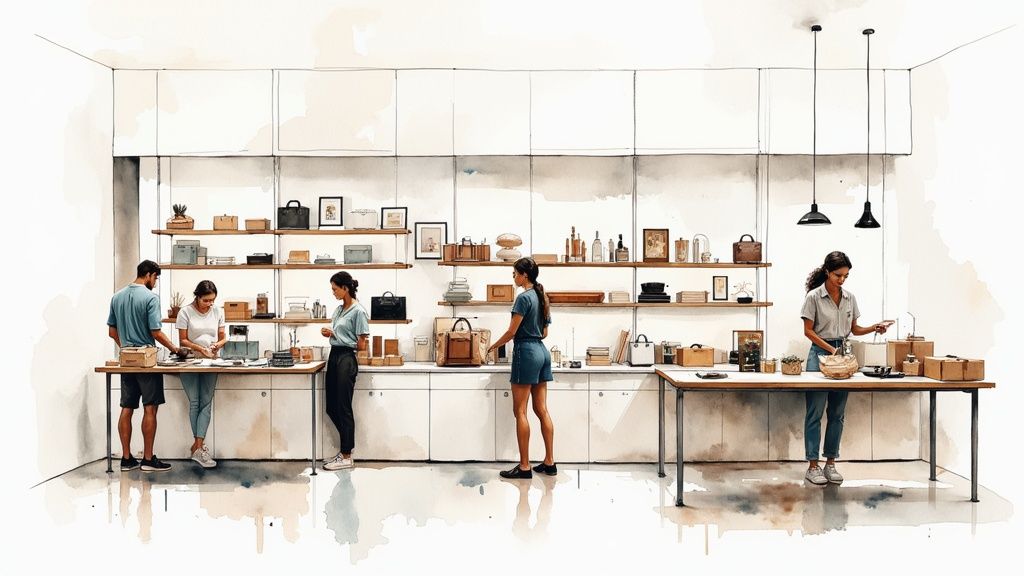
The world of retail has changed dramatically. We have evolved from a landscape dominated by physical shopping streets to a complex, integrated market where online and offline merge seamlessly. This shift offers enormous opportunities, but also raises the bar. How do you stand out in a crowded digital arena?
The secret lies in mastering the mechanisms that drive modern retail. In concrete terms, this means:
- Visibility (SEO & GEO):Ensure you are found where your customers are searching. This means ranking high in Google, both nationally (SEO) and locally (GEO targeting).
- Customer experience:Provide a smooth and enjoyable interaction at every point of contact, from the initial click to after-sales service.
- Conversion & Lead Generation:Learn how to effectively convert visitors into loyal, paying customers and valuable leads.
The Economic Power of Retail in the Netherlands
The Dutch retail sector is an economic powerhouse. With total sales of around€975 billion in 2022and approximately 300,000 companies, its impact is enormous. The sector here is more than twice as large as in neighboring Belgium, which underscores the competition and opportunities.
Although supermarkets showed sales growth of around8%in 2023, the online share is becoming increasingly dominant. At the end of 2023, almost25% of companies soldonline, a huge leap compared to ten years ago. More details about These retail statistics can be found on IBISWorld..
Understanding these dynamics is the first step toward a successful business. Those who understand the principles of modern retail lay a solid foundation for sustainable growth and a better ROI.
Which Retail Model Suits Your Business?
Now that you know the basics, let's dive deeper into thehow. The way you market your products is just as important as the products themselves. Choosing the right retail model is crucial to reaching the right people and building a sustainable business.
Think of it as choosing a vehicle for a trip. A sports car is perfect for the highway, but you need a 4x4 for the mountains. The retail world is not "one-size-fits-all." Today, companies operate using different models, each with its own advantages and challenges.
This infographic provides an overview of how global retail sales are distributed across the most important models.
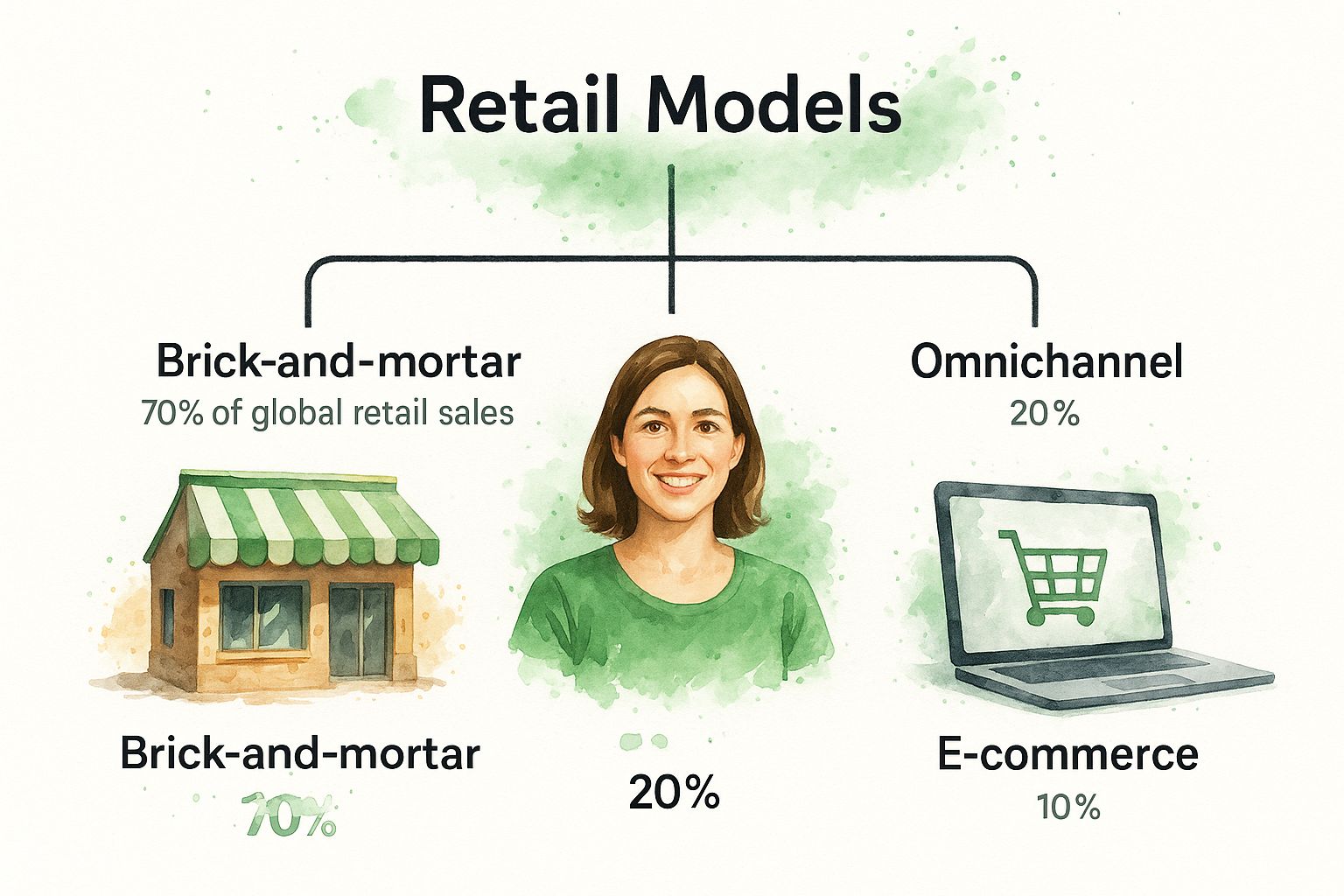
Even with the explosive growth of e-commerce, physical stores still have a huge share of the market. This shows that a smart, integrated strategy is often the key to success.
Physical Store (Brick-and-Mortar): The Traditional Powerhouse
This is the classic store on the high street. The biggest advantage of aphysical storeis the tangible experience. Customers can see, touch, and try products before they buy. The personal interaction with knowledgeable staff is invaluable for building brand loyalty.
The downside is the costs: rent, staff, and utilities. In addition, your customer base is limited to your geographic location. That is why many traditional stores are now integrating digital tools to expand their reach.
E-commerce: The Digital Storefront
E-commercesimply means selling your products online via your own website or web shop. Geographical boundaries disappear and you can reach customers across the country—or even worldwide—24/7. Overhead costs are generally much lower and you have complete control over your brand story and, crucially, your customer data.
The biggest challenge? Standing out. With millions of other online stores, it's a constant battle to attract visitors. This is where a rock-solid digital marketing strategy is absolutely essential.
D2C (Direct-to-Consumer): The Direct Connection
Direct-to-Consumer (D2C)is a form of e-commerce in which the brand sells its products directly to the customer, without intermediaries such as wholesalers. Think of brands such as Ace & Tate or Mr Marvis. This model leads tohigher profit marginsand creates a direct feedback loop with your customers, which is invaluable for building a community.
The downside is that you have to do everything yourself: marketing, shipping, customer service. It takes a serious investment to build a brand that people recognize and trust without the endorsement of major retailers.
Online Marketplaces: The Digital Shopping Center
Anonline marketplaceis a large platform such as Bol.com, Amazon, or Zalando, which houses thousands of sellers under one digital roof. The analogy of a shopping center is perfect: you rent a space in a location that already attracts a huge amount of traffic. This gives you direct access to a gigantic customer base.
The disadvantages? Competition is fierce and you have little control. You are standing alongside your rivals, have to abide by the rules of the marketplace, and pay a hefty commission on every sale. It is also difficult to build a unique brand identity.
Comparison of Modern Retail Models
This table lists the most important aspects of each model, allowing you to see at a glance which approach best suits your business goals.
| Retail model | Primary Channel | Customer relationship | Key Benefit | Biggest Challenge |
|---|---|---|---|---|
| Physical Store | Physical store | Direct, personal | Tangible product experience and personalized service | High overhead costs and limited geographic reach |
| E-commerce | Own website | Immediate, but digital | Global reach and complete control over brand/data | Generating traffic and online visibility (SEO) |
| D2C | Own website | Very direct and personal | Higher profit margins and strong community building | Management of all business functions (marketing, logistics) |
| Online Marketplace | Third-party platform | Indirectly, via platform | Direct access to a huge, existing customer base | Intense competition and lack of brand control |
The right choice depends on your product, your target audience, and your vision. Many successful brands use a hybrid approach, combining the strengths of multiple models for a seamless customer experience.
Map Out the Modern Customer Journey
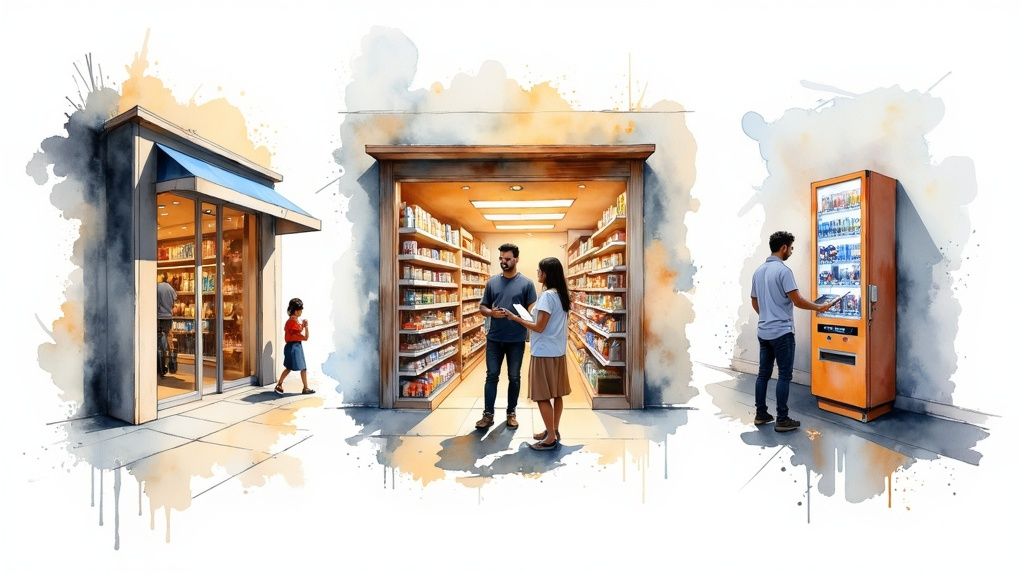
How do customers find their way to your products these days? It used to be simple: you saw an advertisement, went to the store, and bought something. That straightforward route no longer exists. The modern customer journey is a complex web of touchpoints across online and offline channels.
For example, a customer sees an advertisement on Instagram, dives into reviews on a comparison site, and checks out the product in your physical store. The purchase? They may make it days later via the webshop. If you don't understand what this journey looks like, it's impossible to solve problems such as low conversions. You need to know where and why customers drop out.
Multichannel vs. Omnichannel: The Crucial Difference
Many entrepreneurs think they are doing well because they are active on multiple channels: a web shop, an Instagram account, and a physical store. We call this amultichannelapproach. The question is, however: do those channels really work together?
Think of a multichannel strategy as separate roads leading to your business. Each road takes the customer to their destination, but the paths never cross.
Omnichannelis the next crucial step. Here, you don't build separate roads, but an integrated highway system. Customers can switch lanes effortlessly without their journey being interrupted. Everything is connected.
An omnichannel experience means that a customer reserves a product online, tries it on in the store, and completes the purchase on the spot via an app. All systems—from inventory to customer data—work together seamlessly.
The Most Important Touchpoints
To build a strong omnichannel strategy, you need to identify the most important touchpoints in the customer journey. Let's list the crucial stages:
- Awareness:The customer realizes they have a need. They come across your brand through a Google search, a social media post, or an informative blog article.
- Consideration:The customer is actively looking for solutions and comparing options. They read product reviews and compare your offer with that of your competitors.
- Purchase:The decision is made.A smooth, frictionless payment experience is essential here, whether online or in-store.
- Service:After purchase, questions arise about delivery or use. Fast and easily accessible customer service makes all the difference here.
- Loyalty:A positive experience encourages the customer to return. Personalized emails and loyalty programs turn a buyer into a loyal fan.
The key to success is carefully mapping out this journey for your customers. By diving deep intowhat makesa retail experience seamless, you build a system that not only sells, but also forges lasting customer relationships.
Digital Marketing as a Growth Engine for Your Retail Business
We have discussed retail models and the customer journey. But how do you apply that knowledge to achieve real results? Let's get practical. A strong digital presence is the engine that drives a modern retail business and solves problems such as low website traffic or unclear marketing ROI.
Many entrepreneurs we speak to struggle with this. They invest in advertising or social media, but have no idea what actually generates sales. A smart strategy turns marketing from an expense into a predictable way to grow your business.
Can't be found online? That's an SEO problem.
Is your website lost on page two or three of Google? If customers can't find you when they search for what you sell, you're practically invisible. This is exactly whereSearch Engine Optimization (SEO)becomes your best friend.
Think of SEO as the art of getting your website to the top of search results for the right keywords. It's like giving your digital store the most prominent spot on the busiest shopping street in town. A good SEO strategy ensures that when someone searches for a solution to their problem, your company is the first and best answer. This attractshigh-intent traffic: people who are already planning to buy.
Turn Visitors into Leads with Valuable Content
Getting traffic to your site is step one. The real challenge is converting those visitors into leads and customers. Strategic content marketing makes all the difference here. By creating useful blogs, guides, or videos, you solve your audience's problems and win their trust.
Effective content doesn't push sales; it solves a problem. When you position your brand as a helpful expert, you build a relationship long before a customer pulls out their wallet.
This approach allows you to capture their attention and gently guide them through the purchasing process. For example, a detailed guide on choosing the right product in your industry can generate valuable leads and strengthen your reputation as an expert.
Find Your Ideal Customers with AI and Social Media
How do you ensure that your message doesn't disappear into thin air? Modern tools such asAI and social media advertisingenable impressively precise targeting. You can stop casting a wide, expensive net and focus on specific groups based on demographics, interests, or even purchasing behavior.
Here's how it works:
- AI-driven Personalization:AI analyzes customer data and predicts what they want next. This means you can show them relevant product suggestions or personalized offers.
- Targeted Social Ads:Platforms such as Facebook and LinkedIn show your ads to the people who are most likely to be interested, making every marketing dollar work harder.
This laser-focused approach not only generates higher-quality traffic, but also gives your conversion rates a serious boost. You get a clear, measurable return on investment.
Key Trends Shaping the Future of Dutch Retail Forms
Knowing where retail stands today is one thing, but understanding where it is headed gives you a head start. The Dutch retail sector is constantly influenced by new technology and changing customer expectations. To build a future-proof business, you need to anticipate these changes.
Ignoring these trends is not an option; you risk falling behind while your competitors race ahead. Let's take a closer look at the three biggest shifts in Dutch retail.
Sustainability as a Decisive Factor
Today's consumers are smart and conscious. They don't just want a great product; they also want to feel good about it.Sustainability is no longer a niche preference, but a core value that directly influences purchasing decisions. This is particularly evident in food retail, a huge part of the Dutch economy.
The Dutch food retail market, valued at approximately$58 billionin 2024, is seeing huge demand for products that are sustainable, healthy, and reasonably priced. This indicates a major shift in what consumers consider important. More insights into the Dutch food retail market can be found at the USDA..
AI-driven Personalization at Scale
How do you make every customer feel like they are the most important one? The answer isArtificial Intelligence (AI). AI gives companies the power to analyze vast amounts of customer data and create unique shopping experiences.
This goes beyond a first name in an email. AI is pushing for:
- Smarter product recommendations:Suggest items based on previous viewing and purchasing behavior.
- Dynamic pricing:Adjust prices based on demand or customer behavior.
- Personalized marketing:Show different banners or advertisements to different visitor groups.
AI helps you build a stronger connection with your audience, which has been proven to lead to higher conversions and customer loyalty. It transforms a standard online store into a dynamic, personalized shopping assistant.
The Rise of Quick Commerce and Convenience
In today's market, speed is everything. Services such as Gorillas and Flink have completely changed delivery times and set a new standard:quick commerce(q-commerce). Customers now expect faster, more flexible delivery for almost everything.
Although q-commerce is still a small part of the market, its influence is growing rapidly. This trend is forcing every retailer to take a critical look at their logistics. If your delivery is slow, you are likely to lose customers to someone who can do it faster. Efficient delivery options are no longer negotiable. Our expertise in the developing a high-performance online store includes optimizing these vital checkout and fulfillment steps.
Ready for the Next Step in Retail?
We have taken a deep dive into the world of retail: from the basic definition to digital strategies. Understanding all of this is a huge advantage. The retail world never stands still, but every challenge is an opportunity for those who are well prepared.
Remember this:success is no longer just aboutwhatyou sell, but above allhowyou sell it.A seamless experience, supported by a smart digital approach, distinguishes thriving companies from those lagging behind.
From Knowledge to Action: Take the Next Step
Mastering retail is an ongoing process. The next step is to apply these insights to your unique challenges.
- Analyze your own retail model:Are you leveraging all your strengths and working on your weaknesses?
- Map out your customer journey:Where are the bottlenecks that cause potential customers to drop out?
- Evaluate your online presence:Are you truly visible in the places where your customers are searching (SEO)?
By answering these questions honestly, you will automatically see where the opportunities for growth lie. And you don't have to walk that path alone. At Digitalique, we specialize in turning these kinds of retail challenges into measurable growth and a higher ROI.
Ready to turn your retail strategy into concrete results? Let's talk about your goals.
Schedule a free strategy session with us
Your Most Important Retail Questions Answered
Even with a solid understanding of the basics, practical questions often remain. Let's address some of the most common questions we hear from entrepreneurs.
What is the most important aspect of retail today?
If you have to choose one thing, it's thecustomer experience. In a world full of similar products, the way you make a customer feel is what really sets you apart.
The entire journey, from the first point of contact to the post-purchase follow-up, is your opportunity to shine. A smooth, personalized, and helpful experience builds loyalty in a way that competing on price never will. This is the core of what defines a successful retail strategy.
Can a small business really compete with the giants?
Yes, absolutely. Small businesses have a secret weapon:you are agile and can build genuine, human connections. You will never surpass a giant like Bol.com in advertising budget, but you can win hearts with personality, niche expertise, and unforgettable service.
Here's how to do it:
- Dominate your niche:Don't try to be everything to everyone. Focus on a specific target group and become the expert they trust.
- Be human:Offer a level of personal care that a large, faceless company cannot scale.
- Build a community:Use your story and values to build a tribe of loyal fans, not just customers.
- Control local search results:If you have a physical store, dominating local search results in Google is a powerful way to attract customers.
How much should I spend on digital marketing?
There is no magic formula. The right budget depends on your industry, your goals, and the current stage of your business. Stop viewing marketing as an expense and start treating it as aninvestment in your growth.
So don't ask "how much," but "what do I want to achieve?" Do you want to increase your website traffic by20%? Or generate50qualified leads per month?
When you set clear, measurable goals, you can build a budget that directly contributes to those results. That way, you can be sure that every dollar is working hard for a real return on investment.
We address even more common entrepreneurial questions in our own frequently asked questions section, so feel free to take a look.
AtDigitalique, we help companies navigate these challenges every day. Let's map out your path to retail success together
