Is your company struggling to stand out online? You are not alone. In short, Search Engine Marketing (SEM) revolves around using paid advertisements to secure a top position at the top of search results, like Google's. It is a powerful way to drive direct and highly targeted traffic to your website and generate leads immediately.
What is SEM and Why is it Important for Your Business?
Have you ever wondered how some companies appear directly at the top of Google as soon as you search for something? That is SEM in action.
Think of it as renting prime real estate on the busiest digital highway in the world. Instead of spending months working your way to the top organically, you can pay to be there at the exact moment a potential customer is looking for what you sell.
This gives you immediate visibility, which is a game-changer for businesses that need to attract customers now. While Search Engine Optimization (SEO) is a long-term strategy for earning organic traffic, SEM delivers immediate results.
The Billboard Analogy Explained
To really understand the difference, let's sketch a picture.
See SEM as renting a billboard along a busy highway. You pay for the space and thousands of drivers (your potential customers) see your ad immediately. As soon as you stop paying, the billboard is taken down. It is fast, effective, and perfect for highlighting specific campaigns or promotions.
On the other hand, SEO is like building a flagship store in a bustling city center. It takes time, a solid plan, and a lot of effort (good content, a technically sound website) to build. But once built, it becomes a valuable asset that consistently attracts customers without you having to pay for every visitor. The best digital marketing plans use both.
Why Your Business Needs a Smart SEM Strategy
A well-planned SEM strategy is much more than just throwing money at ads; it is about catalyzing strategic growth. It directly tackles common business problems like low website traffic and low-quality leads. By focusing on specific keywords, you bring your message before the eyes of people who are actively looking for your solutions.
The key benefits are compelling:
- Direct Traffic: Drive potential customers to your site as soon as your campaign is live. No waiting time.
- Precise Targeting: You can target users based on their location, demographics, interests, and search behavior. You can even use geo-targeting to attract local customers.
- Measurable ROI: Every click, every conversion, and every euro spent is tracked. This gives you a crystal-clear picture of what works and what your return on investment looks like.
- Increased Brand Awareness: Even if people don't click, seeing your brand at the top of search results builds awareness and trust.
Ultimately, SEM puts you in the driver's seat. You decide the budget, you choose the audience, and you measure the results. This makes it an essential tool for any business that wants measurable growth, better leads, and a clear insight into marketing performance.
The Two Pillars of a Powerful SEM Strategy
A winning SEM strategy isn't about choosing between Search Engine Optimization (SEO) and Pay-Per-Click (PPC), but about letting them work together. See them as two different engines powering the same vehicle. SEO gives you steady, long-term momentum, while PPC provides speed exactly when you need it.
To get the most out of your marketing budget, you must understand the unique role of each pillar. By combining both, you cater to immediate demand with paid ads, while simultaneously building a sustainable, reliable organic presence for the long term. This dual approach ensures you are visible in every phase of the customer journey.
Pillar 1: Search Engine Optimization (SEO)
Search Engine Optimization, or SEO, revolves around organically earning your spot at the top of search results. You don't pay for clicks here. Instead, you prove to search engines like Google that your website is the most credible, relevant, and helpful answer to a user's question.
How do you do that? It comes down to a few key things:
- Creating High-Quality Content: This means publishing blog posts, guides, and pages that genuinely help your target audience. You strive to be a reliable source, not just a seller.
- Building Authority: Getting quality links from other reputable websites is like a vote of confidence. It tells search engines that your site is an authority in its field.
- Ensuring Technical Perfection: Your website must be fast, mobile-friendly, and easy for search engines to crawl and understand. This is the solid foundation on which your online presence is built.
SEO is a marathon, not a sprint. It takes time and consistent effort, but the reward is a resilient online presence that generates high-quality traffic without you having to pay for every visitor.
Pillar 2: Pay-Per-Click Advertising (PPC)
The second pillar, Pay-Per-Click (PPC) advertising, offers the speed and precision that SEO cannot match in the short term. This is the paid side of SEM, where you bid to place your ads for specific keywords on platforms like Google Ads and Microsoft Advertising.
As the name suggests, you pay a small amount each time someone clicks on your ad. PPC is incredibly powerful for targeting customers with high purchase intent — in other words, people who are ready to buy now.
The key components of PPC are:
- Smart Bidding on Keywords: You identify the keywords your ideal customers use and place bids to appear in the ad auction.
- Persuasive Ad Copy: It revolves around writing short, compelling ads that directly address the user's need and persuade them to click.
- Optimized Landing Pages: You send users to a dedicated page on your site designed to make it as easy as possible for them to convert, whether that is a purchase or filling out a form.
PPC gives you immediate data and results, allowing you to quickly test offers, adjust your message, and discover what resonates with your audience. For a deeper dive into the world of paid advertising, you can check our expertise in SEA (Search Engine Advertising) .
The image below shows how a typical paid campaign is structured, with ad groups and keywords neatly organized under one central campaign goal.
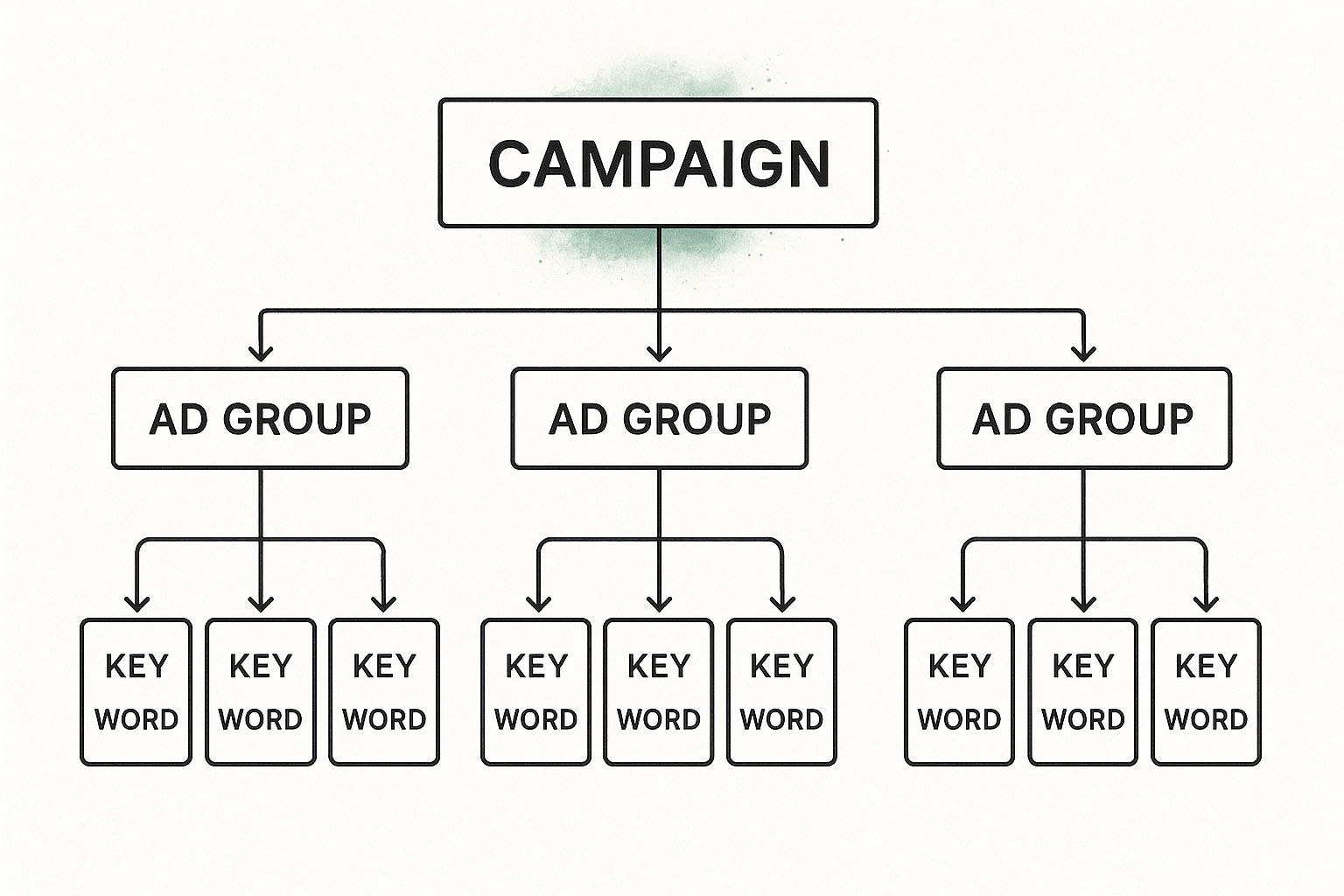
This structure is crucial. By creating tightly themed ad groups, you ensure that your ads and keywords are highly relevant to each other, which ultimately increases your performance and return on investment.
SEO vs PPC: A Quick Comparison
While SEO and PPC are both intended to make you visible to searchers, they tackle this in very different ways. Understanding their core differences helps you decide how to balance them in your strategy.
| Feature | SEO (Search Engine Optimization) | PPC (Pay-Per-Click) |
| Cost | No direct cost per click, but requires investment in content, tools, and expertise. | You pay an amount every time a user clicks on your ad. |
| Speed to Result | Can take months before seeing significant results; it is a long-term strategy. | Results are almost immediate; traffic can start flowing as soon as the campaign is live. |
| Traffic Sustainability | Once you rank, traffic is relatively consistent and doesn't stop if you stop spending. | Traffic stops the moment you stop your ad spend. |
| Targeting Precision | Focuses on users based on queries, but with less control over exact demographics. | Highly precise targeting based on keywords, demographics, location, time, and more. |
| Placement in SERP | Appears in organic search results, below paid ads. | Appears right at the top (or bottom) of the search results page, marked as "Ad". |
| Best Suited For | Building long-term brand authority, credibility, and a sustainable source of organic traffic. | Direct sales, lead generation, promoting special offers, and A/B testing. |
Ultimately, it is not a question of choosing one or the other. The most powerful SEM strategies use SEO and PPC together. PPC can provide quick wins and valuable keyword data that inform your SEO efforts, while a strong SEO foundation reduces your reliance on paid ads in the long term. It is a true partnership.
How to Build Your First SEM Campaign
Ready to start? Setting up your first SEM campaign can feel like a huge task, but breaking it down into a structured process makes it a clear path to making your brand visible to the right people. It is all about being strategic from the start so that every euro you spend works hard for your business.
Think of it as planning a road trip. You wouldn't just hit the road without a destination; you choose where you are going (your goals), plot the best route (your keywords), and calculate your fuel costs (your ad budget). Let's walk through that journey together.
Start with Smart Keyword Research
Keyword research is the absolute foundation of any good SEM campaign. You need to get inside your customers' heads and uncover the exact words and phrases they type into Google when they need what you offer. It is about understanding their search intent.
Keywords come in different flavors, each with its own function:
- Informational Keywords: Think of phrases like "how to fix a leaking tap". These people are looking for information and are at the start of their journey.
- Navigational Keywords: This is when someone searches for example "Digitalique login". They already know your brand and just want to go to your website.
- Transactional Keywords: These are terms like "buy running shoes online" or "emergency plumber near me". These are your money keywords — they indicate a clear intent to buy something.
Don't forget to research negative keywords too. These are the terms you want to exclude from your campaigns to avoid wasting money on irrelevant clicks. For example, if you sell premium running shoes, you might add "cheap" or "free" as negative keywords.
Set Clear Goals and a Realistic Budget
What are you actually trying to achieve here? Without clear goals, you are just throwing money into the wind. Your objective determines every other decision you make, from the keywords you target to the ad copy you write.
A common mistake is chasing clicks. A truly successful campaign is measured by conversions — valuable actions like a sale, a filled-out contact form, or a phone call.
Set a few specific goals for your first SEM campaign:
- Generate Leads: Aim for a specific number of potential customers filling out a contact form.
- Drive Sales: Track direct purchases via your ads and keep a close eye on your Return On Ad Spend (ROAS).
- Increase Brand Awareness: Measure impressions and click-through rates (CTR) to see how many people see your brand and interact with it.
Once your goals are set, you can determine a budget. It is always wise to start small, test the waters, and let the data guide you. Your budget isn't just a total amount; you also need to think about your Cost Per Acquisition (CPA) — how much are you willing to pay to get one new customer? This helps you determine if your campaign is actually profitable. Platforms like Google Ads have tools to help manage your daily spend so you never accidentally exceed your budget.
Write Persuasive Ad Copy
See your ad copy as your digital shop window. You only have a few seconds to grab someone's attention and persuade them to click. Good ad copy is clear, compelling, and directly addresses the searcher's problem.
A solid ad usually contains:
- A Strong Headline: Your primary keyword should appear here to show immediate relevance.
- A Clear Value Proposition: What makes you the better choice? Free shipping? 24/7 service? A unique guarantee?
- A Compelling Call to Action (CTA): Tell people exactly what to do next. Use powerful, active phrases like "Shop now", "Request your free quote", or "Discover more".
Don't be afraid to test different versions of your ads. We call this A/B testing. You can try two different headlines or tweak the CTA to see which performs better. Constantly testing and tweaking is the secret to improving your campaign over time.
Design Landing Pages that Convert
The user's journey doesn't stop at the click — it has just begun. A landing page is a dedicated page on your site where visitors "land" after clicking your ad. Its only job is to get that person to convert.
An effective landing page must have:
- A Clear and Consistent Message: The headline and content on your landing page must perfectly match the promise you made in your ad.
- A Simple and Focused Design: Remove all distractions. That means no navigation menus, no unrelated links — just a laser focus on the one action you want the user to take.
- A Prominent Call to Action: Your CTA button should be large, noticeable, and impossible to miss.
Sending traffic from a super-specific ad to your general homepage is one of the most common and costly mistakes you can make. A dedicated landing page will drastically increase your chances of turning that click into a customer. By following these steps, you aren't just spending money on ads; you are making a strategic investment in the future of your business.
Using AI and Automation to Improve Your SEM
Not so long ago, managing an SEM campaign was a chore. It meant long hours staring at spreadsheets, manually adjusting bids, and trying to make sense of endless data. Today, the world looks very different. Artificial Intelligence (AI) and automation have arrived on the scene, acting as a powerful co-pilot for your marketing efforts.
These technologies take over the heavy lifting — the complex, repetitive tasks that used to eat up all your time. Instead of you manually adjusting bids for hundreds of keywords, AI can do this in real-time based on thousands of different signals. This isn't about replacing the human touch; it's about amplifying it. By letting machines crunch the numbers, you get the freedom to focus on the big picture: strategy, creativity, and growth.
How AI Powers Smarter Campaigns
AI in SEM is much more than just a buzzword. It is a practical tool that adds predictive power to your campaigns. It works by sifting through massive amounts of data to spot trends and make predictions that would be completely invisible to the human eye. This allows you to move from a reactive to a proactive approach with your optimizations.
Here is where AI makes a real difference:
- Predictive Keyword Analysis: AI tools can look into the future and predict the performance of specific keywords. This helps you capitalize on emerging trends early and focus your budget on terms most likely to convert, keeping you a step ahead of the competition.
- Audience Segmentation: Forget broad targeting. AI can analyze user behavior to create incredibly specific audience segments. This means you can serve personalized ad messages to different groups, making your ads much more relevant and engaging.
- Ad Creative Optimization: Some platforms use AI to instantly test countless combinations of headlines, descriptions, and images. The system automatically determines which mix works best and shows that version more often. Google's Responsive Search Ads are a perfect example of this.
The Magic of Automated Bidding
One of the most powerful applications of automation in SEM is automated bidding. Platforms like Google Ads offer "Smart Bidding" strategies that use machine learning to optimize your bids for specific goals in every auction. It is like having an expert analyst working on your account 24/7.
Smart Bidding takes the guesswork out of determining the right price for a click. It analyzes contextual signals — like the device, location, time of day, and browsing history of the user — to determine the perfect bid in real-time.
This is a huge leap forward from the old way of working. Instead of setting one static bid for a keyword, the system adjusts it for every individual user. This significantly improves your chances of hitting your target CPA (Cost Per Acquisition) or ROAS (Return On Ad Spend).
Key Benefits of an AI-Driven Approach
Integrating AI and automation into your SEM workflow doesn't just save time. It is about achieving better results and making your marketing budget work harder.
The key benefits are clear:
- Increased Efficiency: Automation handles the boring tasks like bid adjustments and performance reporting. This gives your team space to focus on high-level strategic and creative thinking.
- Deeper Data Insights: AI is brilliant at finding hidden patterns and correlations in your campaign data. This gives you a much richer understanding of customer behavior, leading to smarter, better-informed decisions.
- Improved ROI: By optimizing bids in real-time and targeting the most valuable users, AI-driven campaigns consistently achieve higher conversion rates and a better return on your investment.
- Staying Ahead of Trends: The market is always moving. AI helps you adapt quickly by signaling shifts in search behavior and automatically adjusting your campaigns so you are never left behind.
When you embrace these tools, you transform your SEM from a static set of rules into a dynamic, learning system that gets better over time. This is not the future of search engine marketing — it is the present.
Measuring SEM Performance with the Right Metrics

Pouring money into a campaign without keeping score is like driving with your eyes closed. How can you know if your investment is actually paying off? The trick is to look past the superficial "vanity metrics" and focus on the Key Performance Indicators (KPIs) that have a real impact on your bottom line.
A smart SEM strategy is built on a foundation of solid data. Once you master a few essential statistics, you can clearly see what works, what is a waste of money, and where your best growth opportunities lie. This gives you the power to make sharp, data-driven decisions that turn your ad spend into tangible results.
Core Metrics for Every SEM Campaign
While you can get lost in dozens of data points, a handful are absolutely indispensable for understanding the health of your campaigns. They tell a clear story about how people interact with your ads and what they do next.
Let's list the must-haves:
- Click-Through Rate (CTR): This is simply the percentage of people who click on your ad after seeing it. A high CTR is a fantastic sign that your ad copy and keywords resonate with your audience.
- Conversion Rate: This is where the magic happens. It is the percentage of users who take the desired action — like buying a product or filling out a form — after clicking your ad. This is the ultimate measure of success.
- Cost Per Acquisition (CPA): This statistic gets straight to the point and tells you exactly how much you spend on average to win a new customer. A low CPA means you are running an efficient, profitable campaign.
- Return On Ad Spend (ROAS): This is the most important one. ROAS measures the total revenue you generate for every euro you put into ads. A ROAS of 4:1, for example, means you earn €4 for every €1 you spend. It's that simple.
Tracking and Analyzing Your Performance
Knowing what to measure is only half the job; you also need the right setup to track everything accurately. Here, platforms like Google Ads and Google Analytics become indispensable. Their dashboards bring all these numbers to life and give you a clear picture of what is going on.
Tracking performance isn't just about staring at numbers; it's about asking "why?". Why does the CTR of one ad perform much better than the other? Why did conversions suddenly drop last week? The real optimizations begin when you find the answers to those questions.
Setting up conversion tracking is the first crucial step. This involves adding a small piece of code to your website that signals your ad platform when a user completes an important action, like checking out or submitting a lead form. Without this, you are essentially flying blind and cannot calculate crucial metrics like CPA or ROAS.
Making Data-Driven Decisions
Once you have a steady stream of reliable data, you can start making smart moves. Is your CTR low? Then it might be time to test new ad copy. If your conversion rate is lagging, your landing page might need a refresh. For a deeper look at using this powerful tool, check out our guide on mastering Google Analytics.
The goal is to create a continuous feedback loop:
- Launch your campaigns.
- Measure performance with your core KPIs.
- Analyze the data to see what works and what doesn't.
- Optimize your ads, keywords, and landing pages based on what you have learned.
- Repeat the cycle.
This iterative process ensures that your SEM efforts don't just run, but get smarter and more profitable over time. By focusing on the metrics that really matter, you can transform your ads from a simple expense into a powerful engine for your company's growth.
Driving Local Traffic with Geo-Targeted SEM
For any business with a physical store or a defined service area, winning the local market is crucial. While large SEM campaigns cast a wide net, geo-targeted SEM is your secret weapon. It works like a magnet attracting customers nearby who are looking for exactly what you offer, at this exact moment. It turns your digital ads from a shout in a crowd to a personal invitation for people around the corner.
This hyper-local approach works so well because it aligns with high-intent search queries like "best coffee shop near me" or "emergency plumber in Amsterdam". By deploying your budget in a specific geographic area, you stop wasting money on irrelevant clicks and start talking directly to the people most likely to walk into your store.
Optimize Your Google Business Profile
Your Google Business Profile (GBP) is the absolute foundation of any local SEM strategy. Think of it as your digital storefront on Google Search and Maps. It is often the very first thing a local customer sees of your brand, so you need to make sure it counts.
A fully completed profile is essentially a powerful, free advertisement. Ensure every part is complete and accurate:
- Business Name, Address, and Phone Number (NAP): These details must be 100% consistent everywhere online. No exceptions.
- Service Areas: Clearly indicate the neighborhoods, cities, or postal codes you serve.
- Opening Hours: Keep them up-to-date, especially during holidays. Nobody likes standing in front of a closed door.
- Photos and Videos: Show your space, products, and team. This builds trust and gives people a real feel for your business before they even visit.
- Customer Reviews: Actively ask for reviews and respond to them. Good feedback is a huge ranking factor and a major trust signal for new customers.
Run Geo-Targeted Ad Campaigns
Once your GBP looks tip-top, it is time to expand your reach with paid campaigns made specifically for a local audience. Here you can be incredibly precise with your targeting, so your ads are only seen by people in locations that really matter to your business.
For example, a marketing agency in Amsterdam can set its ads to only show to businesses within a certain radius of the city. This local focus is crucial in densely populated economic hubs. For a deeper dive into regional economic data, you can explore insights on the SEMCOG blog.
Use Location-Based Keywords and Ad Extensions
To truly dominate local search, your keywords must reflect how people actually search for local businesses. Instead of just "web design agency", target phrases like "web design agency in Amsterdam" or "e-commerce developer Utrecht". These long-tail keywords are often less competitive and attract much more qualified traffic.
Next, you can give your ads an extra boost with location extensions. This brilliant feature adds your address, a map, or the distance to your business directly to your ad. For someone on their phone, this makes getting directions and dropping by incredibly easy. You can learn more about how to boost local sales with smart geo-targeting in our detailed guide.
By combining an optimized GBP with geo-targeted ads and location-specific keywords, you create a powerful local SEM engine. This strategy not only increases website traffic; it drives real store visits and turns local online searches into loyal, paying customers.
Your SEM Questions Answered
When businesses take their first steps into SEM, the same questions often come up. It is a world with many moving parts, so let's clear the air and tackle some of the most common questions directly.
How much should I budget for SEM?
This is the classic "how long is a piece of string?" question. The beauty of SEM is that it is fully scalable. You are in the driver's seat, whether you want to start with €10 a day or €1,000.
A better way to ask the question is: "How much is a new customer worth to my business?" Once you have determined your target CPA (Cost Per Acquisition), you can calculate backwards and set a budget that aligns with your growth ambitions.
Our advice? Start with a modest test budget. This allows you to gather real data, see what actually works, and then confidently invest more money in the parts of your campaign yielding the best return.
How quickly will I see results?
SEM is interesting because it delivers results at two different speeds, matching its two main components.
- PPC (Pay-Per-Click): The impact here is almost immediate. Once your ads get the green light, you can see traffic and leads coming in within hours. It is perfect for direct traction.
- SEO (Search Engine Optimization): This is more of a marathon than a sprint. Building your organic authority and climbing the search results requires patience — usually three to six months before seeing significant, lasting traffic.
A smart strategy uses PPC for those quick wins while building a strong SEO foundation for sustainable growth in the long term.
Should we manage SEM in-house or hire an agency?
Managing SEM yourself gives you total control, but it is a huge commitment. It requires a lot of time, deep expertise, and a dedicated team to keep up with constant platform changes.
Engaging an agency like us takes that burden off your shoulders. We are equipped with specialized tools, certified experts, and cross-industry experience to ensure your campaigns run at full speed from day one. It gives you the freedom to do what you are good at: running your business, knowing your digital marketing is in good hands.
Ready to turn search queries into real business growth? At Digitalique.nl, we build SEM strategies that deliver results you can actually measure.
Start your journey to the top of Google today.