Are you wondering, "What does it reallycost to have a webshop built?" You want a concrete answer, not a vague estimate. Let's dive right in: the cost of a professional webshop varies from€2,000 for a basic setup to more than €25,000for a complex, tailor-made e-commerce machine.
Where your project falls on this spectrum depends entirely on what you need to grow your business. In this guide, we explain where your money goes, so you can make a smart investment that increases your online visibility and conversions.
Your Financial Starting Point
Think of it as building a physical store. You can start with a simple pop-up, move on to a standard retail space, or go all out for a prime location. Each choice serves a different purpose and comes with a different price tag. By understanding the different levels, you can set realistic expectations and align your budget with your ambitions.
Costs Broken Down by Level
To understand the figures, it is useful to divide webshops into a few levels. A simple webshop in the Netherlands starts at around €2,000. However, most small to medium-sized companies end up paying between€8,000 and €20,000for a solid, functional webshop.
For entrepreneurs with bigger plans—think unique designs and advanced features—the investment can easily exceed€25,000. The final price reflects the amount of work involved. Want to dig deeper? You can Discover more insights about web development costs in the Netherlands.
Why such a huge variation? Because a "webshop" is not a standard product; it is a project with many factors that influence the costs:
- The Platform:A template-based system such as Shopify is very different from a custom solution on an open-source platform such as Magento.
- Design Complexity:Do you want a sleek, effective design based on a proven template, or a completely unique brand experience built from scratch? The latter will cost more.
- Customized Functionalities:Do you require special payment methods, advanced product filters, or complex links to your inventory system? Each additional feature increases development time and therefore costs.
- The Team:The experience, size, and reputation of the agency or freelancer you hire will naturally be reflected in their quote.
To give you a clearer picture, we have created a quick overview of what you can expect at different investment levels.
Estimated Investment Levels for Webshops
This table provides a quick comparison of different types of online stores and their typical start-up investments in the Netherlands. Use this as a guideline to determine where your project might fit.
| Webshop Level | Typical Price Range (EUR) | Best Choice For |
|---|---|---|
| Starter / DIY Webshop | $500 - $3,000 | Independent entrepreneurs, hobbyists, or companies testing a product idea with a very limited budget. |
| Professional SME Webshop | $5,000 - $15,000 | Small to medium-sized businesses that need a reliable, well-designed store with standard e-commerce features. |
| Customized High-End Webshop | $20,000 - $50,000+ | Established companies with specific integration needs, high visitor numbers, and a focus on a unique user experience. |
This table will help you shape your budget and discussions with potential developers. Keep in mind that these are starting points; the final costs will always depend on the specific details of your project.
The Core of You Understanding the Development Budget
Let's talk about the biggest expense on your invoice: development. This is the engine of your online store, where the code is written to bring your vision to life. It's almost always the largest part of your investment, and with good reason. But what exactly are you paying for?
First, it is important to understand the two ways in which agencies and developers price their work. Each model has advantages and disadvantages, and the right choice depends on how clear your project plan is and how much flexibility you need.
Fixed Price vs. Hourly Rate
The choice between a fixed price and an hourly rate is one of the first important decisions. It has a huge impact on your budget and project management.
- Fixed-Price Projects:With this model, you agree on a single total price for a very clearly defined project. The big advantage isbudget certainty—youknow exactly what you're paying. The disadvantage? It's rigid. If you want to add a new feature halfway through, you'll probably need a new quote and a contract update.
- Hourly rate (post-calculation):Here, you pay for the actual time the team spends on your online store. This gives youmaximum flexibilityto adjust features or change direction. The pitfall is that the final invoice can be unpredictable if you don't keep a close eye on the scope.
Which one is right for you? A fixed price is perfect if you have a rock-solid, detailed plan. An hourly rate is better for complex projects where you expect requirements to evolve.
Complexity: The Real Cost Driver
What ultimately determines the number of hours or the amount of that fixed price? In a word: complexity. The finalcost of creating a webshopis directly linked to the features you want. A simple webshop with a few products is very different from a huge platform with thousands of items, multiple integrations, and custom logic.
Consider how these common features increase complexity, driving up development time and costs:
- Connections with Payment Providers:Standard payment options such as iDEAL or Stripe Integration is usually straightforward. But what if you need to connect to a specialized or less common international payment system? That requires customization and takes time.
- Advanced Search & Filtering:Allowing customers to filter by size, color, brand, and price seems simple. Behind the scenes, the logic required to make this work seamlessly with a large inventory can become very complex.
- Personalized Customer Accounts:Features such as order history, saved addresses, wish lists, and loyalty programs provide a fantastic user experience. They also require robust and secure database work to manage all that customer data.
- Connections with External Systems:Do you want your webshop to communicate with your accounting software (such as Exact Software), your inventory system, or your CRM? These integrations are crucial for efficient business operations, but each connection increases the scope of development.
Important Insight:Every feature on your "must-have" list translates directly into development hours. It's wise to separate your "essential features for launch" from the "nice to have later" features. This allows you to effectively manage your start-up budget.
The good news? If you have your online store built in the Netherlands, you will receive excellent value for your money. Hourly rates for skilled developers typically range from€40 to €100. This is considerably more affordable than in many other Western countries, allowing you to have more work done without compromising on quality. You can explore this further by reading the comprehensive study of development costs in Europe and the US read. With this information, you can have a much more productive discussion with any potential development partner.
Choosing the Foundation of Your Online Store: The E-commerce Platform
Choosing your e-commerce platform is like choosing the engine for your online store. This one decision affects everything, especiallythe totalcost of setting up yourwebshop.
Compare it to setting up a physical store. You can rent a stall at a busy market (Shopify), lease a ready-to-use retail space (BigCommerce), or pull out all the stops and build your own flagship store (think of Magento).
Every road has its own price tag, both upfront and for daily operation. This is not just a technical choice; it is a core decision that determines your budget, flexibility, and growth opportunities.
SaaS vs. Open-Source Platforms
Your first major choice is between "Software as a Service" (SaaS) and an open-source platform. These are two completely different philosophies for building and managing a web store.
- SaaS Platforms (The "Rental Model"):These are all-in-one solutions such as Shopify or BigCommerce. You pay a monthly fee and get the software, hosting, security, and support in one package. It's user-friendly and predictable, perfect for businesses that want to get online quickly without a team of developers. The downside? Customization can be limited, and you often pay transaction fees on top of your subscription.
- Open-Source Platforms (The "Proprietary Model"):Here we are talking about heavyweights such as Magento (now Adobe Commerce) and WooCommerce for WordPress. The software itself is free to download, but you are responsible for everything else: hosting, security, maintenance, and every line of custom code. This gives youunlimited freedomto build something unique, but the initial build and ongoing maintenance costs are significantly higher.
This image shows how those costs typically compare for basic configurations versus customization, plus the essential ongoing costs that you cannot ignore.
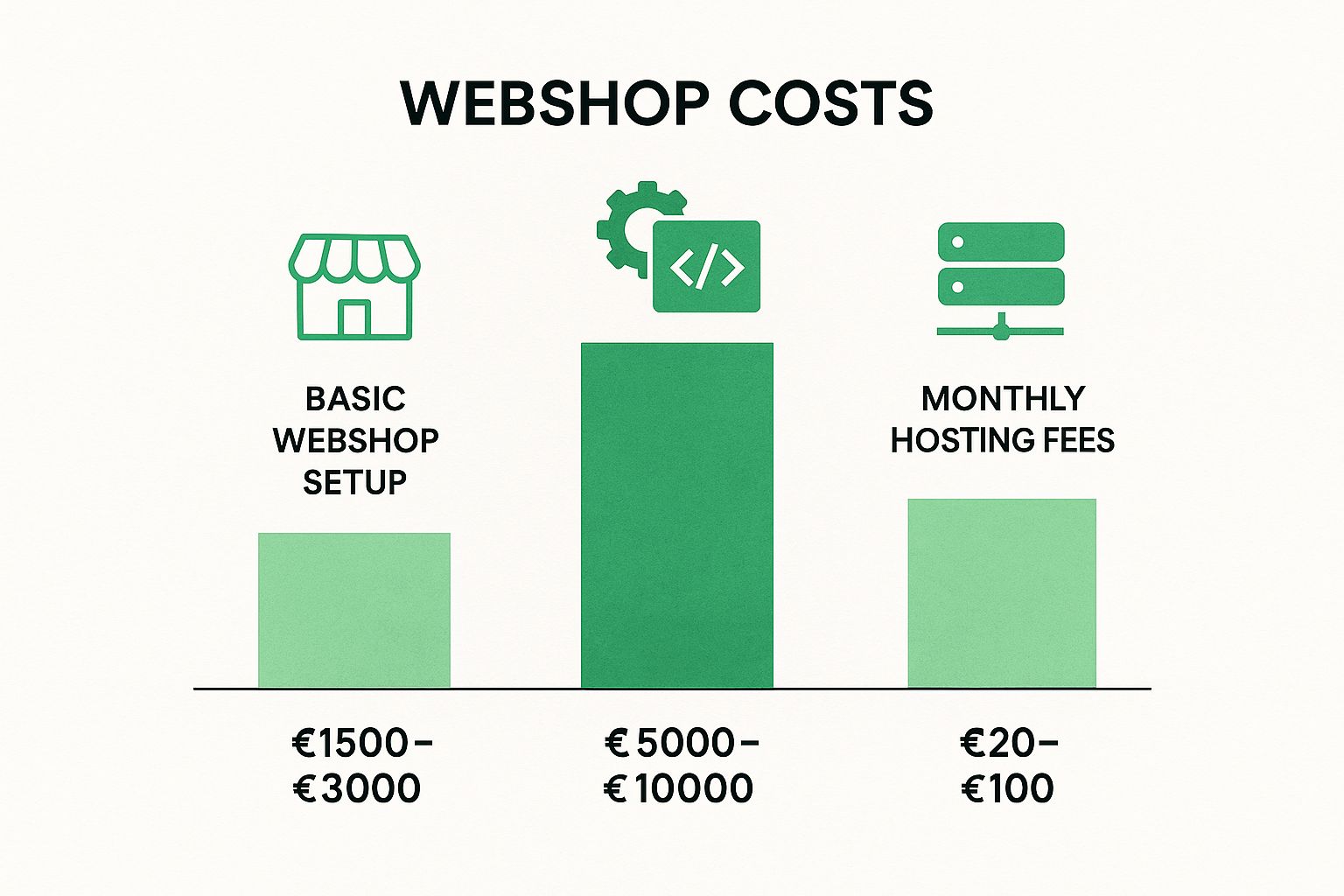
As you can see, a custom-built webshop requires a much larger initial investment, but even the simplest setups have recurring costs that you need to include in your financial planning.
To give you a clearer picture, here is an analysis of the typical costs associated with popular e-commerce platforms. This should help you decide which foundation is right for your budget and needs.
Cost comparison: SaaS vs. Open Source
| Platform Type | Examples | Start-up costs | Ongoing Costs | Best Choice For |
|---|---|---|---|---|
| SaaS | Shopify, BigCommerce | Low (€500 - €5,000for setup) | Monthly subscription (€30 - €300+), transaction fees, app fees | Startups, SMEs, and companies that want a fast, low-maintenance launch. |
| Open-Source | Magento, WooCommerce | High (€10,000 - €50,000+for development) | Hosting, security, maintenance contracts, developer costs | Established companies with unique needs, high sales volume, and long-term growth plans. |
Ultimately, the right choice depends on your specific situation and what you are willing to invest, both now and in the future.
Comparing Financial Obligations
Choosing the right platform is a balance between your immediate budget and your long-term vision. A SaaS solution may seem cheaper on day one due to low start-up costs, but the monthly subscription and transaction fees can add up significantly over time. An open-source web store, on the other hand, requires a substantial upfront investment, but can be more cost-effective for high-volume stores because you don't pay a percentage of each sale to the platform.
Key Insight:Don't just look at the initial construction costs. Calculate theTotal Cost of Ownership(TCO), including subscription fees, transaction costs, essential plug-ins, and maintenance over the coming years.
We know there's a lot to consider. If you're still trying to weigh up the pros and cons, our in-depth explanation of the difference between a custom web shop and a standard platform will clarify everything. Understanding these key differences is the key to choosing a foundation that truly fits your business goals and your budget.
The Hidden Operational Revealing Costs
Having your online store built is a huge milestone, but it's only the beginning. A great online store isn't a static website; it's a living, breathing business that needs constant fuel. After launch, your focus shifts from development to the day-to-day operation of your store.
This is where many start-up entrepreneurs are surprised by the ongoing operating costs.
Understanding these expenses is a crucial part of calculating the truecosts ofhaving a webshop built. By taking this into account from the outset, you can avoid financial surprises and ensure that your business runs smoothly and profitably.
Essential Technical Subscriptions
Before you can even make your first sale, there are a few technical bills to pay. These are the unavoidable subscriptions that keep your digital doors open, your lights on, and your customers safe.
Consider these as the online equivalent of rent and utilities for a physical store. They are recurring, fundamental costs.
You absolutely need this:
- Domain registration:This is the unique address of your online store on the internet (such asyourstore.com). It is a small but essential annual fee, usually between€10 and €20 per year.
- Web hosting:This is the digital piece of land on which your store is built. Hosting costs vary greatly depending on the traffic you expect and the performance you need. Expect to pay€10 to €50 per monthfor shared hosting; dedicated solutions cost considerably more.
- SSL certificate:This provides the padlock in your customer's browser and encrypts their data. It is an absolute must-have for trust and security. Although some hosting packages include a free SSL, premium certificates can cost you€50 to €200 per year.
Transaction and Software Costs
Every time you make a sale, a small portion of that revenue goes to someone else. These are transaction fees, charged by the payment providers that process credit cards, iDEAL and securely process other payment methods.
A popular provider such as Stripe charges a small percentage plus a fixed amount per transaction. For iDEAL payments, you can expect costs of around€0.29 per transaction. It may not seem like much, but trust us, it adds up quickly once the orders start rolling in.
But payments are only one piece of the puzzle. Your daily operations will almost certainly depend on other specialized software. Consider, for example:
- Accounting software:Tools such as Xero Moneybird is essential for managing invoices and keeping your finances in order.
- Customer service tools:Software to help you manage customer questions and issues without going crazy.
- Email marketing platforms:Services such as Mailchimp for sending newsletters, promotions, and reminders for abandoned shopping carts.
Each of these services usually has its own monthly subscription. It is essential to budget for the tools that not only keep your business running, but also make it runbetter.
Budgeting for Maintenance and Future Growth
 Launching your online store isn't the finish line; it's the starting block. To remain secure, fast, and competitive, your site needs a dedicated budget for maintenance and growth. This isn't an optional extra, but a crucial investment in your long-term success.
Think of your online store as a new car. You wouldn't pick it up from the dealer and then ignore oil changes, tire rotations, and maintenance, right? The same logic applies here. Without regular maintenance, performance will decline, safety risks will increase, and you'll quickly fall behind the competition.
Plans for Ongoing Maintenance
A solid maintenance plan is your insurance against future headaches. It includes all the proactive work that keeps your store running smoothly and safely and prevents costly emergencies. Including this in your totalwebshop development costsfrom day one is simply a smart financial move.
A good maintenance contract or internal checklist should cover these basic principles:
- Critical Software Updates:Regularly updating your platform (such as WooCommerce or Magento), themes, and plugins is essential to close security gaps and keep everything compatible.
- Security scans:Proactive scanning for malware and vulnerabilities is essential for protecting your business and your customers' sensitive data.
- Performance checks:Monitoring your site's loading speed is crucial. Slow sites not only frustrate users; they can seriously damage your Google ranking.
- Regular Backups:A reliable backup system means you can quickly restore your site if something goes wrong, minimizing downtime and lost revenue.
As a rule of thumb, you shouldbudget 15-25% of your initial development costsfor maintenance each year. This ensures that you have the resources to keep your digital storefront in perfect condition.
Budgeting for Future Success
But just keeping the lights on isn't enough to grow. Your customers' expectations will change, new technologies will emerge, and your competitors will constantly be looking for an edge. To stay ahead, you need a separate budget for future improvements and marketing.
This growth budget enables you to be agile and responsive. It is the fund you draw on to build the features your customers are asking for or to respond to new market opportunities.
Consider setting aside funds for important growth activities such as these:
- Add New Features:Are your customers constantly asking for a loyalty program, better product filters, or a new payment method? A growth budget makes these kinds of improvements possible.
- Search engine optimization (SEO):Attracting free, organic traffic from Google is one of the most sustainable ways to grow. This requires an ongoing investment in strategy and content.
- Marketing and Advertising:Running targeted advertising campaigns on Google or social media is essential for generating direct traffic and sales, especially during key shopping periods.
Investing in these areas is how you transform a functional online store into a profitable, growing business. Strong content, for example, is a cornerstone of good SEO. If you're wondering why, our guide explains why content marketing is essential for my online store. Setting aside a monthly budget for these activities is crucial for the long-term health of your store.
How to Get a Quote What You Can Count On

You now have a good idea of all the factors that determinethe cost of creating a webshop. The big question is: how do you get a quote you can really rely on? Here's a secret: a transparent, accurate quote doesn't start with the agency, but with you.
Asking a developer for a price without a clear plan is like asking a contractor for a quote on a house without blueprints. You'll get a number, but it will be a wild guess, full of "what if" scenarios. A detailed briefing, on the other hand, gives an agency everything they need for an accurate, honest quote.
This simple preparation gives you control. It allows you to compare different partners fairly, because everyone is bidding on exactly the same project. No more comparing apples with oranges.
Your Checklist Before Requesting a Quote
Before sending that first email, take the time to draft a simple document outlining your vision. Trust us, this one step is the best way to prevent scope creep, budget overruns, and headaches.
Here is a practical checklist to help you get started:
- Define Your Business Goals:What exactly should this online store do for your business? Are you trying to increase online sales by50%? Automate your entire ordering process? Or tap into a new market? Be specific.
- Make a List of Features (Essential vs. Desirable):Take a sheet of paper and draw a line down the middle. On one side, list the absolute, essential features you need for launch (such as iDEAL payments or product filters). On the other side, list the cool features you would like to add later (such as a customer loyalty program).
- Gather Inspiration:Findthree to fiveonline stores that you love. For each one, note down what specifically appeals to you. Is it the sleek design? The smooth checkout process? A clever feature you've never seen before?
Key Insight:The more detailed your briefing, the more accurate your quote will be. This clarity is the basis for a successful collaboration and ensures that your investment is directly linked to your business goals.
With this homework, you'll be ready for a truly productive conversation. You can explore our approach and learn more about the process when you decide to have a have a professional webshop built with a dedicated partner.
Frequently Asked Questions About the Costs of a Webshop
The costs of a new online store can seem overwhelming. To provide clarity, we have compiled a list of the most frequently asked questions from entrepreneurs who are determining their budget. Here are quick, clear answers.
Can I build a web store myself to save money?
Yes, that is certainly possible. Platforms such as Shopify are designed so that you can build a site yourself and can be a fantastic start, especially if you have a tight budget or want to test an idea.
However, be prepared for a serious time investment and a learning curve. If you are aiming for a professional, scalable webshop that strengthens your brand and generates consistent revenue, hiring experts is often the smarter move in the long run. An agency takes the technical headaches off your hands, allowing you to focus on what you do best: running your business.
How much should I budget for marketing my new online store?
Marketing isn't something you add on at the end; it's what will actually bring customers to your new store. A good rule of thumb is to set aside10-20% of your expected revenuefor your marketing efforts.
For a brand-new online store, you also need a special launch budget. This should cover basic work such as SEO, running Google Ads and social media campaigns to generate that initial wave of traffic and generate sales.
Why do quotes from different agencies vary so much?
Quotes can vary greatly, and this is usually due to the experience of an agency, the technology they use, and what exactly is included in the project. It is important to look beyond just the final price.
A lower quote may mean that you will receive a generic template with little room for customization, or that the work will be outsourced. A higher price tag often indicates a fully customized solution, a dedicated project manager, and an experienced in-house team. Always compare the detailed proposals side by side, not just the final amount.
Are you ready to build a webshop that not only looks good, but also delivers real results? AtDigitalique Marketing, we combine strategic thinking with technical expertise to create e-commerce platforms that drive growth.
Let's discuss your project and start building your future success today.
