Let's skip the technical jargon. Imagine you are playing a guessing game with an AI. You give the start of a sentence, like: "The best marketing strategies are..." and the AI's task is to predict the next word.
Perplexity is simply a score that measures how 'surprised' or 'confused' the AI is by the correct answer. A low perplexity score means the model is confident and gets the prediction right, similar to a seasoned expert who knows exactly what you are going to say. This is crucial, because a 'confident' AI helps you create better content, increase your online visibility, and ultimately generate more leads.
In this guide, you will learn:
- Why perplexity has a direct influence on the quality of your marketing content.
- How you can assess AI tools, even without knowing the technical scores.
- How to strategically deploy AI to improve your SEO results and conversion rates.
Why Perplexity is a Powerful Indicator of AI Quality
For your business, this single number is a big deal. It is the difference between an AI tool that generates clear, persuasive content that actually resonates with your target audience, and one that produces confusing, robotic text that actively harms your brand. Understanding perplexity helps you assess the effectiveness of the AI tools you use for your marketing in practice.
A lower score indicates a more advanced and reliable language model. It tells you that the AI has a much better understanding of grammar, context, and all the subtle nuances that make language human. This allows it to produce content that is much more natural, coherent, and ultimately persuasive.
What a Low Score Really Means
When an AI model has low perplexity, it consistently makes accurate predictions about what follows in a sentence. This is not just a technical victory; it has direct, practical benefits for your business. Think about how this translates to your daily marketing tasks:
- Better Content Creation: Your AI assistant can draft blog posts, emails, and social media updates that sound truly human and stay true to your brand's voice.
- Improved Customer Interactions: Chatbots built on models with low perplexity can more accurately understand what your customers are asking and provide truly useful answers.
- More Effective SEO: The content it generates aligns much better with the user's search intent – a crucial factor for ranking higher in search engines like Google.
This graph provides a clear visual comparison of how different language models perform based on their average perplexity scores. [Image placeholder for Graph]
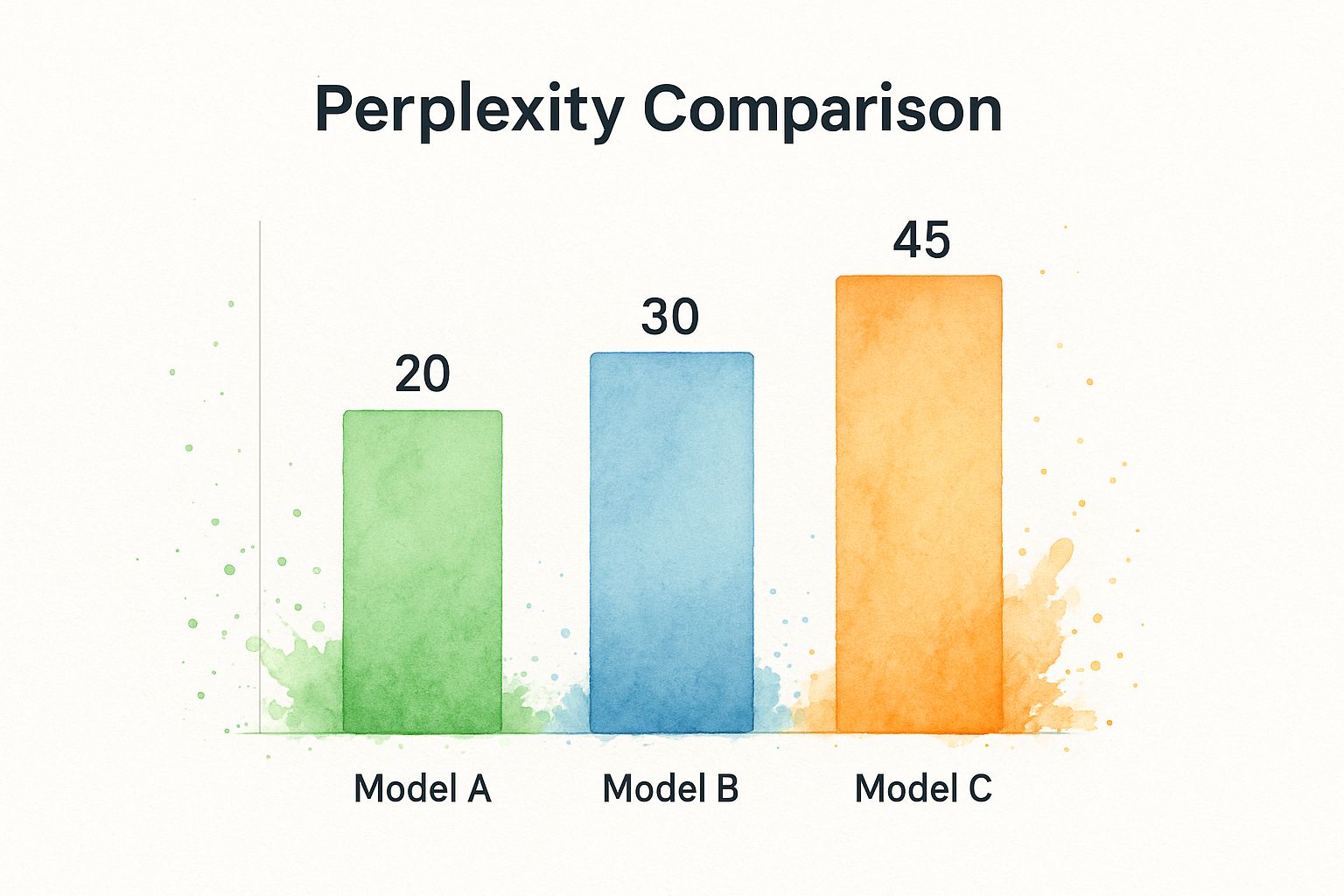
As you can see, Model A, with the lowest score, is significantly less 'confused' than Model C. This is a strong indication that it will produce much more reliable and high-quality output. Choosing AI tools built on such models is not a technical decision; it is a strategic move for growth.
How the Perplexity Score Relates to AI Performance
To make this even clearer, the table below shows the direct link between an AI model's perplexity score and its practical performance in business applications. It really helps to visualize the impact.
| Perplexity Score | Model Confidence | Quality of Output | Business Impact |
| Low (e.g., < 20) | Very High: The model is extremely confident in its predictions. | Excellent: Generates coherent, natural, and contextually relevant text. | Ideal for customer-facing content, chatbots, and creative writing. High user satisfaction and better conversions. |
| Medium (e.g., 20-50) | Average: The model makes reasonable predictions but can occasionally be uncertain. | Good: Generally produces useful text, but may contain minor errors or sound slightly unnatural. | Suitable for internal drafts and data summaries. Requires some human oversight. |
| High (e.g., > 50) | Low: The model is often 'surprised' and struggles to predict the next word. | Poor: Output is often nonsensical, robotic, or irrelevant. | Not recommended for professional use. Leads to a poor user experience and can damage brand reputation. |
In short, a model's perplexity score gives you a solid, data-backed way to predict performance. Lower is always better, which directly translates to higher quality results and a better return on your investment in AI tools.
How Perplexity Shapes Modern AI Language Models

Let's dive a little deeper. For the developers building models like GPT-4 or Google's Gemini, perplexity is the gold standard. You can see it as the final score on an incredibly difficult language exam for an AI.
Researchers and engineers rely on this metric to measure how well a model truly understands grammar, context, and all the subtle nuances of human conversation. A lower perplexity score indicates that a model is less 'surprised' by new text. This means it has a more advanced understanding of language patterns and can predict what is coming with much greater accuracy.
The Direct Impact on Your Business
For your business, this highly technical benchmark has very tangible consequences. An AI tool built on a model with low perplexity can be a serious asset to your marketing and sales efforts.
It translates directly into better performance from the tools you use every day. Why? Because the underlying model is simply better at understanding and generating language that actually connects with people.
This means the AI can:
- Write more persuasive emails that grab attention and generate clicks.
- Draft coherent and authoritative blog posts that build trust with your audience.
- Power chatbots that provide truly useful answers, increasing customer satisfaction.
These are not small tweaks; they are improvements that lead to better customer experiences and can significantly increase your lead generation.
Perplexity as a Measure of a Model's 'Health'
Interestingly, perplexity is not just a one-time assessment; it also acts as a health check for a model over time. The concept, originally from information theory, has become particularly relevant in the Netherlands, a key hub for AI research.
Recent studies from Dutch institutions, as described in this research on language models on eprints.illc.uva.nl, have signaled a fascinating trend: the performance of some language models can actually deteriorate over time. This decline is directly linked to a noticeable rise in their perplexity. It shows that keeping perplexity low is an ongoing battle for AI developers.
Key Insight: A low perplexity score is more than just a technical detail. It is a direct indicator of an AI's ability to produce high-quality, human-like text that can truly support your business goals.
Ultimately, when you choose AI tools powered by models with low perplexity, you are investing in quality and reliability. This is a crucial consideration when integrating AI into your digital marketing strategy.
The Link Between AI Perplexity and Your SEO Success

How does the concept of perplexity translate to your business results? Very simply. Search engines like Google are becoming increasingly good at recognizing and rewarding high-quality, human-centric content. AI tools built on advanced models with low perplexity are your best allies in this game.
These models help you generate content that reads naturally, exudes authority, and – most importantly – meets the user's search intent. These are the pillars of modern search engine optimization. A model with low perplexity is simply better at predicting what a human would find useful, and that is exactly what Google's algorithms try to measure.
The Risk of AI with High Perplexity in Content Marketing
On the other hand, relying on cheap AI with high perplexity can be a disaster for your marketing. These tools often produce generic, repetitive, or downright strange texts. This kind of output not only bores your audience; it actively harms your brand's credibility.
Worse yet, it is a huge red flag for search algorithms trained to detect unhelpful content. Since Google’s Helpful Content Update, the bar for quality is higher than ever. Content that is clearly generated by a machine and offers no real value can lead to lower rankings, undoing all your hard work. That is a risk you do not want to take.
Using Quality AI to Boost Your SEO
How do you turn this knowledge into a competitive advantage? By integrating a qualitative AI with low perplexity into your content workflow, you can significantly improve quality and results. See it as a powerful assistant that helps you execute your strategy more efficiently.
It is a tool to amplify your own expertise, not replace it. Here is how a good AI supports your SEO efforts:
- Brainstorming Relevant Topics: It can analyze search trends and suggest topics that are highly likely to resonate with your target audience.
- Structuring Authoritative Articles: It helps draft logical outlines that cover a topic comprehensively, ensuring you answer all possible questions from a user.
- Drafting Persuasive Copy: It can produce solid first drafts that are well-written and follow SEO best practices, saving you hours of writing time.
By integrating an AI with low perplexity into your content strategy, you create a powerful synergy. You combine human expertise and strategic oversight with the speed and data processing power of AI. The result is content that both users and search engines love.
Ultimately, understanding perplexity helps you choose the right tools to increase your online visibility and attract more organic traffic. This is the core of every successful, long-term SEO Strategy.
How to Choose the Right AI Tools for Your Marketing?

As an entrepreneur, you can't just look up the perplexity score of an AI tool. So, how do you choose the tools that actually boost your marketing? The secret lies in the quality of the output, not in flashy features.
Think of it as a test drive. You don't look under the hood at the technical schematics. No, you feel how smoothly the car drives and if it feels reliable. Evaluating an AI tool works exactly the same way. You need a practical framework to assess performance.
A Practical Checklist for AI Marketing Tools
When testing a new AI writing assistant, don't ask for a standard blog post. Challenge the tool. A powerful model with low perplexity will consistently score well on the following points.
Here is what to look out for:
- Coherence and Flow: Does the text read well? Models with high perplexity often produce disjointed paragraphs.
- Factual Accuracy: Ask the AI about topics you know a lot about yourself. Does the tool give correct information, or does it start to "hallucinate" and make things up?
- Relevance to Your Prompt: Does the AI really answer your question? A good model sticks to your prompt, a weaker model strays quickly.
- Tone of Voice: Give the AI a piece of your own text and ask it to mimic your style. An advanced model adapts its tone, a basic model always sounds generic.
The Characteristics of a Powerful AI
A truly effective AI assistant does more than just string words together. The signs of a powerful model with low perplexity are subtle but telling. Such a model understands context and generates creative ideas that feel fresh.
A considered investment in AI is like choosing a partner. The right AI becomes a full-fledged asset that helps you produce better content faster and offers you the space to focus on strategy.
By applying this practical evaluation framework, you can confidently choose AI solutions that truly support your marketing goals. To help you further on your way, check out our guide on implementing AI in your marketing strategy.
Using AI Perplexity Beyond Content Creation
The idea of 'predictive certainty', which perplexity basically measures, is not just for writing blog posts. It is a powerful concept you can apply to almost any area of your business where machine learning plays a role. Thinking in terms of perplexity helps you gauge the reliability of any AI-driven prediction.
This core logic goes far beyond content. A sales forecasting model with low perplexity, for example, can predict with much greater accuracy which leads are likely to become paying customers. It all comes down to how certain the model is of its predictions.
Increase Your Strategic Edge with AI
Understanding this concept gives you a serious strategic edge. It enables you to look at different AI applications with a much more critical eye. Instead of just accepting the output of an AI, you can ask yourself: "how 'certain' is the AI of this conclusion?"
Think of these practical scenarios where low perplexity is essential:
- Sales Forecasting: An AI with low perplexity can analyze sales data and market trends to deliver much more reliable revenue forecasts.
- Customer Service: Automated systems can predict customer needs with greater accuracy and route them to the right person.
- Lead Scoring: AI can assess and score incoming leads based on their conversion probability. A model with low perplexity makes this scoring system much more reliable.
By viewing perplexity as a measure of predictive certainty, you can apply its logic everywhere. A certain prediction is always more valuable for making smart business decisions.
This broader perspective puts your company in a much better position to make optimal use of new technologies. When you understand the basic principles of AI like perplexity, you are able to make smarter investments in tools that deliver reliable results, leading to more sales and a higher ROI.
How Do You Actually Use Quality AI in Your Marketing?
Knowing what perplexity is, is one thing. Using it to grow your business is something else entirely. It is time for an action plan. The smartest approach is not to let the AI take over completely; it is to keep a human at the wheel. See AI as a powerful co-pilot, not a replacement for your strategic expertise.
The idea is to let the AI do the heavy lifting, while you and your team focus on strategy and creativity. It is not about working faster, but about working smarter. By thoughtfully integrating the right AI tools, you free up your team's most valuable asset: their time.
A Practical Step-by-Step Guide
The biggest mistake you can make is trying to change everything at once. A better approach is to identify specific, repetitive tasks where AI can have an immediate, noticeable impact. This ensures a smooth transition and, more importantly, quick wins.
Here is a simple roadmap to start:
- In-Depth Keyword Research: Use AI to analyze search trends and discover those long-tail keywords your competitors are missing. This immediately gives your content a solid, data-driven foundation.
- Generating Detailed Content Briefs: Instead of staring at a blank page, ask your AI assistant to draft a comprehensive outline for a blog post. A good tool structures the entire piece logically.
- A/B Testing Ad Copy at Scale: Why test one or two headlines when you can test twenty? AI generates dozens of variations in seconds, so you quickly discover which message really resonates.
- Drafting Personalized Customer Emails: Let AI draft email campaigns tailored to individual customer data. This goes beyond adding a first name; it creates a better customer experience that can increase your open and click rates.
Adopting AI is a strategic move. By sticking to a 'human-in-the-loop' model, you combine the speed of AI with the irreplaceable strategic insight of your team. That is the combination that leads to more effective marketing and sustainable growth.
Ultimately, the goal is to make your team more effective, not just more efficient. To dive deeper into this, read our guide on navigating the AI Revolution in Marketing.
Questions About AI Perplexity?
The world of AI can feel complex, and it makes sense that you have questions. We have answered some of the most common questions about perplexity to give you clear, direct answers.
Can I Measure the Perplexity of an AI Tool Myself?
Unfortunately, no. Perplexity is an internal metric, calculated by developers during the training and testing phases of a model. It is not a public score you can look up or test yourself on tools like ChatGPT.
Focus instead on evaluating the quality of the output. Look at coherence, accuracy, and tone – that is your indirect, practical measure of the quality of the underlying model.
Does a Low Perplexity Score Always Guarantee Good Content?
Not necessarily. A low perplexity score simply means the AI is very good at predicting the next word. This usually results in fluent, grammatically correct text.
However, it says nothing about creativity, factual correctness, or whether the content aligns with the unique voice of your brand. That is why the 'human-in-the-loop' approach is so important. The AI can give you a solid draft, but your expertise adds the necessary nuance, strategic insight, and human touch.
How Does Understanding Perplexity Affect the Future of SEO?
Knowledge of perplexity helps you make smarter choices when selecting AI tools for content creation. Google is increasingly betting on high-quality, truly useful content. Using an AI that generates natural, authoritative text therefore gives you a serious advantage.
Models with lower perplexity are better capable of producing content that truly meets the user's search intent, which is the core of modern SEO. It is about using the right technology to more effectively meet search engine standards.
Ready to integrate high-quality AI into your marketing and realize real growth? At Digitalique, we are your strategic partner in digital transformation. We not only help you choose the right tools but also ensure they align seamlessly with your business goals.
Let's build tomorrow's success, today.