
Conversie Ratio Optimalisatie, vaak afgekort tot CRO, is de kunst en wetenschap om meer van jouw websitebezoekers om te zetten in daadwerkelijke klanten. Het gaat niet om het najagen van meer verkeer; het gaat erom meer waarde te halen uit het verkeer dat je al hebt.
Jouw website is een lekkende emmer. CRO is de oplossing.

Klinkt dit bekend? Je hebt geld geïnvesteerd in SEO en advertenties, je bezoekersaantallen stijgen, maar je verkopen en leads blijven achter. Het is een veelvoorkomend en ongelooflijk frustrerend probleem voor veel ondernemers.
De harde realiteit is dat verkeer alleen de rekeningen niet betaalt. Als jouw website niet is ontworpen om bezoekers naar een aankoop of aanvraag te leiden, giet je in feite water in een lekkende emmer. Elke bezoeker die vertrekt zonder actie te ondernemen, is een gemiste kans en verspilde marketinguitgave. Dit is precies het probleem waarvoor CRO is ontwikkeld.
Voorbij giswerk: een data-gedreven aanpak
CRO gaat niet over het willekeurig uitproberen van ideeën om te zien wat werkt. Het is een methodisch proces dat data-analyse, een diepgaand begrip van gebruikerspsychologie en rigoureuze A/B-testen combineert om te achterhalen waarom mensen niet converteren. Zie ons als detectives voor jouw website.
In plaats van wijzigingen door te voeren op basis van een onderbuikgevoel, ziet het CRO-proces er als volgt uit:
- Gebruikersgedrag begrijpen: Eerst duiken we in de data. We gebruiken tools om te zien waar mensen klikken, hoe ver ze scrollen en waar ze afhaken. Dit toont ons precies waar de knelpunten zitten.
- Een hypothese vormen: Gewapend met die data, vormen we een onderbouwde aanname. Bijvoorbeeld: "Wij geloven dat het veranderen van de knoptekst van 'Verzenden' naar 'Ontvang jouw gratis offerte' het aantal ingevulde formulieren zal verhogen, omdat het de waarde voor de gebruiker benadrukt."
- Testen en meten: Vervolgens testen we de nieuwe versie (de 'uitdager') tegen het origineel (de 'controle') om te zien welke beter presteert. Deze door data ondersteunde validatie zorgt ervoor dat elke verandering daadwerkelijk de gebruikerservaring en uiteindelijk jouw conversieratio verbetert.
De lekken dichten en jouw ROI maximaliseren
Het hele doel van CRO is om systematisch de lekken in jouw conversietrechter te vinden en te dichten. Door deze barrières te identificeren en te verwijderen, creëren we een veel soepelere en intuïtievere reis voor jouw klanten. Dit kan betekenen dat we je afrekenproces vereenvoudigen, een verwarrende koptekst herschrijven of je call-to-action knoppen onmisbaar maken.
CRO gaat fundamenteel over het maximaliseren van het rendement op je bestaande investeringen. Het maakt jouw SEO winstgevender, je betaalde advertenties effectiever en je hele digitale marketingstrategie efficiënter.
Uiteindelijk transformeert een solide CRO-strategie jouw website van een simpele online brochure naar jouw meest krachtige, 24/7 verkoper. Het is een continue cyclus van verbetering die ervoor zorgt dat je elke druppel waarde uit elke bezoeker haalt. Door meer browsers in kopers te veranderen, bouw je een duurzame groeimotor en laat je jouw marketingbudget slimmer werken, niet alleen harder.
Waarom CRO de groeimotor voor jouw bedrijf is
Kijk, mensen naar je website trekken via SEO en betaalde advertenties is geweldig werk. Het vult de bovenkant van je funnel met potentiële klanten. Maar dat is slechts de helft van de klus. Bezoekers krijgen is één ding; hen daadwerkelijk iets waardevols laten doen is een heel ander spel. Dit is precies waar een solide CRO-strategie in beeld komt en de échte motor voor jouw bedrijfsgroei wordt.
Wanneer je investeert in CRO, verleg je de focus van oppervlakkige statistieken zoals ruwe verkeersaantallen naar wat echt het verschil maakt: het bouwen van een efficiënter, winstgevender bedrijf. Het draait allemaal om het maximaliseren van de waarde van elke bezoeker waar je al zo hard voor hebt gewerkt.
De krachtige ROI van een toegewijde strategie
Zie je website als je sterspeler in de verkoop – eentje die nooit slaapt en 24/7 werkt. CRO is simpelweg het proces om die verkoper te trainen om overtuigender, behulpzamer en effectiever te zijn in het sluiten van deals. Zelfs een kleine verbetering in je conversieratio kan een enorme impact hebben op je bedrijfsresultaat, zonder ook maar één extra euro aan advertenties uit te geven.
Een toegewijde CRO-strategie levert op verschillende belangrijke manieren echte waarde op:
- Verhoogde omzet per bezoeker: Door de gebruikersreis te versoepelen en het voor mensen eenvoudig te maken hun doelen te bereiken, zet je vanzelf meer bezoekers om in klanten. Dit verhoogt direct de omzet uit het verkeer dat je al hebt.
- Lagere kosten voor klantenwerving (CAC): Wanneer een hoger percentage van je bezoekers converteert, dalen de kosten om elke nieuwe klant te werven. Dit maakt je hele marketingbudget, van onze SEO-diensten tot je advertentiecampagnes, direct veel winstgevender.
- Verbeterde gebruikerservaring: In de kern draait CRO om de gebruiker. Door knelpunten weg te nemen en je site intuïtief te maken, creëer je een betere ervaring die vertrouwen opbouwt en ervoor zorgt dat mensen terugkomen.
Onschatbare klantinzichten verkrijgen
Een van de meest onderschatte voordelen van CRO is de goudmijn aan klantinzichten die je onderweg ontdekt. Het proces van testen, aanpassen en analyseren van gebruikersgedrag vertelt je niet alleen welke wijzigingen je moet doorvoeren; het onthult waarom je klanten zich gedragen zoals ze doen.
Deze inzichten zijn puur goud. Ze leggen de motivaties van je klanten bloot, hun aarzelingen en wat ze echt waarderen. Deze informatie kan – en moet – alles informeren, van productontwikkeling tot je overkoepelende marketingboodschap, waardoor je een serieuze voorsprong op de concurrentie krijgt.
Uiteindelijk gaat het bij focussen op CRO om je marketing slimmer te laten werken, niet alleen harder. Het transformeert je website van een statische digitale brochure naar een dynamisch, goed presterend bedrijfsmiddel dat consequent browsers omzet in kopers en interesse in echte, tastbare omzet.
Impact van CRO op belangrijke bedrijfscijfers
Deze tabel laat zien hoe het implementeren van CRO-strategieën direct bijdraagt aan cruciale prestatie-indicatoren van je bedrijf. Het is een duidelijke weergave van hoe kleine websiteverbeteringen zich vertalen in meetbare, bottom-line groei.
| Bedrijfsdoel | Beïnvloede metriek | Directe impact van CRO |
| Verkoop verhogen | Conversieratio, Omzet per bezoeker | Het optimaliseren van afrekenprocessen en calls-to-action leidt direct tot meer voltooide aankopen. |
| Meer leads genereren | Inzendingspercentage leadformulieren | Het vereenvoudigen van formulieren en verduidelijken van de waardepropositie moedigt meer gebruikers aan om hun gegevens achter te laten. |
| Winstgevendheid verbeteren | Kosten voor klantenwerving (CAC) | Door meer bestaand verkeer te converteren, dalen de kosten om elke nieuwe klant te werven aanzienlijk. |
| Merkloyaliteit opbouwen | Customer Lifetime Value (CLV) | Een soepele gebruikerservaring bouwt vertrouwen en tevredenheid op, wat herhaalaankopen en loyaliteit stimuleert. |
Zoals je ziet, is CRO niet alleen het aanpassen van knoppen; het is een strategische aanpak die de financiële gezondheid en klantrelaties van je hele bedrijf versterkt.
De kernpilaren van effectieve conversie-optimalisatie
Succesvolle CRO is geen nattevingerwerk en ook niet het blindelings kopiëren van je concurrenten. Het is een gestructureerd, methodisch proces gebouwd op vier fundamentele pilaren die harmonieus samenwerken. Begrip van deze pilaren is de sleutel om van willekeurige aanpassingen over te stappen op een betrouwbaar systeem voor groei.
Zie deze pilaren als de poten van een stevige tafel. Als er één wankel is, wiebelt het hele geheel. Maar als alle vier solide zijn, heb je een stabiel platform voor het nemen van slimme, data-gedreven beslissingen die echt het verschil maken.
User Experience (UX) Design: de soepele reis
In de kern draait CRO erom dingen makkelijker te maken voor je bezoekers. Dat is de essentie van User Experience (UX) design – de kunst en wetenschap van het creëren van een website die gewoon goed voelt. Het moet intuïtief, logisch en moeiteloos zijn om te navigeren.
Goede UX betekent dat je bezoekers niet hoeven na te denken. Ze kunnen vinden wat ze nodig hebben, begrijpen wat je aanbiedt en hun doelen bereiken zonder op frustrerende doodlopende wegen of verwarrende obstakels te stuiten. Zelfs kleine frictiepunten, zoals een pagina die een extra seconde laadt, kunnen genoeg zijn om een potentiële klant te doen afhaken. Wij bieden deskundig advies over hoe je jouw WordPress-website sneller maakt voor een soepele ervaring.
Het doel is simpel: verwijder elk obstakel tussen de aankomst van een bezoeker en de "bedankt"-pagina. Dit omvat:
- Intuïtieve navigatie: Een logische sitestructuur en menu's die perfect logisch zijn.
- Mobiele optimalisatie: Een vlekkeloze ervaring voor gebruikers op smartphones en tablets, waar het grootste deel van je publiek zich waarschijnlijk bevindt.
- Paginanasnelheid: Zorg ervoor dat je pagina's razendsnel laden, want vertragingen zijn beruchte conversiekillers.
- Duidelijke lay-outs: Gebruik design om het oog van de gebruiker te leiden naar wat het belangrijkst is, zoals je call-to-action knoppen.
Copywriting en waardepropositie: je overtuigende boodschap
Zodra je website eenmaal gemakkelijk te gebruiken is, moet je mensen een krachtige reden geven om actie te ondernemen. Hier komen overtuigende copywriting en een kristalheldere waardepropositie om de hoek kijken. Je woorden zijn je 24/7 verkoper.
Je waardepropositie moet direct de belangrijkste vraag van de bezoeker beantwoorden: "What's in it for me?" Het moet duidelijk de unieke voordelen communiceren die je biedt en waarom ze voor jou moeten kiezen en niet voor een ander. Deze kernboodschap moet doorschijnen in je koppen, productbeschrijvingen en calls-to-action.
Een sterke waardepropositie is niet zomaar een pakkende slogan; het is een belofte. Het is de boodschap die het probleem van je klant direct verbindt met jouw oplossing, waardoor de beslissing om te converteren de meest logische volgende stap lijkt.
Effectieve copywriting neemt vervolgens die belofte en laat deze resoneren. Het spreekt de taal van je klant, raakt hun pijnpunten en bouwt vertrouwen op, waardoor passieve bezoekers veranderen in oprecht geïnteresseerde kopers.
A/B-testen: de wetenschappelijke methode
Hoe weet je zeker of die nieuwe kop of knopkleur echt beter zal werken? Je test het. A/B-testen (ook wel split-testen genoemd) is de motor van CRO en geeft je een wetenschappelijke manier om je ideeën te valideren met echte gebruikersdata.
Het proces zelf is vrij eenvoudig. Je creëert twee versies van een webpagina: het origineel (Versie A, de 'controle') en een met een wijziging (Versie B, de 'variatie'). Vervolgens verdeel je je websiteverkeer willekeurig over de twee. Door te meten welke versie meer conversies oplevert, krijg je onweerlegbaar bewijs van wat je publiek echt verkiest.
Deze data-gedreven aanpak haalt giswerk en persoonlijke meningen uit de vergelijking. Het stelt je in staat om kleine, op bewijs gebaseerde verbeteringen aan te brengen die na verloop van tijd optellen, wat leidt tot serieuze, duurzame groei.
Analyse en gebruikersonderzoek: het leidende kompas
Met al deze mogelijkheden, waar begin je dan? Het antwoord ligt in analyse en gebruikersonderzoek. Deze pilaar is het kompas dat je de juiste richting wijst en elke beslissing in je CRO-proces leidt.
Analysetools, zoals Google Analytics, vertellen je wat er op je site gebeurt. Ze kunnen je laten zien welke pagina's een hoog uitstappercentage hebben, waar je gebruikers vandaan komen en de typische paden die ze nemen. Deze kwantitatieve data is fantastisch voor het opsporen van problemen en het identificeren van gebieden met het grootste potentieel voor verbetering.
Gebruikersonderzoek vertelt je daarentegen waarom het gebeurt. Methoden en tools zoals heatmaps, sessie-opnames en gebruikersenquêtes geven je kwalitatieve inzichten rechtstreeks van de bron. Ze laten je precies zien waar mensen vastlopen, in de war raken of gefrustreerd zijn, wat je de context geeft die je nodig hebt om slimme hypotheses voor je A/B-tests te vormen.
Jouw stapsgewijze gids voor een CRO-proces
De overstap van theorie naar actie is waar de echte groei plaatsvindt. Een gestructureerd Conversie Ratio Optimalisatie (CRO) proces onderscheidt de professionals van de amateurs. Het haalt het giswerk uit het verbeteren van de prestaties van je website en vervangt het door een betrouwbaar, herhaalbaar raamwerk.
Zie het als een cyclus van leren en verfijnen. Elke verandering die je maakt, wordt een berekende stap voorwaarts. Laten we de exacte methodologie die professionele optimalisatiespecialisten gebruiken om meer bezoekers om te zetten in loyale klanten, stap voor stap doornemen.
Stap 1: Onderzoek en analyse
Dit is de detectivefase. Serieus. Voordat je ook maar één knop op je site aanraakt, moet je precies begrijpen hoe mensen je website nu gebruiken. Het doel hier is om de knelpunten te vinden – de "lekken" in je emmer waar potentiële klanten afhaken.
Om het volledige beeld te krijgen, combineren we twee soorten data:
- Kwantitatieve data (het "Wat"): Dit zijn de harde cijfers. Tools zoals Google Analytics vertellen je wat er op je site gebeurt. Je kunt zien welke pagina's een alarmerend hoog uitstappercentage hebben of waar mensen precies je afrekenproces verlaten.
- Kwalitatieve data (het "Waarom"): Deze data geeft je de cruciale context achter de cijfers. Heatmaps tonen waar gebruikers klikken (of proberen te klikken), sessie-opnames laten je echte gebruikersreizen zien, en eenvoudige enquêtes kunnen je directe feedback geven over wat verwarrend of frustrerend is.
Wanneer je deze twee combineert, kun je de grootste kansen voor verbetering aanwijzen.
Stap 2: Hypothese formuleren
Zodra je een probleemgebied hebt gevonden, is de volgende stap het formuleren van een duidelijke, testbare hypothese. Dit is niet zomaar een wilde gok; het is een onderbouwde stelling gebaseerd op je onderzoek. Het moet de specifieke verandering die je wilt maken, wat je verwacht dat er zal gebeuren en waarom je denkt dat het zal gebeuren, schetsen.
Een solide hypothese volgt altijd deze eenvoudige structuur:
Als we [deze specifieke wijziging doorvoeren], dan zal [dit specifieke resultaat optreden], omdat [dit de redenering is gebaseerd op ons onderzoek].
Bijvoorbeeld: "Als we ons afrekenformulier vereenvoudigen van zes naar drie velden, dan zullen we het aantal voltooide aankopen verhogen, omdat ons onderzoek aantoont dat gebruikers op dit complexe punt afhaken." Zie je? Het is specifiek, meetbaar en direct gekoppeld aan een bedrijfsdoel.
Stap 3: Prioriteren
Laten we eerlijk zijn – je zult tientallen geweldige ideeën voor tests bedenken. De sleutel is om ze te prioriteren, zodat je je tijd en energie steekt waar ze de grootste impact hebben. Niet alle tests zijn gelijk.
Een klassiek raamwerk hiervoor is het PIE-model:
- Potentie: Hoeveel verbetering kunnen we realistisch verwachten van deze verandering? Is het een kleine aanpassing of een potentiële gamechanger?
- Impact: Hoe waardevol is het verkeer naar deze pagina? Een verandering op je productpagina met het meeste verkeer is veel belangrijker dan een op een oude, vergeten blogpost.
- Eenvoud: Hoe eenvoudig zal het zijn om deze test te ontwerpen, te bouwen en te lanceren?
Door elk idee te scoren op basis van deze criteria, creëer je een slimme, geprioriteerde roadmap. Je zult je uiteindelijk richten op de tests met de hoogste impact en de minste inspanning.
Stap 4: Testen en analyseren
Hier ontmoet je hypothese de werkelijkheid. Met behulp van A/B-testsoftware creëer je een nieuwe versie van je pagina (de "uitdager") en zet je die tegenover het origineel (de "controle"). Je websiteverkeer wordt verdeeld over de twee versies, en je meet welke beter presteert ten opzichte van je hoofddoel, zoals een verkoop of een formulierinzending.
Het is absoluut cruciaal om de test lang genoeg te laten lopen om statistische significantie te bereiken. Dit is een chique manier om te zeggen dat je er zeker van kunt zijn dat de resultaten niet slechts toeval zijn. Zodra de test is voltooid, heb je harde data die aantonen wat echt het beste werkt voor jouw publiek.
Dit stroomdiagram visualiseert perfect de kerncyclus van CRO: gedrag analyseren, tests uitvoeren en implementeren wat werkt.
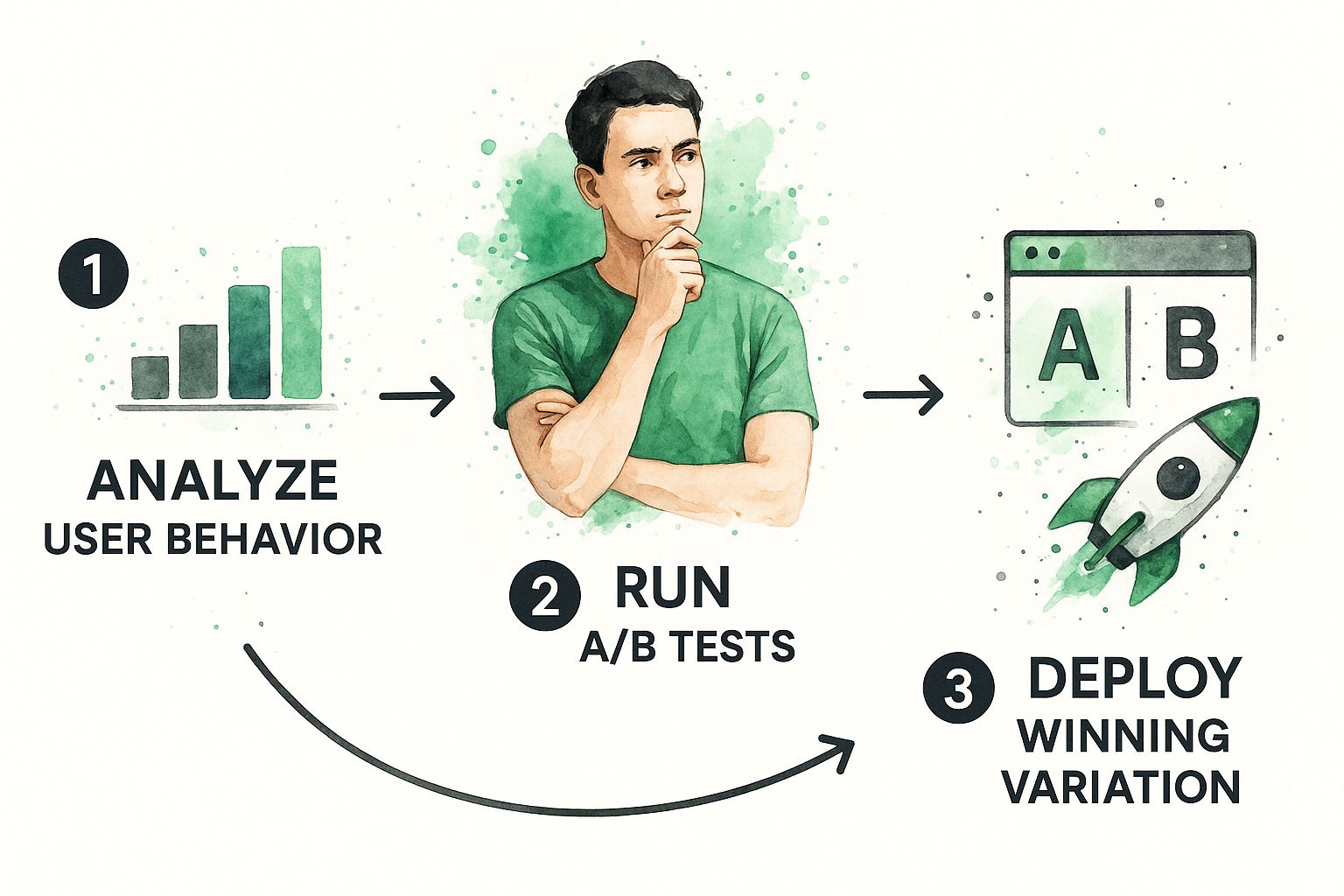
Deze eenvoudige lus is de motor van continue verbetering, die ruwe inzichten omzet in meetbare bedrijfsgroei.
Stap 5: Leren en implementeren
De laatste stap is handelen naar wat je hebt ontdekt. Als je uitdager-versie heeft gewonnen, geweldig! Je rolt deze uit als de nieuwe standaard voor iedereen. Maar het proces eindigt daar niet. Of je nu wint, verliest of gelijkspeelt, elke test geeft je waardevolle inzichten in het gedrag van je klanten.
Een onsuccesvolle test is nooit een mislukking; het is een leermoment. Het vertelt je wat niet werkt, wat net zo belangrijk is als weten wat wel werkt. Documenteer alles wat je leert en gebruik die inzichten om je volgende reeks hypotheses te voeden. Deze continue feedbackloop maakt CRO zo'n krachtige motor voor duurzame groei.
Het optimaliseren van je belangrijkste pagina's is een cruciale eerste stap. Als je deskundige ondersteuning nodig hebt om te beginnen, kan onze landingspagina optimalisatie service je helpen inzichten om te zetten in resultaten.
Essentiële CRO-statistieken die je moet volgen
"Meten is weten." Het is een oud gezegde, maar in de wereld van Conversie Ratio Optimalisatie (CRO) is het de absolute waarheid. Om de impact van je wijzigingen echt te begrijpen, moet je de juiste Key Performance Indicators (KPI's) bijhouden. Verder kijken dan alleen de uiteindelijke conversieratio geeft je het volledige verhaal over gebruikersgedrag en websiteprestaties.
Zie de juiste data als een routekaart voor je website. Het wijst precies aan waar gebruikers betrokken zijn, waar ze vastlopen en waar je grootste groeikansen verborgen liggen. Zonder deze data gis je maar in het duister.
Verder kijken dan de basis conversieratio
Natuurlijk is de conversieratio zelf de ster van de show. Het is het percentage bezoekers dat doet wat je wilt dat ze doen – of dat nu een product kopen is of een formulier invullen. Het is het ultieme scorebord voor elke CRO-campagne.
Maar daar stoppen is een vergissing. Een redelijke algehele conversieratio kan gemakkelijk een landingspagina verbergen die bezoekers verliest of een gebroken stap in je afrekenproces. Om echt te optimaliseren, moet je dieper graven in de statistieken die het verhaal achter dat eindcijfer vertellen.
Ontdekken hoe gebruikers interageren
Deze statistieken helpen je te achterhalen hoe bezoekers met je site omgaan voordat ze zelfs maar bij het punt van conversie komen. Het zijn de vroege waarschuwingssignalen die problemen met betrokkenheid, duidelijkheid of de algehele gebruikerservaring kunnen signaleren.
- Bouncepercentage: Dit is het percentage mensen dat op een pagina landt en vertrekt zonder iets anders te doen – geen klikken, niet scrollen, niets. Een hoog bouncepercentage betekent vaak dat er een mismatch is tussen wat de gebruiker verwachtte en wat hij vond. Voor landingspagina's is dit een enorm waarschuwingssignaal dat je onmiddellijke aandacht vereist.
- Gemiddelde sessieduur: Deze is eenvoudig: hoe lang blijven mensen op je site tijdens één bezoek? Een langere sessie betekent meestal dat je inhoud aanslaat en hen geïnteresseerd houdt. Als ze snel afhaken, is je inhoud mogelijk niet overtuigend genoeg, of is je site misschien moeilijk te navigeren.
Door deze betrokkenheidsstatistieken in de gaten te houden, kun je problemen vroeg in het traject opsporen. Je ziet welke pagina's de aandacht trekken en welke ervoor zorgen dat bezoekers hun interesse verliezen en de uitgang zoeken.
Voordat we dieper ingaan op de details van het bijhouden, laten we enkele van de belangrijkste statistieken die je zult bekijken, opsplitsen. Elk vertelt een ander deel van het verhaal van je gebruiker.
Belangrijke CRO-statistieken en hun betekenis
| Statistiek | Wat het meet | Waarom het belangrijk is voor CRO |
| Conversieratio | Het percentage bezoekers dat een gewenst doel voltooit (bijv. aankoop, aanmelding). | De ultieme maatstaf voor succes. Het weerspiegelt direct hoe effectief je site is in het overtuigen van gebruikers. |
| Bouncepercentage | Het percentage bezoekers dat vertrekt na het bekijken van slechts één pagina. | Hoge bouncepercentages duiden op problemen met paginarelevantie, ontwerp of gebruikerservaring. |
| Gemiddelde sessieduur | De gemiddelde tijd die bezoekers op je site doorbrengen tijdens een enkele sessie. | Langere duur duidt vaak op boeiende inhoud en een goede gebruikersstroom. |
| Winkelwagenverlatingspercentage | Het percentage shoppers dat items aan een winkelwagen toevoegt maar de aankoop niet voltooit. | Een cruciale e-commerce metriek die wijst op frictie in het afrekenproces. |
| Leadformulierverlating | Het percentage gebruikers dat begint met het invullen van een formulier maar het niet verzendt. | Voor B2B benadrukt dit problemen zoals formulierlengte, complexiteit of vertrouwensproblemen. |
| Click-Through Rate (CTR) | Het percentage gebruikers dat op een specifieke link of call-to-action (CTA) klikt. | Meet de effectiviteit van je CTA's, koppen en advertentieteksten. |
Het begrijpen van deze statistieken is de eerste stap. De volgende stap is ze gebruiken om precies aan te wijzen waar je je optimalisatie-inspanningen moet richten om de grootste winsten te behalen.
Kritieke e-commerce en leadgeneratie statistieken
Voor bedrijven die afhankelijk zijn van verkoop of leads, zijn een paar specifieke cijfers onmisbaar. Ze wijzen de exacte momenten aan waarop je potentiële omzet verliest, waardoor je duidelijke doelen voor verbetering krijgt.
Het winkelwagenverlatingspercentage is een allesbepalende metriek voor elke e-commercesite. Het meet hoeveel mensen producten aan hun winkelwagen toevoegen maar verdwijnen voordat ze betalen. Een hoog percentage is vaak een symptoom van frictie in je afrekenproces—denk aan onverwachte verzendkosten, een verwarrend formulier of een gebrek aan vertrouwde betalingsopties. Zelfs een kleine verbetering hier kan een serieuze omzetstijging betekenen.
In de B2B-wereld is het leadformulierverlatingspercentage net zo cruciaal. Hoeveel mensen beginnen je "Vraag een demo aan"-formulier maar klikken nooit op verzenden? Dit vertelt je vaak dat het formulier te lang is, te veel gevoelige informatie vooraf vraagt, of gewoon technische bugs heeft. Simpelweg het formulier inkorten of vertrouwenssignalen zoals testimonials toevoegen kan een wereld van verschil maken.
Het hebben van al deze statistieken op één plek is essentieel voor het nemen van slimme beslissingen. Om grip te krijgen op je data, bekijk onze uitgebreide gids over Google Analytics. Een tool als deze stelt je in staat problemen te diagnosticeren, kansen met hoge impact te spotten en uiteindelijk de financiële ROI van je hele CRO-strategie te bewijzen.
Klein beginnen, groots winnen: CRO-voorbeelden uit de praktijk
De krachtigste overwinningen in CRO komen zelden van een complete website-revisie. Het zijn juist de kleine, slimme aanpassingen die vaak de grootste impact hebben. Hier gaan we van theorie naar praktijk en bekijken we echte voorbeelden die bewijzen hoe consistente, op data gebaseerde verbeteringen serieuze groei kunnen ontsluiten.
Laten we een paar mini-casestudy's bekijken. Ze illustreren perfect hoe het optimaliseren van iets simpels als een kop, het vereenvoudigen van een formulier of het toevoegen van een beetje social proof het verschil kan maken voor je conversieratio's.
De kracht van een betere call-to-action
Een e-commercewinkel die digitale producten verkocht, voelde dat hun landingspagina niet goed presteerde. De belangrijkste call-to-action (CTA) knop was een luie "Verzenden". Natuurlijk, het was functioneel, maar het was totaal niet inspirerend en vertelde de gebruiker niets over wat hij ervoor terugkreeg.
Nadat ze van gebruikers hoorden die verward waren over waarvoor ze zich precies aanmeldden, had het team een duidelijke hypothese: een meer specifieke, waardegedreven CTA zou de downloads stimuleren. Tijd voor een A/B-test.
- Versie A (Controle): De knop las simpelweg "Verzenden".
- Versie B (Variatie): De knoptekst werd veranderd in "Ontvang nu je gratis gids".
Het resultaat? Versie B zorgde voor een 24% toename in conversies. Die kleine verandering in de bewoording verduidelijkte onmiddellijk het voordeel voor de gebruiker, nam alle twijfel weg en maakte de klik een gemakkelijke beslissing. Het is een klassiek geval van hoe een paar woorden een enorme impact kunnen hebben op het bedrijfsresultaat.
Hoe social proof demo-aanvragen stimuleerde
Een B2B-softwarebedrijf kreeg veel verkeer naar zijn demo-aanvraagpagina, maar het aantal formulierinzendingen was teleurstellend laag. Een snelle blik op hun analyses toonde aan dat gebruikers aarzelden net voordat ze begonnen met typen. Het onderbuikgevoel van het team was dat een gebrek aan vertrouwen de boosdoener was.
Ze besloten dit aan te pakken met een dosis social proof. De hypothese was simpel: het toevoegen van klanttestimonials direct naast het formulier zou de geloofwaardigheid verhogen en prospects geruststellen op dat kritieke beslismoment.
Ze implementeerden een roterende carrousel van korte, impactvolle citaten van tevreden klanten direct naast de formuliervelden. Deze testimonials voegden niet alleen een laag vertrouwen toe; ze benadrukten specifieke resultaten en prezen de ondersteuning van het bedrijf.
Deze ene verandering leidde tot een 18% stijging in demo-aanvragen in de eerste maand alleen al. Het is een solide bewijs dat het herinneren van gebruikers aan je prestaties op het moment dat ze twijfelen, een ongelooflijk effectieve CRO-tactiek is.
Het pad naar aankoop vereenvoudigen
Een andere e-commerceretailer worstelde met een hoog percentage verlaten winkelwagens. Een diepgaande analyse van heatmaps en sessie-opnames wees op een duidelijk knelpunt: de afrekenpagina was lang en verwarrend. Het was vol met te veel velden, waarvan vele niet eens nodig waren.
De hypothese van het team was eenvoudig: een korter, schoner afrekenproces zou de frictie verminderen en meer verkopen over de streep trekken. Ze gingen terug naar de tekentafel met een focus op minimalisme.
Dit is wat ze deden:
- Minder formuliervelden: Ze schrapten genadeloos optionele velden en combineerden "Voornaam" en "Achternaam" in één "Volledige naam" veld.
- Voortgangsindicatoren toegevoegd: Een eenvoudige visuele balk werd toegevoegd om gebruikers precies te laten zien waar ze zich in het driestapsproces bevonden.
- Gast-checkout optie: Ze maakten de gast-checkout optie prominenter, waardoor de druk op gebruikers om direct een account aan te maken werd weggenomen.
Deze veranderingen verminderden de frictie bij het afrekenen drastisch, wat resulteerde in een 31% daling in het aantal verlaten winkelwagens. Het is een krachtige herinnering dat soms het beste wat je voor je conversieratio kunt doen, simpelweg uit de weg van je klant gaan is.
Vragen over CRO? Wij hebben de antwoorden
Zelfs met een solide plan kan het starten met Conversie Ratio Optimalisatie (CRO) een beetje ontmoedigend aanvoelen. Laten we enkele van de meest voorkomende vragen die we van ondernemers horen, behandelen, zodat je met duidelijkheid verder kunt.
Hoe lang duurt het om CRO-resultaten te zien?
Deze vraag krijgen we voortdurend. Hoewel een goed opgezette A/B-test soms binnen een paar weken een duidelijke winnaar kan laten zien, zit de echte magie van CRO niet in één snelle overwinning.
De ware waarde komt van continue verbetering. Je eerste test kan je een leuke kleine boost geven, maar het is het cumulatieve effect van doorlopende, op data gebaseerde veranderingen dat serieuze, langetermijngroei opbouwt. Zie het als een marathon, niet als een sprint.
Wat is een goede conversieratio?
Ah, de klassieke "dat hangt ervan af"-vraag. De waarheid is dat een "goede" conversieratio sterk varieert. Het hangt enorm af van je branche, waar je verkeer vandaan komt en wat je eigenlijk probeert te bereiken.
Een e-commerceshop kan blij zijn met 2-3%, terwijl een pagina die hoogwaardige B2B-leads genereert, een conversieratio van 5% zou kunnen vieren. De beste aanpak? Vergelijk je prestaties met je eigen verleden en focus op het maken van gestage verbeteringen, in plaats van een willekeurig branchegemiddelde na te jagen.
Is CRO hetzelfde als SEO?
Nee, maar ze vormen een absoluut powerkoppel. Zie het zo: SEO brengt mensen naar je website; CRO overtuigt hen om te blijven en daadwerkelijk iets te doen.
Een site die op nummer 1 staat in Google maar niet converteert, is zonde van een goede ranking. Aan de andere kant is een perfect geoptimaliseerde pagina nutteloos als niemand hem kan vinden. Elke sterke digitale strategie heeft beide nodig om echt te slagen.
Klaar om je websiteverkeer om te zetten in echte, meetbare resultaten? Bij Digitalique.nl combineren we data-gedreven inzichten met deskundige uitvoering om een krachtige CRO-strategie te bouwen die voor jouw bedrijf werkt.
Start vandaag nog met het optimaliseren van je conversies met ons! Zoals altijd, jullie reacties zijn van harte welkom.