
Worstel je met een wirwar van softwaretools voor je verkoop, voorraad en marketing? Het is een bekend probleem voor groeiende bedrijven, dat leidt tot tijdverspilling en versnipperde data. Odoo snijdt door die chaos en functioneert als het centrale besturingssysteem voor je hele bedrijf, waardoor al je bedrijfsprocessen samenkomen op één slim platform.
In dit artikel ontdek je wat Odoo is, hoe het je online zichtbaarheid en sales kan verhogen, en waarom het de perfecte basis is voor duurzame groei.
Wat is Odoo en waarom is het relevant voor jouw bedrijf?
Stel je voor dat elk onderdeel van je bedrijf—van de eerste e-mail van een klant tot de uiteindelijke factuur—perfect samenwerkt binnen één systeem. Het gaat niet om zomaar een app toevoegen; het gaat om het creëren van één centrale bron van waarheid voor je hele organisatie. Die helderheid is goud waard. Het stelt je in staat om slimmere, data-gedreven beslissingen te nemen en je werkprocessen écht te stroomlijnen.
In de kern is Odoo een uitgebreide suite van open-source bedrijfsapplicaties. De beste manier om het te zien is als een set LEGO-blokken. Je kunt klein beginnen, misschien alleen met een CRM-app voor je salesteam, en vervolgens meer blokken toevoegen naarmate je bedrijf groeit en je behoeften veranderen. Deze modulaire aanpak is een van de grootste krachten.
De kracht van een alles-in-één platform
Veel bedrijven zitten gevangen in het "softwaresilo"-probleem. Je kent het wel: je boekhoudsoftware weigert te communiceren met je voorraadsysteem, en geen van beide synchroniseert goed met je e-commerceplatform. Dit is een recept voor inefficiëntie, lage conversieratio's en onnodige handmatige fouten.
Odoo is ontworpen om die silo's af te breken. Door alles met elkaar te verbinden, krijg je ineens een compleet 360-graden beeld van je bedrijfsvoering.
- Verhoogde Efficiëntie: Wanneer je salesteam een deal sluit, kan het systeem automatisch een factuur genereren, je voorraadniveaus bijwerken en het magazijnteam een seintje geven—allemaal zonder dat iemand een vinger hoeft uit te steken.
- Betere Klantervaring: Met een enkel overzicht van elke klantinteractie kan iedereen, van verkoop tot support, de volledige geschiedenis zien. Dit leidt tot persoonlijkere en effectievere gesprekken.
- Data die echt zinvol is: In plaats van rapporten uit drie verschillende systemen aan elkaar te knopen, krijg je realtime dashboards die laten zien hoe het hele bedrijf presteert. Het signaleren van trends, het identificeren van knelpunten en het begrijpen van de ROI van je marketing wordt oneindig veel eenvoudiger.
De filosofie van Odoo is gebouwd op het bieden van een enkele, kosteneffectieve en modulaire oplossing om een bedrijf te runnen. Het verwijdert de technische en financiële obstakels die bedrijven ervan weerhouden om écht geïntegreerde bedrijfssoftware te omarmen.
Meer dan alleen een ERP-systeem
Hoewel Odoo vaak in de categorie Enterprise Resource Planning (ERP) wordt geplaatst, doet het veel meer dan dat label suggereert. Een traditioneel ERP-systeem richt zich voornamelijk op backoffice-processen zoals financiën en productie. Odoo dekt dat allemaal, maar integreert ook al je frontoffice-behoeften.
Zo heeft Odoo krachtige modules voor het bouwen van websites, het beheren van webshops, het managen van je social media en het versturen van e-mailmarketingcampagnes.
Deze unieke mix maakt het een serieuze tool voor elk bedrijf dat streeft naar echte, duurzame groei. Het geeft je de operationele ruggengraat van een klassiek ERP, terwijl het je ook de marketing- en salestools geeft die je nodig hebt om leads te genereren en klanten te behouden. Voor ons bij Digitalique, die leven en ademen voor digitale marketing en e-commerce, is die integratie van onschatbare waarde.
Door je marketinginspanningen direct te koppelen aan je verkoop- en operationele data, kun je eindelijk de volledige klantreis duidelijk zien. Dit maakt ongelooflijk precieze optimalisatie mogelijk, waardoor je alles verbetert, van je leadgeneratie tot je uiteindelijke conversieratio's. Het draait allemaal om het bouwen van een solide, schaalbare basis voor wat komen gaat.
De evolutie van Odoo: Van TinyERP tot wereldspeler
Om echt te begrijpen wat Odoo vandaag de dag zo krachtig maakt, helpt het om terug te kijken naar waar het vandaan komt. Dit platform was geen plotseling succes; het is het resultaat van jarenlang hard werk, community-samenwerking en een glasheldere visie. Voor Nederlandse ondernemers is dit verhaal meer dan achtergrondinformatie—het is een bewijs van de stabiliteit en innovatieve geest van het platform.
De reis begon in 2005. Oprichter Fabien Pinckaers lanceerde een klein open-source project genaamd TinyERP. De missie was eenvoudig maar ambitieus: kleinere bedrijven toegang geven tot de krachtige beheertools die tot dan toe alleen beschikbaar waren voor grote bedrijven met diepe zakken. Dat kernidee – bedrijfssoftware op enterprise-niveau toegankelijk maken – zit nog steeds in het DNA van Odoo.
De keuze voor open-source was een game-changer. Het opende de deur voor een wereldwijde gemeenschap van ontwikkelaars om mee te doen, bugs op te lossen, nieuwe functies te bouwen en de software in een razend tempo vooruit te helpen.
Van TinyERP naar OpenERP
Naarmate de software capabeler werd, voldeed de naam "TinyERP" niet meer. Het was allesbehalve klein. In 2009 werd het omgedoopt tot OpenERP, een naam die beter de open-source wortels en de groeiende reeks bedrijfsapps weerspiegelde.
Deze periode stond in het teken van groei en professionalisering. Het platform werd robuuster, trok grotere bedrijven aan en bouwde een netwerk van officiële partners op voor implementatie en maatwerk. De focus verschoof van een verzameling handige tools naar een volledig geïntegreerde bedrijfsmanagementoplossing.
De geboorte van Odoo
In 2014 was het platform opnieuw geëvolueerd. Het was niet langer alleen een ERP-systeem. Het bood nu een compleet spectrum aan bedrijfstools, van websitebouwers en e-commerce tot marketingautomatisering. Om deze alles-in-één scope te weerspiegelen, onderging het zijn laatste naamswijziging: OpenERP werd Odoo.
De naam Odoo, een afkorting van "On-Demand Open Object," markeerde een complete transformatie. Het was nu een uitgebreide suite van apps die een heel bedrijf kon runnen vanaf één uniform platform. Deze stap verstevigde zijn unieke positie in de markt, door de operationele kracht van een ERP te combineren met de klantgerichte tools van een modern sales- en marketingplatform.
Deze reis van TinyERP naar Odoo is niet zomaar een reeks naamswijzigingen. Het vertegenwoordigt een constante toewijding aan aanpassing en innovatie, geleid door de echte behoeften van zijn gebruikers.
Waarom is deze geschiedenis belangrijk voor jou als ondernemer? Het laat zien dat je niet investeert in een vluchtige tech-trend. Je investeert in een volwassen, betrouwbaar platform dat is gebouwd voor de lange termijn. Dit is een systeem dat heeft bewezen te kunnen groeien, zich aan te passen en bedrijven op hun reis te ondersteunen.
Ontdek de kernmodules van Odoo voor bedrijfsgroei
De echte magie van Odoo zit in de modulaire aanpak. In plaats van je in een star, one-size-fits-all systeem te dwingen, kun je de 'apps' of modules kiezen die jouw bedrijf op dit moment nodig heeft. Naarmate je groeit, voeg je simpelweg meer modules toe. Deze flexibiliteit maakt Odoo een uitstekende keuze voor zowel een kleine startup als een grote multinational.
Laten we de essentiële modules voor Nederlandse bedrijven opsplitsen, gegroepeerd op basis van de problemen die ze oplossen.
Dit diagram toont hoe de kernapps van Odoo voor verkoop, voorraad en boekhouding met elkaar verbonden zijn en het centrale zenuwstelsel van je bedrijf vormen.
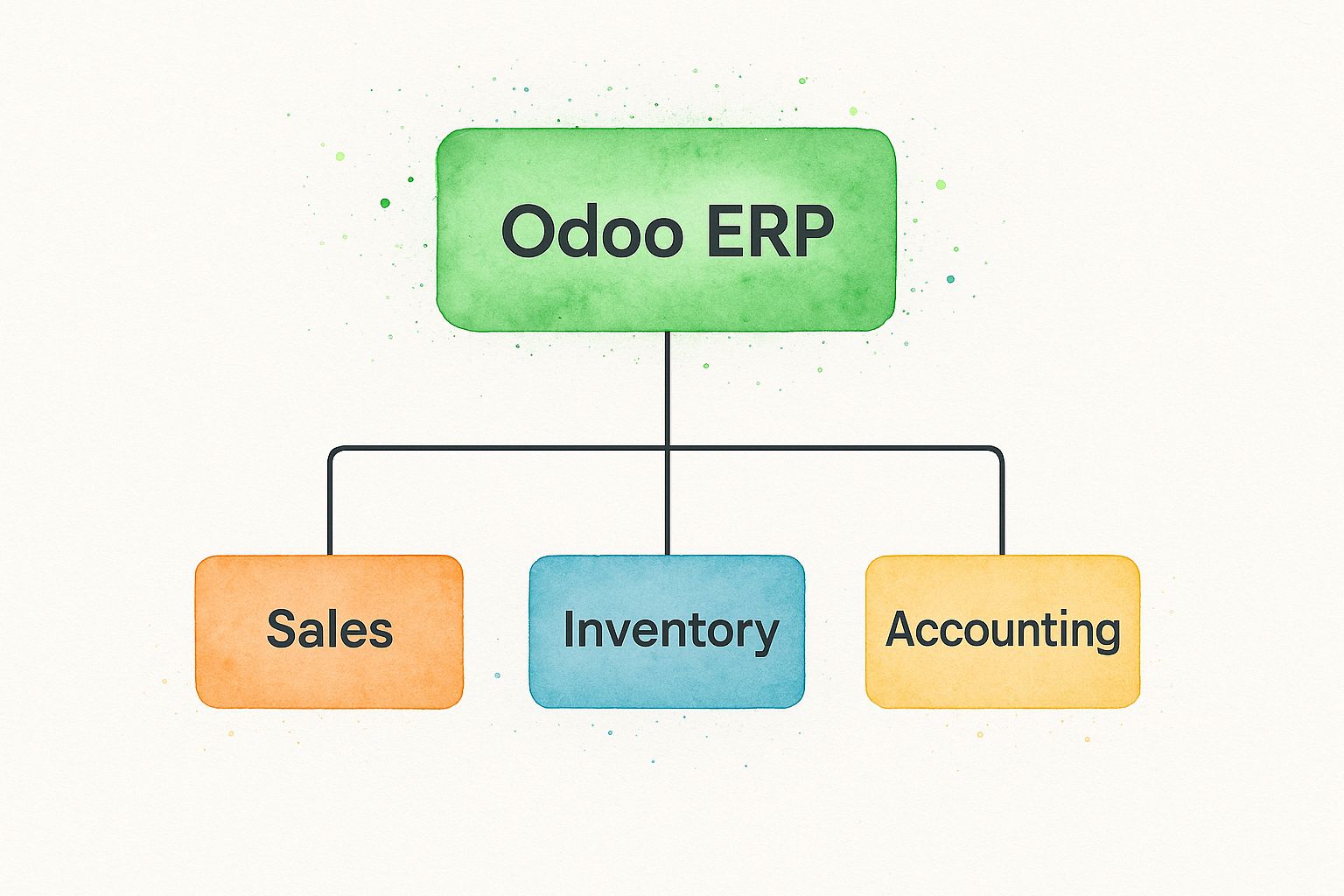
Je ziet hoe de integratie van deze sleutelgebieden een soepele informatiestroom creëert, waardoor de datasilo's die groei zo vaak in de weg staan, worden afgebroken.
Stimuleer verkoop en klantrelaties
Laten we eerlijk zijn: voor elk bedrijf is het beheren van klantinteracties cruciaal. Een rommelig verkoopproces en slecht leadbeheer leiden direct tot omzetverlies. Odoo biedt je krachtige tools om dit aan te pakken.
De CRM (Customer Relationship Management) module is het hart van je hele verkoopoperatie. Zie het als je digitale commandocentrum voor elke lead en klant. Het stelt je in staat om:
- Je verkooppijplijn te visualiseren: Volg elke lead van het eerste contact tot een gesloten deal in een overzichtelijke, aanpasbare pijplijn. Je weet direct waar elke kans staat.
- Follow-ups te automatiseren: Stel herinneringen en activiteiten in zodat geen enkele lead door de mazen van het net glipt. Consistentie is de sleutel tot het omzetten van prospects in klanten.
- Prestaties te analyseren: Krijg live rapporten over de prestaties van je team, controleer conversieratio's en voorspel toekomstige omzet met veel meer vertrouwen.
Bouw je digitale etalage
In de huidige markt kun je niet overleven zonder een professionele webshop. Veel bedrijven worstelen met weinig websiteverkeer en lage conversieratio's, vaak omdat hun website volledig losstaat van hun dagelijkse operatie. De webmodules van Odoo lossen dit probleem structureel op.
De Website en eCommerce modules werken samen, zodat je een prachtige, functionele webshop kunt bouwen zonder een codeerexpert te zijn. De drag-and-drop editor is eenvoudig, maar de echte kracht zit in de naadloze integratie met alles wat er achter de schermen gebeurt.
Wat betekent die integratie voor jou? Wanneer een klant een bestelling plaatst op je Odoo-website, wordt je voorraad automatisch bijgewerkt, een verkooporder aangemaakt en de boekhouding voorbereid. Dit niveau van automatisering vermindert handmatig werk en elimineert kostbare menselijke fouten.
Bovendien hebben deze modules ingebouwde tools om je SEO (Search Engine Optimization) te ondersteunen. Je kunt eenvoudig metatitels aanpassen, SEO-vriendelijke URL's maken en al je content beheren—allemaal vanuit hetzelfde platform waar je ook je producten beheert.
Stroomlijn je operationele processen
Operationele efficiëntie is wat een winstgevend bedrijf onderscheidt van een bedrijf dat alleen maar druk is. Handmatige voorraadtellingen, omslachtige productieprocessen en een onsamenhangende boekhouding zijn stille winstvreters. De operationele modules van Odoo zijn gebouwd om automatisering en duidelijkheid te brengen in deze vitale gebieden.
De snelle adoptie van Odoo in Nederland laat zien hoe effectief het is, vooral in snel veranderende sectoren. Zo rapporteerde in 2023 meer dan 65% van de middelgrote Nederlandse food & beverage-bedrijven dat ze Odoo gebruiken voor hun dagelijkse operaties. Deze sector waardeert de mogelijkheid van het platform om alles te beheren, van voorraad tot klantrelaties, waar snelheid en nauwkeurigheid cruciaal zijn. Je kunt meer inzichten ontdekken over de rol van Odoo in de Nederlandse voedingsindustrie om te zien hoe de flexibele aard ervan bedrijven helpt zich aan te passen en te groeien.
Een helder overzicht van de Odoo-prijzen

Voordat je je aan nieuwe software verbindt, moet je de kosten begrijpen. Dat is gewoon slim zakendoen. Als het om Odoo gaat, is de prijsstelling verfrissend flexibel en ontworpen om met je mee te groeien, wat fantastisch nieuws is voor ambitieuze bedrijven. Laten we de kosten opsplitsen zodat je een weloverwogen beslissing kunt nemen die past bij je budget en doelen.
De prijsstelling van Odoo draait om twee hoofdversies: Odoo Community en Odoo Enterprise. Ze dienen verschillende behoeften, en het verschil begrijpen is de eerste stap naar de juiste keuze voor jouw bedrijf.
Odoo Community: De gratis en open-source optie
Allereerst is er Odoo Community. Dit is de volledig gratis, open-source versie van het platform. En nee, het is geen beperkte proefversie of uitgeklede demo; het is een krachtige set bedrijfstools die je kunt downloaden, op je eigen server kunt installeren en voor altijd kunt gebruiken zonder licentiekosten.
Deze optie is een briljant startpunt voor startups, kleine bedrijven, of elk bedrijf met een solide intern technisch team dat comfortabel is met het beheren van zijn eigen hosting en onderhoud.
Maar "gratis" heeft altijd een paar afwegingen:
- Beperkte functionaliteit: Je krijgt de kernmodules zoals CRM, Sales en Invoicing, maar mist enkele van de geavanceerde functies uit de betaalde versie, met name op het gebied van boekhouding en productie.
- Geen officiële ondersteuning: Je bent op jezelf aangewezen voor ondersteuning. Dat betekent vertrouwen op communityforums en je eigen technische expertise.
- Zelf gehost: Jij bent verantwoordelijk voor de hosting, beveiliging en updates.
Odoo Enterprise: Het all-inclusive betaalde plan
Dan is er Odoo Enterprise. Dit is de premium, betaalde versie die elke beschikbare app ontgrendelt, professionele ondersteuning rechtstreeks van Odoo biedt en een meer verfijnde gebruikerservaring levert. Het is gebouwd voor bedrijven die een complete, kant-en-klare oplossing nodig hebben met alle toeters en bellen.
De prijsstelling voor Odoo Enterprise is verrassend eenvoudig. Het is gebaseerd op een "betaal voor wat je gebruikt"-filosofie, bepaald door twee factoren:
- Het aantal gebruikers: Je betaalt een vergoeding voor elke persoon in je organisatie die toegang nodig heeft.
- De specifieke apps die je kiest: Je selecteert en betaalt alleen voor de modules die je bedrijf daadwerkelijk nodig heeft.
Deze modulaire aanpak is een enorm voordeel. Je zit niet vast aan een opgeblazen systeem vol functies die je nooit zult gebruiken.
De prijsstructuur van Odoo is een directe weerspiegeling van de schaalbaarheid. Het stelt een bedrijf in staat klein te beginnen en uit te groeien tot een uitgebreid ERP-systeem zonder een enorme, onbetaalbare aanvangskost.
Dit model is ook voorspelbaar, wat budgetteren een stuk eenvoudiger maakt. Voor bedrijven die op zoek zijn naar duidelijke, beheersbare kosten, is dit een enorm pluspunt. Bij Digitalique geloven we in dezelfde transparantie, wat je terugziet in onze digitale marketingabonnementen.
De financiële stabiliteit en groei van Odoo inspireren ook vertrouwen. De wereldwijde omzet van het bedrijf schoot voorbij €370 miljoen in 2023, met gedurfde prognoses om €1 miljard te bereiken in 2027. Deze indrukwekkende prestatie, gedreven door het aanpasbare en kosteneffectieve model, resoneert sterk in de Nederlandse markt waar bedrijven schaalbare technologie waarderen. Je kunt de trends verkennen die de groei van Odoo tot 2025 vormgeven om een beter beeld te krijgen van de stijgende marktinvloed.
Is Odoo de juiste keuze voor jouw Nederlandse bedrijf?
We komen bij de grote vraag: is Odoo de juiste keuze voor jouw bedrijf? Na het verkennen van de geschiedenis, functies en prijzen, is het tijd om de balans op te maken. Laten we de belangrijkste voordelen afwegen en eerlijk zijn over waar het misschien niet de perfecte match is.
De grootste kracht van Odoo is het alles-in-één, geïntegreerde ontwerp. Voor een ambitieus MKB-bedrijf dat verdrinkt in een zee van losgekoppelde systemen, is dit een echte game-changer. Als je team uren verspilt aan het handmatig synchroniseren van gegevens tussen je verkoopsoftware, voorraadspreadsheets en boekhoudtools, dan is Odoo gebouwd om precies dat probleem op te lossen.
Dankzij de modulaire aanpak betaal je alleen voor wat je nu nodig hebt, waardoor het een systeem is dat met je meegroeit, en je niet tegenhoudt.
Wanneer Odoo uitblinkt
Odoo is een uitzonderlijke keuze als je jezelf herkent in deze scenario's:
- Je bent aan het opschalen: Je bent je basistools ontgroeid en hebt nu een professionele, centrale hub nodig om de groeiende complexiteit in verkoop, voorraad en klantrelaties te beheren.
- Je hebt één bron van waarheid nodig: Je beslissingen worden vertraagd door tegenstrijdige gegevens uit verschillende apps. Odoo geeft je één uniform dashboard voor een helder, realtime overzicht van je hele operatie.
- Efficiëntie is een topprioriteit: Je wilt repetitieve taken—zoals facturering, orderverwerking en marketing-follow-ups—automatiseren om je team vrij te maken voor waardevoller werk.
Wanneer je moet heroverwegen
Echter, wij geloven in transparantie. Odoo is niet voor iedereen. Als je een freelancer bent die alleen een simpele manier nodig heeft om facturen te sturen, is het platform waarschijnlijk overkill. Ook als je bedrijf extreem niche, gespecialiseerde softwarebehoeften heeft die niet netjes in standaardmodules passen, kan een volledig op maat gemaakte oplossing geschikter zijn.
Het platform is krachtig, maar het vereist een echte toewijding om het correct op te zetten.
Uiteindelijk komt de beslissing neer op ambitie en complexiteit. Als je meerdere processen beheert en streeft naar serieuze, duurzame groei, is Odoo een van de sterkste kandidaten op de markt.
Als je nog steeds je opties afweegt en denkt dat je een meer op maat gemaakte oplossing nodig hebt, kunnen we je helpen je eisen te definiëren en de beste weg voorwaarts uit te stippelen. Je kunt meer te weten komen over onze maatwerkdiensten om te zien hoe we bedrijven ondersteunen bij het nemen van deze kritieke technologische beslissingen.
Veelgestelde Vragen Over Odoo
We horen vaak dezelfde vragen van ondernemers die Odoo overwegen. Het is een flinke stap, dus twijfels zijn heel normaal. Hier geven we duidelijke, eerlijke antwoorden op die veelvoorkomende punten, zodat je een goed beeld krijgt van de implementatie en het dagelijks gebruik.
Is Odoo moeilijk te leren voor mijn team?
Odoo staat bekend om zijn schone, gebruiksvriendelijke interface, wat een enorme verademing is vergeleken met oudere, logge ERP-systemen. Het is ontworpen om intuïtief te zijn.
Maar laten we eerlijk zijn: net als bij elke krachtige bedrijfssoftware is er een leercurve. Verwachten dat je team het van de ene op de andere dag onder de knie heeft, is niet realistisch. Voor een soepele overgang adviseren we altijd een gefaseerde uitrol, beginnend met één of twee kernmodules. Gecombineerd met professionele training, zorgt deze aanpak ervoor dat je team zich vanaf dag één zelfverzekerd en ondersteund voelt.
Kan Odoo integreren met onze bestaande software?
Jazeker. Odoo is vanaf de basis gebouwd als een platform dat makkelijk kan samenwerken met andere tools. Het beschikt over een krachtige API (Application Programming Interface), die je kunt zien als een universele stekkerdoos waarmee het verbinding kan maken met honderden andere applicaties.
Dit betekent dat je het kunt koppelen aan essentiële tools die je al gebruikt, van betaalproviders zoals Mollie tot je favoriete e-mailmarketingsoftware. Veel standaardintegraties zijn direct beschikbaar, en voor unieke of gespecialiseerde software kunnen op maat gemaakte koppelingen worden ontwikkeld.
Hoe helpt Odoo met onze SEO en online marketing?
Dit is waar Odoo zich echt onderscheidt van traditionele ERP's. De Website- en eCommerce-modules hebben ingebouwde SEO-tools. Hiermee beheer je zaken als metatitels en -omschrijvingen direct binnen het platform, zonder dat je een aparte tool nodig hebt voor de basis van je on-page SEO.
Maar nog belangrijker: echt SEO-succes draait om een geweldige gebruikerservaring. Door je website te integreren met de CRM- en Marketing Automation-modules, creëer je een naadloze klantreis. Deze geïntegreerde aanpak verhoogt de betrokkenheid en houdt bezoekers langer op je site – beide sterke, positieve signalen voor Google. Een goed geïntegreerd systeem is het fundament voor een krachtige, datagedreven marketingstrategie.
Mocht je ooit tegen technische problemen aanlopen of advies nodig hebben over het optimaliseren van je setup, dan staat ons supportteam voor je klaar. Meer over onze toewijding aan uitstekende service lees je bij onze customer care helpdesk.
Klaar om te zien hoe een geïntegreerd platform jouw bedrijfsvoering en marketingresultaten kan versterken? Digitalique is jouw strategische partner in digitale groei. Wij helpen bedrijven krachtige tools zoals Odoo in te zetten voor een solide basis voor de toekomst.
Start vandaag nog met groeien via Digitalique. Laat zoals altijd je opmerking achter wat je vond van dit artikel.