
Are your traditional sales methods becoming less and less effective? You’re not alone. The way companies here in the Netherlands conduct research and make purchases has shifted almost entirely online. Your marketing needs to keep pace with this shift. In fact, effectiveB2B online marketingis no longer just a good idea—it’s the engine driving modern business growth.
In this guide, you’ll learn exactly how to build a powerful B2B online marketing strategy that helps you tackle these challenges. We’ll cover everything from laying a solid foundation to measuring results that really matter.
Why Your B2B Sales Strategy needs a digital upgrade

Does it feel like your sales team is working harder than ever for fewer results? That’s a common frustration among B2B companies that still rely on cold calling and trade shows. The hard truth is that the buyer’s journey has completely changed. Your ideal customers are now digital-first researchers.
The Modern B2B Buyer Has the Audit
Long before your sales team gets the chance to make a pitch, your prospect has already done their homework. They turn to Google to understand their challenges, find potential solutions, and evaluate different vendors. They read reviews, compare competitors, and seek expert advice on professional networks such as LinkedIn.
If your company isn't visible during this crucial research phase, you're essentially invisible to a huge portion of your potential market.
Think of it this way: a strong online presence is your best salesperson, working for you 24/7. It informs prospects, builds trust, answers their questions, and directs them straight to your solution.
The Change in The Behavior of B2B Buyers
This change is not just a passing trend; it is a fundamental shift in the way business is conducted. The table below illustrates just how much has changed.
| TTraditional B2B Purchasing | Modern Online B2B Purchasing |
|---|---|
| Depending on outreach by salespeople | Initiated by the buyer's own online research |
| Information verified by the seller | The buyer has been informed and is fully aware |
| A linear, predictable sales process | A non-linear journey across multiple digital channels |
| Face-to-face meetings and phone calls | Digital interactions, demos, and online content |
This new reality is backed by compelling data. Research predicts that by 2025, a staggering80% of B2B sales interactionswill take place through digital channels. It is clear that self-service research and online purchases have become the norm—a trend that Dutch buyers have fully embraced.
From Frustration to Predictable Growth
This new buyer-driven world explains many common business frustrations. Are you struggling with any of the following issues? A weak online presence is often the culprit:
- Low website traffic:Your ideal customers simply can't find you when they're looking for solutions.
- Poor online visibility:Your competitors appear for key search terms, but your business is nowhere to be found.
- Inconsistent lead flow:You're stuck in an unpredictable cycle of surges and lulls in sales inquiries.
- Low conversion rates:The leads you do get aren't a good fit or aren't nearly ready to make a purchase.
The good news? These aren’t permanent problems. By strategically investing inB2B online marketing, you can trade unpredictability for a system of consistent, measurable growth.
You can often see immediate results with targeted campaigns. That’s why we offer comprehensive search engine advertising services to capture buyers with a high intent to purchase right from the start.
The Fundamentals of a Effective B2B Online Marketing Strategy
Are you feeling a bit overwhelmed by all theB2B online marketingoptions out there? We get it. The best way to think about it is like building a house. After all, you wouldn’t start putting up walls without a solid foundation, would you?
A strong marketing foundation isn’t about trying to do everything at once. It’s about establishing a few key pillars effectively, so they work together to attract, engage, and ultimately convert your ideal business customers. These pillars solve those nagging problems—such as low website traffic or a flood of low-quality leads—and create a reliable system for growth.
The Three Core Pillars in B2B Marketing
For most B2B companies here in the Netherlands, a solid foundation comes down to three core activities. When these work together in harmony, they create a powerful cycle of visibility, trust, and conversion.
Let’s take a look at what these essential pillars entail:
- Search Engine Optimization (SEO): This is how your ideal customers find you in the first place. When a potential customer types a problem into Google, SEO ensures that your website appears at the top of the results.
- Content Marketing: This is how you build trust and demonstrate your expertise. By creating truly useful content—such as blog posts, detailed case studies, or white papers—you position your company as a credible authority.
- B2B Advertising (SEA & Social): This is your fast track to immediate, targeted interest. Platforms such as Google Ads and LinkedIn let you get your message directly in front of the right professionals and companies.
Think of it this way:SEOattracts people.Content marketingconvinces them that you’re the expert they need. Andtargeted adsbring in highly qualified visitors who are now ready to do business.
How SEO Laying the Foundation
SEO is the cornerstone of your foundation. It’s a long-term strategy that pays off time and time again. By optimizing your site for the specific keywords your customers use, you create a steady stream of relevant traffic.
A crucial part of this istechnical SEO, which ensures that search engines can easily read your website. This includes things like a fast-loading site and the use of "schema markup."
What exactly is schema markup?Simply put, schema markup is a piece of code that you add to your website and that acts as a set of labels for Google. It tells the search engine, "Hey, this section is a B2B service," or "this is a customer review." This helps you stand out in search results.
Building Authority with Content Marketing
Once people find you through search results, you need to give them a compelling reason to stay and trust you. That’s where content marketing really shines. High-quality content doesn’t just showcase your expertise; it actively helps buyers in their decision-making process.
Truly valuable content solves real problems for your audience. It’s not just a disguised sales pitch. This philosophy is at the heart of how we work at Digitalique.nl. For more practical ideas, check out our approach to content marketing for growth .
Catching the Ball on the Fly with B2B Advertising
While SEO and content build your long-term authority, sometimes you just need to get the phone ringing faster. That’s where B2B advertising on platforms like Google Ads and LinkedIn is incredibly powerful. It allows you to target decision-makers with surgical precision.
These ads put your solution right in front of people exactly when they need it. This generates leads with a high intent to buy who can start filling your sales pipeline today. It’s the perfect way to boost your organic efforts.
Your B2B Online Developing a Marketing Plan
Ready to stop with random marketing campaigns? It’s time to switch to a targeted, well-thought-out strategy. A solid plan is what truly sets apart simplydoingmarketing from actually achieving measurable business growth.
Now let’s get down to business. I’ll walk you through a step-by-step framework for building aB2B online marketingstrategy that actually works. We’ll cover how to identify your target audience, set goals that really matter, and understand your customers’ journey.
Start with Who, Not with Wat
Before you spend a single euro on an advertising campaign, you need to have a crystal-clear understanding of who you’re trying to reach. Too many companies skip this step and waste time and money on an audience that will never buy.
The solution? Define yourIdeal Customer Profile (ICP).
An IKP isn’t just a vague persona; it’s a detailed blueprint of theideal companyyou want as a customer. It goes beyond demographics and delves into the firmographics that are essential for B2B success:
- Industry:Which specific sectors are facing the biggest challenges that your service addresses?
- Company size:Are you equipped to serve startups, small and medium-sized businesses, or large enterprises?
- Revenue:What is the typical annual revenue of a customer who gets the most value out of your service?
- Location:Do you focus on companies in a specific region, such as the Randstad, or throughout the Netherlands?
- Pain points:What specific business challenges does your product or service help solve?
Once you’ve defined your IKP, every marketing decision becomes simpler and more effective.
Set Goals That Generate Revenue
Do you spend your time tracking website visits and social media likes? While those numbers may look impressive, they don’t pay the bills. EffectiveB2B online marketingfocuses on goals that are directly linked to business growth.
Here, theSMART framework is more than just an acronym—it’s a lifesaver. It forces you to set goals that are:
- Specifically: "Increase the number of qualified marketing leads by20%" is much better than "get more leads."
- Measurable: You can track progress using hard data.
- Acceptable: Is the goal realistic given your current resources?
- Relevant: Does achieving this goal directly contribute to revenue?
- Time-bound: Set a clear deadline, such as "within the next quarter."
Setting SMART goals forces you to shift your mindset—away from vanity metrics and toward performance indicators that your CEO and finance department truly care about. That’s how you start demonstrating the true ROI of your marketing.
Bring the B2B Customer Journey Map
The B2B buying process is almost never a straight line. It’s more like a winding road with multiple touchpoints and a whole committee of people involved in the final decision. Understanding this journey is the key to providing the right information at the right time.
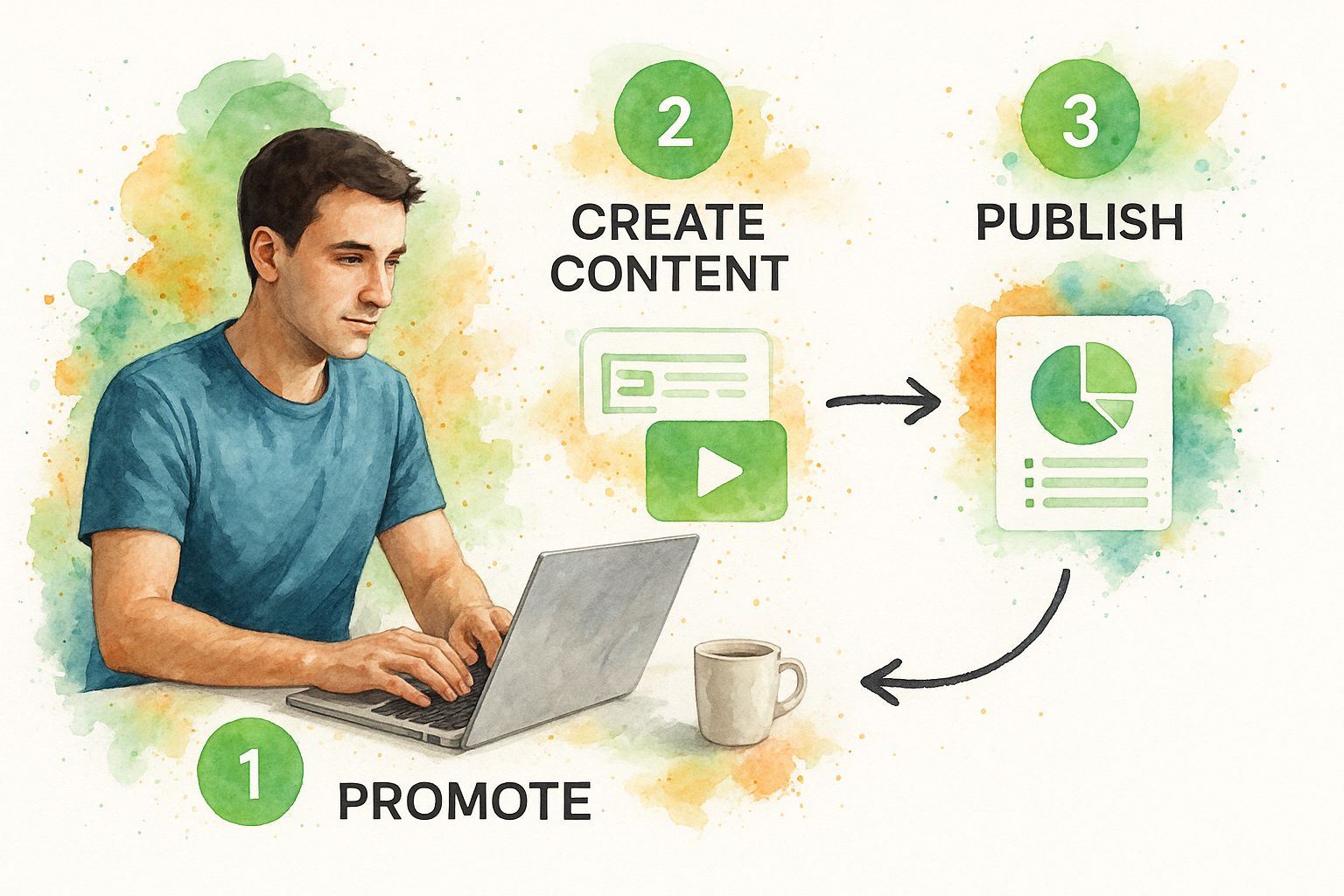
The key insight here is that channels such as content marketing and advertising are not separate from one another; they work together to guide prospects through every stage of their decision-making process.
And this digital journey is more important than ever. The Dutch e-commerce market is expectedto reach an incredibleUSD 56.73 billion by 2030. What is driving this growth? The B2B segment is growing at a robust CAGR of10.51%. You can view this data in the Mordor Intelligence report on the Dutch e-commerce market, demonstrates just how urgent it is for B2B companies to have a structured digital strategy.
A well-planned journey, backed by valuable content, transforms your website from a static online brochure into a dynamic lead-generating machine.
Your B2B Marketing Strategy Putting into Practice
Okay, you’ve mapped out your strategy. Now for the fun part: putting it into action. This is where theory meets practice and where yourB2B online marketingreally comes to life.
In this section, we’ll get down to the nitty-gritty. We’ll dive into the core channels and explore how you can actually use them. I’ll show you how to identify the specific challenges your Dutch B2B clients face and how to create resources that ensure you’re their first and only choice.
Dominating Search Engines with Practical SEO
SEO isn't about chasing vanity metrics. It's about getting therightpeople to find you. It all starts with understanding what your Ideal Customer Profile (ICP) types into Google.
Forget guesswork. Use the right tools to uncover your customers’ actual search terms and questions. Look specifically forproblem-oriented keywords. For example, if you’re an IT consultant, it’s a waste of your time and money to target a broad term like “IT services.” Instead, think of a specific pain point, such as “how can I protect my business from data breaches?” That’s a question from someone with an urgent, specific business need.
Once you have your list of keywords, it’s time to put them to work:
- On-Page SEO:This involves optimizing your individual web pages. Make sure your main keyword appears naturally in the title, meta description, H1 heading, and somewhere near the top of your content.
- Technical SEO:Think of this as the essential behind-the-scenes work. It’s all about ensuring your site is fast, works perfectly on mobile devices, and is secure (HTTPS). A solid technical foundation is essential for good rankings. For a no-nonsense overview, check out the Google’s Search Essentials guide is an excellent resource.
- Local SEO:If you’re targeting specific regions in the Netherlands, this is crucial. Make sure your Google Business Profile is fully completed. And don’t be shy about asking satisfied customers to leave a review—they’re worth their weight in gold.
Content Creation that Converts
The purpose of your content is to build trust and guide potential customers through the purchasing process. We’re talking about more than just blog posts here. In the B2B world, high-quality resources are what truly demonstrate your expertise.
Effective B2B content does more than just inform; it empowers your potential customer to make a better decision. It’s about being a valuable partner long before any money changes hands.
Here are some content formats that work exceptionally well for B2B:
- Case Studies:These are your ultimate proof points. A good case study clearly outlines a client’s problem, describes the solution you provided, and demonstrates the measurable results.
- White Papers & E-books:When you need to cover a complex topic, these in-depth guides establish you as a true authority. They’re great for lead generation.
- Webinars:A webinar provides you with a platform to connect with your audience on a more personal level. You can demonstrate your solution and answer questions in real time.
This goes to the heart of our philosophy at Digitalique.nl. We believe in building sustainable growth through authentic connections, and it all starts with creating content that is genuinely useful.
Generate Leads with Targeted B2B Ads
While SEO and content form your long-term foundation, targeted ads provide that immediate boost. For B2B, platforms like Google Ads and LinkedIn are incredibly effective because they allow you to be so precise about who sees your ads.
Structuring Your LinkedIn Campaigns
LinkedIn is the go-to platform for reaching specific professionals. Be specific when setting up your campaign:
- Target Job Titles:Focus on the decision-makers who matter, such as "Marketing Manager," "CFO," or "Operations Director."
- Target by Company Size:Filter for companies that match your ideal customer profile, whether they have11–50employees or500+.
- Target by Industry:Choose specific industries that benefit most from your service, such as "Financial Services" or "Software & IT."
Optimizing Your Google Ads for B2B
With Google Ads, it’s all about intent. You reach people who are actively looking for a solutionright now:
- Use B2B-Specific Keywords:Add terms such as "for businesses," "supplier," "software," or "service" to your keywords.
- Create Dedicated Landing Pages:Please don’t send your ad traffic to your homepage. Build a specific, well-organized landing page with a single clear call to action.
- Focus on Conversion Tracking:You need to track what really matters—form submissions, phone calls, or demo requests. Without this data, you’re simply throwing money away. You can see how we put this into practice with our search engine advertising services.
Measuring Success and Prove Your ROI

How do you prove that your marketing actually generates revenue for the company? This is probably the most important question in business. It’s far too easy to get lost in a sea of data without knowing what it really means for profits.
This is where many companies go wrong. They measure activity, but not impact. But effectiveB2B online marketingisn’t about looking busy; it’s about driving real, profitable growth. Let’s focus on the numbers that really matter.
Beyond the Vanity metrics
The first, most crucial step is to stop obsessing over "vanity metrics." These are numbers that feel good but have no direct link to revenue. A thousand new followers on LinkedIn is nice, but it doesn't pay the bills.
Instead, we should focus onKey Performance Indicators (KPIs). These are the metrics that directly measure the health of your business.
Think of it like driving a car. The number of trees you pass is just a vanity metric. Your speed and the amount of fuel in your tank are your KPIs—they tell you whether you’ll reach your destination.
The KPIs That Really Matter What to Do for B2B
For most B2B companies, a handful of key KPIs tell pretty much the whole story. Let’s take a look at the most important ones.
| KPI (Key Performance Indicator) | What it tells you | Why it is important for B2B |
|---|---|---|
| Lead-to-Customer Conversion Rate | What percentage of your leads become paying customers? | This is the ultimate test of your lead quality and sales process. |
| Customer Acquisition Cost (CAC) | How much does it cost you to acquire a single new customer? | Essential for understanding profitability and setting marketing budgets. |
| Customer Lifetime Value (CLV) | What is the total revenue you can expect from a single customer? | In B2B, long-term relationships are crucial. A high CLV justifies higher acquisition costs. |
| Marketing-Qualified Leads (MQLs) | How many leads are ready for a sales call? | This measures thequality—not just the quantity—of your leads. |
Tracking these results is more important than ever. The Dutch B2B e-commerce sector is a perfect example: in 2023, revenue from online transactions for physical goods exceeded34 billion U.S. dollars. Explore the data behind these trends in B2B e-commerce revenue on Statista.
Connecting the Dots with Google Analytics 4
How do you keep track of all this? Your most powerful free tool isGoogle Analytics 4 (GA4). It might seem a bit intimidating at first, but its purpose is to help you connect your marketing activities to real business results.
GA4 is designed to help you understand the entire customer journey. You can track specific, valuable actions—such as form submissions or demo requests—as "conversion events."
When you set up these conversions correctly, you can see exactly which channels are bringing in your best leads. You might find that your blog posts (SEO) generate the most MQLs, while your LinkedIn Ads have the lowest CAC. That’s the kind of insight that helps you make smart, data-driven decisions.
This data-driven mindset should apply to every channel, including email. Our approach to growing your business with email marketing newsletters is built on this principle of clear tracking.
By focusing on these key KPIs and using tools like GA4, you can finally get a clear picture of your marketing ROI and demonstrate that yourB2B online marketingis a powerful driver of growth.
Do you have any questions about B2B online marketing? Let's clear things up
We’ve explored the world of B2B marketing, but it’s only natural to still have questions. That’s a good sign—it means you’re thinking strategically. Let’s address some of the most common questions we hear from Dutch entrepreneurs.
How Much Should I Budget? for B2B Marketing?
That’s the key question, isn’t it? While there’s no one-size-fits-all answer, a good rule of thumb for a company serious about growth is to allocate5–10% of your annual revenueto marketing.
But look at it another way: don’t view it as an expense, but as a strategic investment. The real answer lies in your numbers. Calculate your Customer Acquisition Cost (CAC) and your Customer Lifetime Value (CLV). If a new customer brings in €10,000, how much does it make sense to invest to acquire that customer?
Which Channel Is Better: SEO or SEA?
The classic dilemma. But the truth is, it’s not a contest. The best strategies don’t choose one over the other—they use both in harmony.
- SEA (Search Engine Advertising):This is your tool for immediate results. SEA delivers traffic and leads right now.
- SEO (Search Engine Optimization):This is your long-term investment. SEO builds sustainable, organic traffic and establishes your brand as an authority.
Think of it this way: SEA is the sprinter—fast and powerful. SEO is the marathon runner, building up the stamina to win the entire race.
How Long Does It Take? Do You ReallyWant to See Results?
The honest answer? It depends entirely on the channel you use. If you use well-targeted search engine advertisingcampaign, you can see new traffic and leads within a few days.
Content marketing and SEO, however, are a different ballgame. You’re building a foundation of trust and authority, and that can’t be rushed. You can expect to see the first signs of traction in about4–6 months, with a more significant impact around 6–12 months. Patience here is more than a virtue; it’s a strategy.
Your Next Step Toward Sustainable Growth
Knowing the theory is one thing, but achieving results comes from consistent, focused action. You’ve just gone through the basics ofB2B online marketing. You have the blueprint.
But the secret isn't to try to do everything at once. That's a surefire recipe for burnout. Real, sustainable growth comes from starting small, being disciplined about what the data tells you, and then doubling down on what really works foryourbusiness.
From Knowledge to Practical Steps
What now? The best way forward is to break everything down into small, manageable steps. Focus on doing one thing well, and then move on to the next.
At its core, it all comes down to one thing: building genuine relationships by providing value at every touchpoint. If you do that, your ideal customers won’t just find you—they’ll choose you.
Your Quick Start B2B Marketing Checklist
To help you get started right away, here’s a simple, practical checklist. Use it to decide what to tackle first on your path to predictable growth.
- Define your Ideal Customer Profile (ICP):Be incredibly specific about the type of business you want to attract. Write it all down.
- Conduct Basic Keyword Research:Identify5–10 core "problem-aware" keywordsthat you would type into Google.
- Review Your Key Pages:Take a critical look at your homepage and main service pages. Do they address the issues outlined in your IKP?
- Set up conversion tracking in GA4:You can’t improve what you don’t measure. Make sure you can track at least one key conversion.
- Create One High-Quality Piece of Content:Focus on creating a single, incredibly useful piece of content. Think of a detailed case study.
- Optimize your Google Business Profile:This is a great quick win. Make sure all your information is correct.
Start with these six steps. They are the essential building blocks for a powerful B2B marketing engine that will pay dividends for years to come.
About Digitalique
Your vision of greater visibility, more customers, and more growth is within reach. AtDigitalique.nl, we serve as your strategic partner to turn that vision into reality by combining a smart strategy with transparent, measurable actions.
Ready to grow tomorrow? Let’s start the conversation today. Visit us at https://digitalique.nl to see how we can help you.