
.
Enhancing your website conversion rate transcends mere interface adjustments; it involves converting a greater proportion of visitors into customers. This is not achieved through a singular magical intervention but through a systematic understanding of visitor motivations and the barriers impeding their progression. As an entrepreneur or marketing manager, you recognize the value of every visitor, but how do you effectively guide them to become actual customers?
In this article, you will discover practical, proven strategies to achieve precisely that. We will cover realistic benchmarks, the psychology behind trust and urgency, and how to incrementally enhance your website through intelligent testing. Let's begin.
Setting Realistic Goals with Dutch Conversion Benchmarks
Before you change a single element on your site, you need to know where you stand. Without a clear picture of your current performance and realistic benchmarks, it is impossible to measure success. You want to base your strategy on data, not guesswork. Setting clear goals is therefore the very first step toward higher conversion.
The Dutch e-commerce market is unique and highly competitive. By the end of 2023, the average conversion rate for Dutch webshops hovered around 2.8%, slightly above the global average. However, this figure alone does not tell the whole story, as the origin of your traffic plays a significant role in what you can expect.
Average Dutch Conversion Rates by Traffic Source
A rapid comparison illustrating the conversion performance of various traffic sources on an average Dutch e-commerce website.
| Traffic source | Average Conversion Rate |
|---|---|
| Direct Traffic | 3,3% |
| Paid Search Queries | 3,2% |
| Organic search | 2,7% |
| Email Campaigns | 2,6% |
| Social media | 1,5% |
These metrics indicate that not all visitors are equal. Direct traffic and paid search typically yield the highest-intent leads, whereas social media often focuses more on discovery and less on immediate conversion.
Why These Figures Are Important
These data provide a framework. Imagine your organic traffic converts significantly below the average of 2.7%. This immediately gives you a concrete starting point for optimization. Conversely, if your social media marketing performs well above 1.5%, that's excellent; you're clearly excelling in that area. The objective is not to blindly pursue the average, but to identify your specific weaknesses and further leverage your strengths.
Data is the voice of your customer. Benchmarks are the way to hear if you are listening.
Each traffic source attracts a distinct visitor type, each with varying intent. An individual who directly types your URL likely already recognizes your brand and is significantly further along in the purchase journey than someone arriving via a broad search query.
The graph below illustrates the potential effect of optimization, where an increase in conversion directly leads to a lower bounce rate.
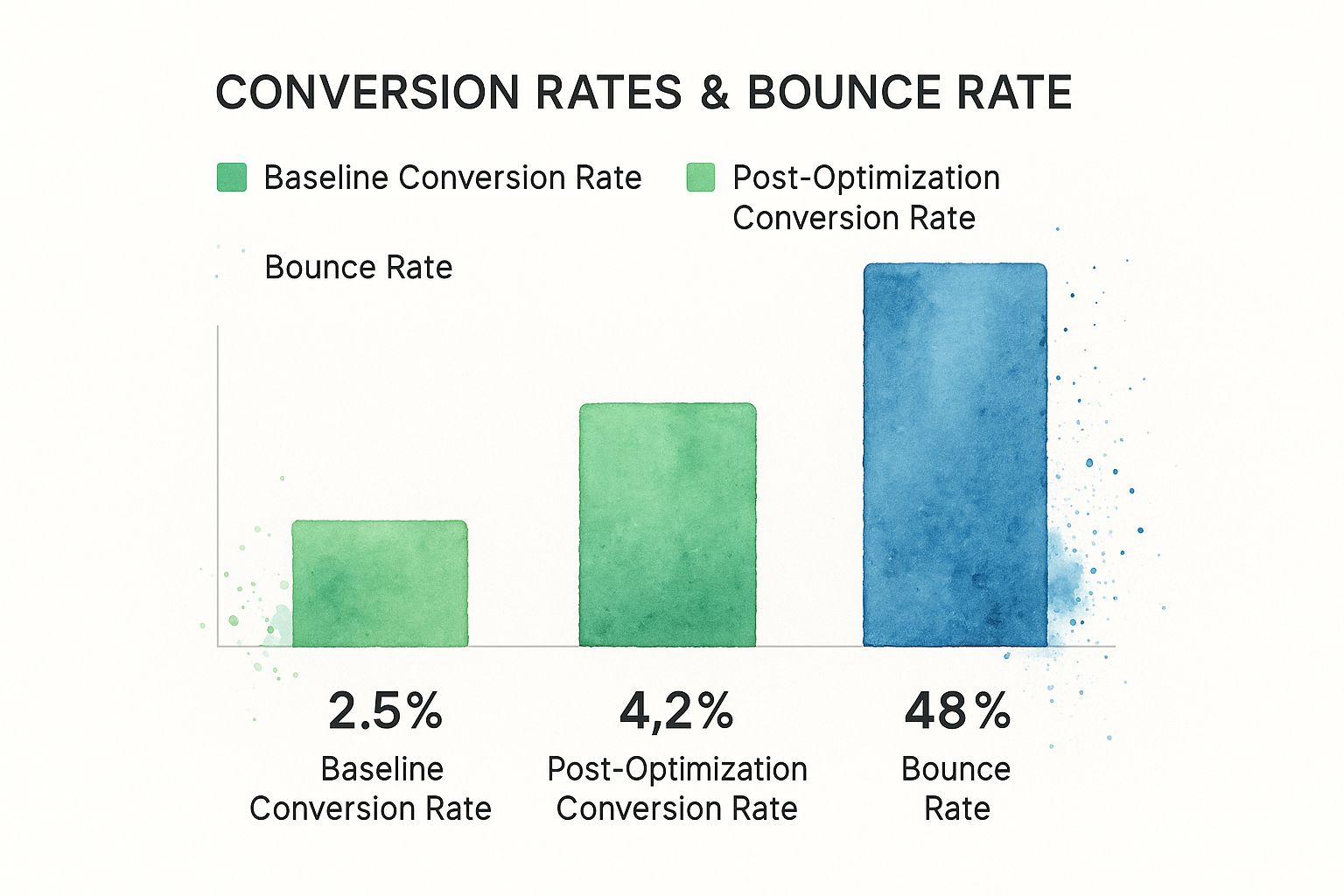
As you can see, a seemingly small jump from2.5%to4.2%can have a huge impact on your operating results.
The Role of Device Usage
Another crucial element to consider is device usage. Traditionally, desktops exhibit higher conversion rates than mobile phones. This is logical: complex purchases or extensive form completion are inherently more manageable on a larger screen.
Nevertheless, an increasing portion of the customer journey takes place on mobile devices. A poor mobile experience immediately drives visitors away, before they even have the opportunity to convert later on their desktop.
Consequently, a fluid mobile site is no longer an optional enhancement but an absolute imperative. Ensure that your website not only functions on mobile devices but is truly optimized for an intuitive user experience. Consider the following:
- Fast Load Times: Every second counts, especially on mobile.
- Intuitive Navigation: Visitors should be able to locate desired information with minimal cognitive effort.
- Prominent CTA Buttons: Buttons must be adequately sized and easily accessible for thumb interaction.
- Concise Forms: Request only the absolutely essential information. Make it easy for your visitor.
The Psychology of Trust and Urgency
To increase yourwebsite conversion, we needto dig deeper than just the technology. We dive into the human psyche. As soon as a visitor lands on your site, two questions unconsciously pop into their head: "Can I trust this club?" and "Why should I do thisnow?". The answer to those questions is the key to better conversion.
One may possess the most aesthetically sophisticated website globally, yet without cultivating trust, no meaningful engagement will transpire. Trust serves as the foundational imperative.
Instantly Build Trust with Social Proof
One of the most potent psychological principles is social proof. Human behavior often exhibits herd mentality; we consistently observe the actions of others to validate our own decisions. Witnessing positive experiences from peers instills a greater sense of security in adopting similar courses of action.
How to Strategically Apply Social Proof?
- Customer Reviews and Testimonials: Authentic, honest reviews are invaluable. Display them prominently, such as on your product pages, homepage, and even during checkout.
- Quality Marks and Certifications: Logos from recognized entities (such as Thuiswinkel Waarborg or an industry association) function as a visual shortcut to establishing credibility.
- Case Studies: Demonstrate with concrete figures and narratives how you have assisted other clients. Results speak louder than vague promises.
By demonstrating social proof, you significantly lower the barrier to entry for new visitors. This is a pivotal step in enhancing your website's conversion rates.
A visitor will only commit to a purchase when they perceive their investment – encompassing both financial outlay and trust – to be secure.
Cultivate a Sense of Urgency and Scarcity
Okay, you've gained their trust. Now what? The next step is to motivate visitors to take actionnow. People are masters at procrastinating. Without a good reason to decide immediately, they will leave your site with the vague promise of "I'll come back later" – which nine times out of ten they won't.
Here, urgency and scarcity become pivotal. These techniques capitalize on our innate fear of missing out (commonly known as FOMO: Fear Of Missing Out).
Practical ways to create urgency:
- Limited-Time Offers: Utilize a countdown timer for a discount promotion. "2 days left for 20% off" performs significantly better than a generic sale.
- Delivery Deadline: "Order within 3 hours and receive your package tomorrow" establishes a clear deadline, prompting users towards a swift decision.
And this is how you apply scarcity:
- Limited Stock: Notifications such as "Only 3 left in stock" can often incentivize hesitant buyers to complete a purchase.
- Exclusive Access: Offer a limited number of spots for a webinar or a limited edition product.
An important caveat: always employ these techniques ethically. Fabricated scarcity is easily detected by consumers and will undermine the trust you have diligently built.
Formulate a Crystal-Clear Value Proposition
The final, and arguably most critical, psychological pillar is clarity. What do you offer? To whom? And why are you superior to the competition? This constitutes your value proposition.
A compelling value proposition directly addresses the query: "What's in it for me?".
Consider Coolblue's slogan: "Everything for a smile." This not only communicates what they sell but also the emotional promise of premium service. Alternatively, take a B2B software company stating: "Save 10 hours weekly on administration." That represents a concrete, tangible benefit.
Your value proposition must immediately stand out on your homepage and be consistently reinforced across all touchpoints. Use clear, concise language, avoiding marketing jargon. If a visitor doesn't grasp what you offer and its benefits within five seconds, you've lost them. This is the ultimate test in your mission to increase website conversion.
A Frictionless Designing User Experience
A visitor who is compelled to search, deliberate, or wait is a visitor who disengages. Any form of friction — be it a slow page, an ambiguous button, or a confusing menu is — will incur significant financial losses. To enhance your website's conversion rate, you must roll out the red carpet and relentlessly eliminate every impediment along the customer journey.
A seamless User Experience (UX) is not a luxury; it is the fundamental prerequisite for a profitable website. The objective is to facilitate the visitor's journey towards conversion as effortlessly as possible. This commences with an in-depth analysis of the entire user journey, from the initial click to the ultimate conversion.

Simplify Your Navigation to the Extreme
Can your visitors find what they are looking for within three clicks? If the answer is no, you have some work to do. A complicated navigation structure is one of the biggest conversion killers there is. People are impatient and don't have time to solve a puzzle.
Your navigation must be so intuitive that it requires no cognitive effort. Utilize clear, recognizable terminology in your menu. Eschew creative jargon in favor of terms your customers naturally employ. Analyze on-site behavior with tools such as heatmaps to identify areas where users encounter friction or engage in excessive clicks.
Optimal navigation is imperceptible. It guides the user effortlessly from point A to point B without requiring conscious thought.
Make Your Website Mobile-Perfect
For many of your customers, their mobile phone is the starting point of their search. A website that doesn't function perfectly on a small screen is like leaving the door of your physical store ajar. Technically accessible, but not particularly inviting.
A perfect mobile experience extends far beyond merely a 'responsive' design. It signifies:
- Rapid Load Times: Each second of delay on mobile devices results in a significant attrition of your visitor base. Consequently, prioritize the optimization of your images and code.
- Large, Tap-Friendly Buttons: Ensure that CTAs and menu buttons are easily operable with a thumb.
- Legible Fonts: Text must be comfortably readable without requiring users to zoom in.
- Simplified Forms: Minimize the number of fields and leverage autofill options intelligently.
Initial engagement with a prospective customer frequently occurs via mobile devices. If that experience proves frustrating, they are highly unlikely to return on their desktop later.
Optimize Your Charging Speed
Waiting is detrimental to conversions. A website that takes longer thanthree secondsto load loses almost half of its visitors. A slow site feels unprofessional and unreliable, which directly affects your results.
Employ tools like Google PageSpeed Insights to assess your site's performance. The resulting recommendations, such as image compression and code minification, represent actionable insights. While accelerating your website is a technical endeavor, it stands as one of the most impactful methods to significantly enhance your conversion rate.
Design Intuitive Forms and Powerful CTAs
The form frequently represents the final hurdle before conversion. Your mandate is to minimize this barrier. Request only the information that is absolutely essential. Each additional field presents a new impetus for abandonment.
Combine a concise, clear form with a compelling Call-to-Action (CTA). An effective CTA is characterized by:
- Action-Oriented: Use verbs that incite action, such as "Download Now," "Request Your Quote," or "Start Your Free Trial."
- Visually Striking: Ensure the button utilizes a contrasting color and is surrounded by ample whitespace.
- Clear: The button text must accurately describe the action that occurs upon clicking. No surprises.
Collectively, these elements determine whether a visitor takes that final, crucial step. A systematic approach to this is an essential component of any conversion optimization strategy.
It is crucial to understand that most visitors do not convert immediately. Research indicates that only 22% of new visitors to e-commerce sites make a purchase within the first month. This underscores the paramount importance of a seamless user experience to create a compelling first impression, thereby encouraging their return visits.
A Practical Guide to A/B Testing
Stop guessing what works and what doesn't on your website and start knowing for sure. This is where A/B testing comes in. It may sound technical, but the concept is surprisingly simple: you show two versions of the same page to different groups of visitors to see which one performs better. This data-driven approach is the engine behind continuous improvement.
Think of it as an eye test at the optician. They show you two lenses and ask, "Which one is clearer, number one or number two?" Based on your answer, they adjust the lens. A/B testing does exactly the same thing for your website and helps youincrease website conversionthrough small, measurable adjustments.
Formulate a Robust Hypothesis
Every successful A/B test does not begin with a random idea, but with a solid hypothesis. This is merely an informed conjecture about which change will lead to a better outcome, and crucially, why. It represents the distinction between arbitrarily altering a button color and having a strategic rationale for it.
A well-formulated hypothesis adheres to a simple structure: "If I modify [A] to [B], then [C] will occur, because [D]."
- [A] is the element you are modifying (e.g., the text on a button).
- [B] is the proposed alteration (e.g., from "Send" to "Receive your free quote").
- [C] is the anticipated outcome (e.g., an increase in form submissions).
- [D] is the rationale for expecting this result (e.g., the new text is more specific and value-driven).
A concrete example: "If we change the button text from 'Read More' to 'Watch a 2-minute demo,' we anticipate an increase in the click-through rate, as visitors will have precise expectations regarding the content and time commitment." This approach necessitates strategic deliberation for each test.
What Can You Test to Improve Conversion?
The possibilities for A/B testing are nearly endless, but it is best to focus on elements with the greatest potential impact on user behavior. Begin with pages that receive the most traffic or are crucial to your conversion funnel, such as your homepage, product pages, and the checkout process.
Here are a few high-impact elements to consider:
- Headings and Subheadings: Does a heading emphasizing a benefit perform better than one focusing on a feature? Test various approaches to see what captures your audience's attention.
- Call-to-Action (CTA) Buttons: Experiment with the text, color, size, and placement of your CTAs. A simple change from "Buy Now" to "Add to Cart" can yield a significant difference.
- Images and Videos: Test various visuals. Does a product video lead to more sales than static images? Does a photograph of someone utilizing your product build more trust?
- Page Layout and Design: You can also test more substantial modifications, such as repositioning a form from the right side to the left, or implementing a single-column layout instead of a multi-column structure.
- Product Descriptions: Experiment with a different tone of voice or focus on alternative benefits. One version might emphasize technical specifications, while another focuses on how the product solves a specific problem.
Remember that the goal isn't just to find a "winner." The real goal is to learn what resonates with your audience so you can apply those insights to your entire website.
Tools to Get Started
Commencing A/B testing does not necessitate a substantial budget or a dedicated development team. Numerous intuitive tools are readily available, streamlining the setup and execution of tests.
- Google Optimize: While being phased out, its functionalities are being integrated into Google Analytics 4. For many businesses, this remains a powerful and free option.
- VWO (Visual Website Optimizer): A highly popular and accessible platform featuring a visual editor that enables the implementation of modifications without requiring direct code manipulation.
- Optimizely: A more advanced platform, designed for larger enterprises requiring robust testing functionalities.
Many of these tools offer visual editors. This means you can click directly on elements on your page and adjust them to create a test variant. They take care of the technical side of splitting traffic and measuring results, so you can focus on the strategy.
Correctly Interpreting the Results
Once your test has run long enough to collect sufficient data, it's time to analyze the results. The tool shows which version—the original (the control) or the variant—performed better and by what percentage. But the most important number to look at is thestatistical significance.
Statistical significance tells you how confident you can be that the results are not simply due to chance. Most platforms calculate this for you and aim for a confidence level of95%. If your test reaches this level, you can be reasonably sure that the winning variant will also perform better in the long term.
Don't stop a test too early just because one version seems to be winning. Let it run for its full duration—at least one to two full business cycles—to account for daily and weekly fluctuations in visitor behavior. By testing patiently and implementing the winners, you'll gradually build a stronger, more effective website based on data rather than gut feeling.
The Customer Experience Personalize
Not all your website visitors are the same, so why treat them that way? A uniform approach for everyone is a missed opportunity. If youwant to increase website conversion, you need to personalize and segment the experience. It's the transition from shooting with buckshot to precision work.
The essence of personalization is fundamentally simple: delivering the right message, to the right person, at the right time. This creates a significantly more relevant and, consequently, more effective customer journey. After all, a visitor who already knows and trusts your brand requires a vastly different approach than someone encountering it for the first time.
The Difference Between Branded And Non-Branded Traffic
A foundational approach to audience segmentation involves analyzing their discovery pathway. Did they originate from a search query incorporating your brand name (branded traffic), or through a generic search term (non-branded traffic)? This seemingly minor divergence in search intent carries substantial strategic ramifications.
Visitors who specifically search for your brand name exhibit significantly higher purchase intent. They are already familiar with your brand, likely trust it, and are often further along in their decision-making process. For this segment, the conversion path should be optimized for brevity and fluidity. This includes intuitive product pages, a streamlined checkout process, and the prominent display of popular items.
Non-branded traffic, on the other hand, consists of people who have a problem or need but don't yet have a specific brand in mind. For example, they search for "sustainable running shoes" rather than "Nike Pegasus." You first need to convince and inform these visitors. They need confidence-building content, such as reviews, comparisons, and detailed product information. It is essential to optimize the content and customer journey for these different intentions in order to increase your conversion rate.
Implement Dynamic Content
Today's technology makes it possible to tailor your website content to visitors in real time. This is calleddynamic content. Think of it as a digital chameleon that changes color based on its environment. It allows you to offer a unique, personalized experience that significantly increases the chance of conversion.
What can you customize?
- Location: Display a special offer for visitors from Amsterdam or direct them to the nearest physical store.
- On-site Behavior: If a user has repeatedly viewed a specific product category, dynamically display a homepage banner featuring products from that category.
- Referral Source: If a visitor originates from a partner website, greet them with a personalized welcome message, such as: "Welcome, [Partner Name] reader! Here is your exclusive discount."
- Timing: Display a different message in the morning ("Start your day right with...") than in the evening ("Order now, delivered tomorrow").
Personalization is no longer a "nice-to-have." It is the expectation of the modern consumer. A personalized experience shows that you understand and value your customer.
Re-engage Abandoning Visitors Through Retargeting
What do you do with the majority of visitors who leave your website without converting? You don't just let them go. Withretargeting(or remarketing), you can reach this group again with targeted ads on other platforms, such as social media or other websites.
It is a highly effective strategy because you are advertising to an audience that has already demonstrated interest in your brand. You can also be highly granular. For instance, someone who has abandoned a pair of shoes in their shopping cart can be shown an advertisement featuring those exact shoes, perhaps even with a small discount to incentivize conversion.
A sophisticated retargeting strategy is an indispensable component of your efforts to enhance website conversion. It serves to remind individuals of your brand and provides the subtle impetus needed to complete their intended action.
The key to successful personalization, both on-site and through retargeting, is robust content. Delivering the right message at the right time requires a well-considered approach. Discover how we can assist you with an effective Content Marketing Strategy. By personalizing the customer journey, you not only enhance the relevance of your marketing efforts but also significantly boost their profitability.
Frequently Asked Questions About Increase Website Conversion
Here, we delve into frequently asked questions from Dutch entrepreneurs and marketing managers. We provide concise, clear answers to guide you through the subsequent stages of the website conversion optimization process.

How Quickly Will I See Results from Conversion Optimization?
This is the question universally posed, and the candid response is: it varies. There is simply no fixed timeline for achieving results in conversion optimization.
For minor adjustments, such as an A/B test on the call-to-action text of a high-traffic page, statistically significant results can sometimes be observed within a few weeks. More substantial strategic modifications, such as a complete redesign of your checkout process, necessitate a longer timeframe for sufficient data collection, typically spanning several months.
Consistency is key. View CRO not as a one-time project, but as an ongoing process of testing, learning, and refinement. It is the small, continuous improvements that yield the most significant long-term growth.
What is a good conversion rate for my industry?
While industry benchmarks, such as the 2.8% for Dutch e-commerce, are accessible online, it is perilous to fixate solely on them. An 'optimal' conversion rate is entirely contingent upon your unique operational context.
Contributing factors include:
- Industry and Product: An e-commerce store selling consumer goods priced at a few tens of euros will naturally exhibit a higher conversion rate than a B2B company offering complex software.
- Price: A luxury watch brand might be perfectly content with a conversion rate of 0.5%, whereas a fast-fashion retailer aims for 3-5%.
- Traffic Source: As we have already observed, direct traffic converts very differently from visitors arriving via social media.
Shift your focus from generic industry benchmarks to the continuous enhancement of your own performance. The primary objective is to surpass your results from the preceding quarter. This represents the sole truly relevant benchmark.
Are Expensive Tools Necessary to Initiate CRO Efforts?
Absolutely not. The misconception that immediate investment in expensive, complex software is requisite unnecessarily impedes numerous entrepreneurs. Significant progress can be achieved utilizing complimentary and highly cost-effective tools that provide robust insights.
A comprehensive starter kit comprises:
- Google Analytics 4: Indispensable and entirely free. It enables analysis of visitor acquisition channels, page engagement, and drop-off points within the conversion funnel.
- Heatmap & Session Recording Tools: Tools such as Hotjar or Microsoft Clarity offer generous free plans. These tools provide visual insights into user click behavior and scroll depth, invaluable for identifying friction points on your site.
Commence by thoroughly comprehending the data insights yielded by these tools. The consideration for investment in more sophisticated software should only arise upon encountering the inherent limitations of these complimentary solutions.
Also, keep in mind that visitors don't always convert immediately. A good follow-up strategy is crucial. Learn more about how to keep leads warm in our A Guide to Effective Email Marketing.
Your online presence is the engine driving your future growth. Procrastination is not an option. By investing today in a robust digital marketing and e-commerce strategy, you establish the foundation for tomorrow's successes. Are you prepared to take this step? Digitalique is your strategic partner.
Leave a message or ask your question. We would love to hear from you.