
Besteed je jouw marketingbudget wel effectief, of ben je vooral aan het gokken welke kanalen nu écht voor omzet zorgen? Dit is een vraag waar veel Nederlandse ondernemers en marketingmanagers mee worstelen. Marketing Mix Modelling (MMM) is de datagedreven oplossing die hier duidelijke antwoorden op geeft. Het kijkt verder dan simpele metrics en laat je de ware return on investment (ROI) van elke geïnvesteerde euro zien.
In deze gids leer je:
- Wat marketing mix modelling precies is en waarom het essentieel is voor jouw bedrijf.
- Welke data je nodig hebt voor een succesvolle analyse.
- Een praktisch stappenplan om MMM te implementeren.
- Hoe je de resultaten vertaalt naar slimmere, winstgevende beslissingen.
Wat is Marketing Mix Modelling Nu Eigenlijk?

Stel je voor dat je een chef-kok bent die een signatuurgerecht perfectioneert. Je gebruikt allerlei ingrediënten – specerijen, groenten, eiwitten – maar je weet niet precies welke hoeveelheden de beste smaak opleveren. Is het de paprika, de verse kruiden of toch de kooktijd die het verschil maakt?
Marketing Mix Modelling (MMM) werkt op een vergelijkbare manier voor je bedrijf. Het is een krachtige statistische analysetechniek die elk van je marketingactiviteiten als een ‘ingrediënt’ behandelt. Het analyseert al je inspanningen, van Google Ads en socialmediacampagnes tot tv-spots en winkelpromoties, om te bepalen hoe elk onderdeel bijdraagt aan je totale omzet.
In plaats van kanalen los van elkaar te bekijken, geeft MMM je dus een holistisch beeld van je volledige marketingprestaties.
Verder Kijken dan Simpele Metrics
De meeste marketingplatforms geven je basisstatistieken zoals kliks, impressies of likes. Hoewel die nuttig zijn, vertellen ze niet het hele verhaal. Een Facebook-campagne kan duizenden likes opleveren, maar heeft die ook echt geleid tot meer verkopen in je webshop? Dit is precies waar MMM uitblinkt.
Het legt de verbinding tussen je marketinguitgaven en de daadwerkelijke bedrijfsresultaten, zoals omzet of marktaandeel. De analyse houdt bovendien rekening met externe factoren die de verkoop kunnen beïnvloeden, waardoor je een veel nauwkeuriger beeld krijgt. Denk aan factoren zoals:
- Seizoensinvloeden: De impact van feestdagen als Kerstmis of Sinterklaas op je verkopen.
- Economische trends: Hoe consumentenvertrouwen of inflatie het koopgedrag beïnvloedt.
- Acties van concurrenten: Het effect van een grootschalige promotie van een concurrent op jouw prestaties.
- Prijswijzigingen: Hoe je eigen prijsaanpassingen de vraag beïnvloeden.
Door deze variabelen mee te nemen, isoleert marketing mix modelling de ware impact van je marketing en filtert het de externe 'ruis' eruit.
Waarom Dit Belangrijk Is voor Jouw Bedrijf
In een wereld met talloze marketingkanalen, van Bol.com-advertenties tot de strategische inzet van influencer marketing, is het makkelijk om het overzicht te verliezen. Je hebt een beperkt budget en je wilt dat elke euro telt.
MMM gaat niet alleen over het meten van prestaties uit het verleden; het is een strategische tool om de toekomst te plannen. Het stelt je in staat om met vertrouwen cruciale bedrijfsvragen te beantwoorden, zoals: "Als ik volgend kwartaal € 10.000 extra te besteden heb, waar kan ik dat dan het beste in investeren voor de hoogste opbrengst?"
Deze datagedreven aanpak haalt het giswerk uit je strategie. Het stelt je in staat om budget te verschuiven van kanalen die onderpresteren naar kanalen die bewezen resultaten opleveren, waardoor je jouw ROI systematisch verbetert. Dit inzicht is de basis voor duurzame groei en het maken van slimmere, winstgevendere marketingbeslissingen.
De Bouwstenen van een Krachtige Marketing Mix Modelling Strategie

Om echt waardevolle, game-changing inzichten uit marketing mix modelling te halen, moet je bouwen op een ijzersterk fundament. Vergelijk het met een huis: als de fundering zwak is, wordt de hele constructie instabiel. Dit betekent dat je moet beginnen met duidelijke doelen en – het allerbelangrijkste – data van hoge kwaliteit.
Een succesvol MMM-project gaat niet alleen over het invoeren van cijfers in een systeem; het draait om het stellen van de juiste vragen vanaf het begin. Welke zakelijke uitdagingen probeer je op te lossen? Wil je de algehele ROI begrijpen, of moet je weten hoe je jouw budget voor het volgende kwartaal moet verdelen? Door deze doelen scherp te stellen, zorgen we ervoor dat je model antwoorden levert die er echt toe doen voor jouw bedrijfsresultaat.
Data: De Brandstof voor je MMM-Motor
Hoogwaardige, goed georganiseerde data is simpelweg onmisbaar voor een effectief model. Zie het als de brandstof voor je MMM-motor – als je vervuilde brandstof gebruikt, kun je geen topprestaties verwachten. De nauwkeurigheid van je model hangt direct af van de consistentie en volledigheid van de data die je aanlevert.
Het ‘garbage in, garbage out’-principe is niet voor niets een bekende uitspraak in de datawetenschap. Voordat je überhaupt aan modelleren denkt, moet je verschillende soorten data verzamelen en opschonen.
"Een moderne MMM vertrouwt op Bayesiaanse causale inferentie, waarmee je je voorkennis kunt combineren met real-world data en de ware incrementele impact van je marketing kunt onthullen." Dit inzicht van Google benadrukt dat MMM niet alleen over historische data gaat; het gaat om het creëren van een model dat leert en zich aanpast. Lees meer over hun aanpak op de officiële blog van Google.
Om een compleet beeld te krijgen, moet je informatie verzamelen uit verschillende hoeken van je bedrijf. Elke dataset levert een cruciaal stukje van de puzzel.
Essentiële Datacategorieën voor je Model
Voor een robuuste analyse moet je data verzamelen over sales, marketingactiviteiten én externe factoren. Deze holistische aanpak stelt het model in staat om de impact van jouw campagnes te onderscheiden van andere krachten in de markt.
Dit zijn de kerntypes data die je marketing mix modelling project nodig heeft:
- Verkoop- en Conversiedata: Dit is je belangrijkste prestatie-indicator. Het omvat historische informatie zoals dagelijkse of wekelijkse omzet, verkochte eenheden, aanmeldingen van nieuwe klanten, of elke andere KPI die succes definieert voor jouw bedrijf. Hoe gedetailleerder, hoe beter.
- Marketinguitgaven en Activiteitendata: Je hebt gedetailleerde overzichten nodig van je investeringen in alle kanalen. Denk aan je uitgaven voor Google Ads, social media campagnes, e-mailmarketing, offline advertenties zoals radio of print, en zelfs PR-activiteiten. Volg niet alleen de uitgaven, maar ook activiteitsstatistieken zoals impressies of bereik.
- Website en Digitale Analytics: Gegevens uit tools zoals Google Analytics bieden cruciale context. Statistieken zoals websiteverkeer, sessieduur en kanaalspecifieke conversiepercentages helpen het model te begrijpen hoe digitale contactmomenten bijdragen aan de uiteindelijke verkoop.
- Externe Factoren en Contextuele Data: Wat gebeurde er nog meer terwijl je campagnes liepen? Deze data helpt het model rekening te houden met externe 'ruis'. Denk aan feestdagen (zoals Sinterklaas, Kerstmis), economische trends, promoties van concurrenten, productprijswijzigingen en zelfs weerspatronen als die relevant zijn voor jouw business.
De belangrijkste voorbereidende stap is ervoor zorgen dat deze data schoon, consistent en beschikbaar is over een voldoende lange periode (meestal minstens twee jaar). Het is een tijdsinvestering die zich ruimschoots terugbetaalt in de vorm van betrouwbare en bruikbare inzichten die je strategie echt vooruit helpen.
Een Praktisch Stappenplan voor Marketing Mix Modelling Implementatie
Dus, je bent overtuigd van de kracht van marketing mix modelling en klaar om erin te duiken. Maar waar begin je eigenlijk? Het implementeren van MMM kan klinken als een enorm, data-intensief project dat je het beste aan statistici kunt overlaten, maar we hebben het opgedeeld in een duidelijk, praktisch stappenplan. Zie dit minder als een technische handleiding en meer als een strategische gids voor drukke managers zoals jij.
Het hele proces komt neer op vier logische fasen. Elke fase bouwt voort op de vorige en brengt je van ruwe, ongeordende data naar concrete inzichten die je bedrijfsprestaties echt kunnen verbeteren. Ons doel hier is om het proces te demystificeren en je te laten zien hoe MMM een toegankelijke en krachtige tool kan zijn voor elk bedrijf dat serieus wil groeien.
Deze infographic geeft je een overzicht van het MMM-proces, van dataverzameling tot de uiteindelijke optimalisatie.
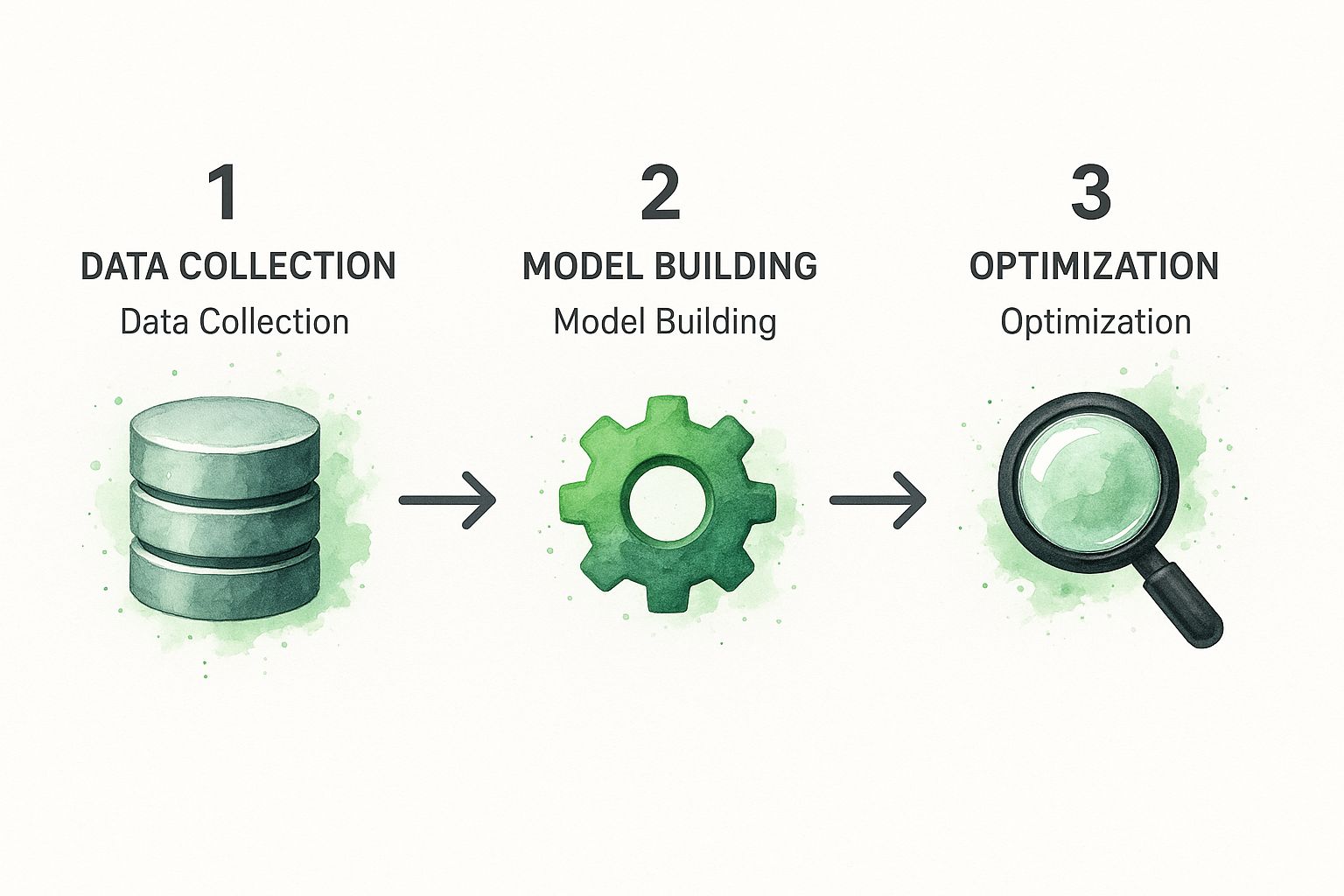
Zoals je ziet, begint succes met solide data, gaat het verder met rigoureus modelbouwen en eindigt het met strategische optimalisatie. Het is een cyclus van continue verbetering.
Om je een duidelijker beeld te geven, volgt hier een vereenvoudigde uiteenzetting van wat je in elke fase kunt verwachten.
Jouw MMM Implementatie Stappenplan
| Fase | Hoofddoel | Belangrijkste Activiteiten |
|---|---|---|
| 1. Dataverzameling & Voorbereiding | Een enkele, betrouwbare dataset creëren | Verkoopdata, marketinguitgaven en externe factoren verzamelen. Alle informatie opschonen en standaardiseren. |
| 2. Modelbouw & Testen | Een statistisch en zakelijk relevant model ontwikkelen | Variabelen selecteren, regressies uitvoeren en verschillende modelconfiguraties testen. Resultaten backtesten en valideren. |
| 3. Resultaatanalyse | Statistische output vertalen naar heldere zakelijke inzichten | Kanaalbijdragen analyseren, ROI berekenen en de wet van de verminderde meeropbrengst identificeren. |
| 4. Actie & Strategie | Inzichten gebruiken voor toekomstige marketingbeslissingen | Budgetten herverdelen, toekomstscenario's simuleren en de marketingmix optimaliseren voor maximale impact. |
Laten we dieper ingaan op wat elke fase in de praktijk inhoudt.
Fase 1: Data Verzamelen en Voorbereiden
Dit is de meest kritische en, eerlijk gezegd, vaak de meest tijdrovende fase. Zoals we al aangaven, is de kwaliteit van je inzichten volledig afhankelijk van de kwaliteit van je data. Je belangrijkste doel hier is om alle benodigde informatie te verzamelen, op te schonen en samen te voegen in één enkele, bruikbare dataset.
Allereerst moet je al je databronnen identificeren. Denk aan verkoopdata uit je CRM of e-commerceplatform, marketinguitgaven van platforms zoals Google Ads en Meta, en websiteverkeer uit Google Analytics. Vergeet ook niet externe factoren mee te nemen, zoals feestdagen, campagnes van concurrenten of grote economische verschuivingen die je verkoop kunnen hebben beïnvloed.
Cruciale Tip: Zorg voor minimaal twee tot drie jaar aan historische data. Een langere periode geeft het model voldoende context om seizoenspatronen en langetermijntrends nauwkeurig te herkennen, wat leidt tot veel betrouwbaardere resultaten.
Zodra je alles hebt, moet de data grondig worden opgeschoond. Dit omvat het corrigeren van fouten, het invullen van ontbrekende waarden en ervoor zorgen dat alles consistent is geformatteerd (bijvoorbeeld alle datums in dezelfde structuur). Deze stap is absoluut onmisbaar als je een model wilt bouwen waarop je kunt vertrouwen.
Fase 2: Het Model Bouwen en Testen
Met je schone dataset klaar voor gebruik, is het tijd voor het spannende gedeelte: het bouwen van het daadwerkelijke model. Hier komen statistische technieken om de hoek kijken om de relaties tussen je marketinginspanningen en je verkopen te achterhalen. Hoewel het technisch kan worden, is het concept eenvoudig: je leert het model te begrijpen wat jouw bedrijf drijft.
Het proces omvat het selecteren van de juiste variabelen en het testen van verschillende modelopstellingen om te zien welke het beste je historische verkooppatronen verklaart. Een ervaren data-analist of een gespecialiseerd bureau neemt hier meestal het zware werk voor zijn rekening, maar het is essentieel dat jij de logica erachter begrijpt.
Een groot deel van deze fase is modelvalidatie. Dit omvat:
- Back-testing: Het model gebruiken om resultaten uit het verleden te "voorspellen" om te zien hoe goed de output overeenkomt met wat er daadwerkelijk is gebeurd.
- Plausibiliteitscontroles: Zorgen dat de resultaten zakelijk logisch zijn. Toont het model bijvoorbeeld een positieve impact van die campagne waarvan je weet dat het een groot succes was?
Deze rigoureuze tests zorgen ervoor dat het model niet alleen statistisch solide is, maar ook de realiteit van je bedrijf weerspiegelt.
Fase 3: De Resultaten Interpreteren
Zodra je model is gebouwd en gevalideerd, krijg je een overvloed aan informatie. De uitdaging is nu om die complexe statistische outputs te vertalen naar duidelijke, bruikbare zakelijke inzichten. Hier komt de ware waarde van marketing mix modelling echt tot zijn recht.
De resultaten geven je doorgaans een "bijdrageanalyse", die je totale verkopen opsplitst en een percentage toewijst aan elk marketingkanaal en elke externe factor. Het kan bijvoorbeeld aantonen dat 30% van je verkopen afkomstig is van Google Ads, 15% van social media, 10% van merkbekendheid, enzovoort.
Je krijgt ook een duidelijk beeld van de ROI voor elk kanaal en, cruciaal, het punt van verminderde meeropbrengst—het moment waarop meer uitgeven aan een kanaal geen evenredige opbrengst meer oplevert.
Fase 4: Inzichten Omzetten in een Actiegerichte Strategie
De laatste en belangrijkste fase is het in de praktijk brengen van al deze nieuwe kennis. De inzichten uit je MMM moeten direct je toekomstige marketingstrategie en budgettoewijzing vormgeven. Dit is geen eenmalig rapport dat je archiveert; het is een dynamisch hulpmiddel voor continue verbetering.
Als het model bijvoorbeeld onthult dat je e-mailmarketing een verrassend hoge ROI heeft terwijl je printadvertenties achterblijven, kun je met vertrouwen je budget verschuiven. Je kunt het model ook gebruiken om simulaties uit te voeren. Stel vragen als: "Wat zou er met onze omzet gebeuren als we ons social media-budget met 20% verhogen en onze display-advertentie-uitgaven met 10% verlagen?"
Door deze datagedreven inzichten te integreren, stap je over van reactieve beslissingen naar proactieve, strategische planning. Deze fase profiteert vaak van een geautomatiseerde aanpak; je kunt onderzoeken hoe onze marketing automation services je kunnen helpen deze strategische verschuivingen efficiënt door te voeren. Dit creëert een krachtige feedbackloop waarin je continu je marketingmix verfijnt voor maximale impact.
MMM-data Vertalen naar Slimmere Marketingbeslissingen

Dit is het moment waarop je harde werk in marketing mix modelling zich echt uitbetaalt. Na al het data verzamelen en model bouwen, heb je een schat aan informatie. De sleutel is echter weten hoe je deze output vertaalt naar zelfverzekerde, winstgevende beslissingen die daadwerkelijk groei stimuleren.
De resultaten van het model zijn niet zomaar een stapel statistieken; ze vormen een strategische landkaart. Deze kaart laat je precies zien wat werkt, wat niet, en waar je verborgen kansen liggen. Door een paar kernconcepten te begrijpen, kun je complexe data omzetten in duidelijke, uitvoerbare stappen voor je bedrijf.
De Bijdrageanalyse Begrijpen
Het eerste en krachtigste inzicht uit je MMM is de bijdrageanalyse. Zie het als een gedetailleerde uitsplitsing van je omzettaart. Het laat je precies zien hoeveel elk van je marketingkanalen – en andere factoren – heeft bijgedragen aan je totale omzet over een bepaalde periode.
Je model kan bijvoorbeeld onthullen dat:
- 35% van je omzet wordt gedreven door je basislijn—zaken als merkkracht en algemene marktaanwezigheid.
- 25% rechtstreeks afkomstig is van je Google Ads-campagnes.
- 15% toe te schrijven is aan je social media-inspanningen op platforms als Instagram en LinkedIn.
- 10% wordt gegenereerd door e-mailmarketing.
- De resterende 15% wordt beïnvloed door externe factoren zoals seizoenspromoties of een grote uitverkoop van een concurrent.
Dit soort inzicht is van onschatbare waarde. Het haalt je uit het giswerk en toont welke kanalen je zwaargewichten zijn, waardoor je elke euro van je marketingbudget met solide data kunt rechtvaardigen.
De Wet van Verminderde Meeropbrengst Identificeren
Heb je ooit dat knagende gevoel gehad dat je misschien te veel uitgeeft aan een specifiek kanaal? Dat is waar het concept van verminderde meeropbrengst om de hoek komt kijken. Je MMM kan een responscurve voor elk kanaal plotten, die precies aangeeft op welk moment meer geld uitgeven geen evenredige toename in resultaten meer oplevert.
Stel je je advertenties op Bol.com voor. De eerste € 5.000 die je uitgeeft, kan een ongelooflijke opbrengst opleveren. Maar als je het budget verhoogt naar € 10.000, heb je misschien al het grootste deel van je doelgroep bereikt. Die volgende € 5.000 levert dan misschien maar een fractie van de initiële resultaten op.
Je model identificeert dit verzadigingspunt voor elk kanaal. Dit is een cruciaal inzicht dat voorkomt dat je jouw budget verspilt aan kanalen die hun prestatieplafond al hebben bereikt, waardoor je geld vrijmaakt om te herinvesteren voor een veel hogere algehele return on investment.
Het kennen van dit punt is het geheim van maximale efficiëntie. Het helpt je eindelijk die kritische vraag te beantwoorden: "Hoeveel is genoeg?"
Het Halo-effect Ontdekken
Marketingkanalen werken zelden in een vacuüm. Een krachtige tv- of YouTube-campagne kan merkbekendheid opbouwen, wat er op zijn beurt toe leidt dat mensen een week later op Google naar je bedrijf zoeken. Dit fenomeen, waarbij activiteit in het ene kanaal indirect de prestaties van een ander kanaal verbetert, staat bekend als het halo-effect.
Een standaard last-click attributiemodel zou in dit scenario ten onrechte alle eer aan Google Search geven. Een geavanceerd marketing mix model is echter slim genoeg om deze kruislingse invloeden te detecteren. Het kan je bijvoorbeeld laten zien hoe je investering in top-of-funnel videoadvertenties een tastbare lift veroorzaakt in organisch zoekverkeer en merkgerelateerde zoekconversies.
Het begrijpen van deze halo-effecten is essentieel voor het opbouwen van een echt holistische strategie. Het voorkomt dat je het budget snijdt van een kanaal dat op zichzelf ondermaats lijkt te presteren, maar eigenlijk het succes van andere kanalen voedt. Dit is een veelvoorkomende valkuil die MMM helpt oplossen, zodat je het volledige beeld van je marketingecosysteem ziet. De impact is significant; recente data laat zien dat Nederlandse e-commercemerken die MMM inzetten een gemiddelde omzetstijging van 2,9% behaalden, puur door hun kanaalmix te optimaliseren. Je kunt meer over markttrends ontdekken op Statista's media overview.
Jouw Weg naar Marketing Mix Modelling Kiezen
Dus, je bent klaar om te beginnen met marketing mix modelling. Het goede nieuws is dat je niet van de ene op de andere dag een datawetenschapper hoeft te worden. De sleutel is het vinden van een pad dat past bij de middelen, doelen en bestaande expertise van je bedrijf.
Je hebt drie belangrijke routes om uit te kiezen. Elk heeft zijn eigen voordelen en uitdagingen. Het begrijpen van deze opties is de eerste stap naar een slimme beslissing die daadwerkelijk waarde oplevert. De juiste keuze hangt echt af van je budget, de huidige vaardigheden van je team en hoeveel directe controle je wilt.
Softwareplatforms
Kant-en-klare software heeft marketing mix modelling veel toegankelijker gemaakt. Deze platforms hebben gebruiksvriendelijke interfaces die rechtstreeks op je databronnen kunnen worden aangesloten, waardoor veel van het zware statistische werk wordt geautomatiseerd.
- Voordelen: Ze zijn vaak de meest budgetvriendelijke optie en kunnen relatief snel inzichten opleveren. Dit maakt ze een uitstekend startpunt voor bedrijven die net beginnen met MMM.
- Nadelen: De modellen kunnen soms aanvoelen als een "black box," met beperkte aanpassingsmogelijkheden. Je kunt merken dat ze niet helemaal de unieke kenmerken van je bedrijf of markt vastleggen.
In-house Team
Voor grotere bedrijven met serieuze datacapaciteiten kan het opbouwen van een in-house team een krachtige langetermijnstrategie zijn. Dit betekent het aannemen van toegewijde datawetenschappers en analisten om een op maat gemaakt MMM speciaal voor jou te bouwen en te onderhouden.
Deze route geeft je de ultieme mate van controle en maatwerk. De vraag naar dit soort talent is in Nederland enorm gestegen, omdat meer bedrijven op data vertrouwen om hun marketing te verfijnen.
Het In-House Voordeel: Een toegewijd team kan het model perfect afstemmen op jouw specifieke bedrijfsvragen. Ze kunnen het voortdurend verfijnen en de inzichten direct verweven in de dagelijkse operaties, waardoor je marketing ongelooflijk wendbaar wordt.
Natuurlijk is dit ook de duurste en meest tijdrovende weg. Het vereist een aanzienlijke investering in salarissen, training en technologie, wat het voor veel kleine tot middelgrote bedrijven onbereikbaar maakt.
Gespecialiseerde Bureaus en Partners
Samenwerken met een gespecialiseerd bureau, zoals Digitalique, biedt een uitstekende balans. Je krijgt toegang tot een team van experts die data-analyse ademen, maar zonder de overhead van het aannemen van een fulltime in-house team. Voor velen is dit de meest praktische oplossing.
Een goede partner brengt meer dan alleen technische vaardigheden; ze brengen strategische marketingkennis. Wij begrijpen het unieke consumentengedrag en het medialandschap van de Nederlandse markt, wat ervoor zorgt dat de output van het model relevant en uitvoerbaar is. Een partner kan ook MMM-inzichten verbinden met andere strategische inspanningen, zoals het optimaliseren van je content marketing strategy om vol in te zetten op kanalen die de beste ROI laten zien. Het is een duidelijke, transparante weg naar datagedreven groei, waarbij geavanceerde analyses worden gecombineerd met praktische implementatie.
Jouw Vragen over Marketing Mix Modelling Beantwoord
De stap zetten naar iets krachtigs als marketing mix modelling roept ongetwijfeld vragen op. Dat is een goed teken. Het betekent dat je serieus nadenkt over hoe je jouw budget en strategie ten goede kunt veranderen. Wij hebben dit vaker meegemaakt en de meest voorkomende vragen gehoord van ondernemers en marketeers zoals jij.
Laten we dus eventuele twijfels wegnemen. Ons doel is om je het vertrouwen te geven om de volgende stap te zetten met MMM in je eigen organisatie.
Hoe lang duurt het voordat ik resultaten zie van MMM?
Dit is altijd een van de eerste vragen, en terecht—je wilt weten wanneer de investering zich begint terug te betalen. Een typisch marketing mix modelling project, van dataverzameling tot een gevalideerd model, duurt meestal enkele weken. Maar het goede nieuws is dat de eerste bruikbare inzichten vaak snel genoeg naar boven komen om je budget voor het volgende kwartaal al vorm te geven.
Het is belangrijk te onthouden dat MMM geen eenmalige oplossing is. Het is een doorlopend strategisch hulpmiddel. De echte waarde bouwt zich op na verloop van tijd, naarmate je het model meer data voedt en ziet hoe nieuwe campagnes presteren.
Zie het als het afstellen van een high-performance motor. De eerste aanpassingen geven je een merkbare boost, maar het is de voortdurende fijnafstelling die je seizoen na seizoen voorblijft op de concurrentie. De inzichten stapelen zich op naarmate je begrip verdiept.
Is MMM alleen voor grote bedrijven?
Niet meer. Het is waar dat marketing mix modelling vroeger het domein was van enorme bedrijven met gigantische budgetten en in-house data science teams. Zij waren de enigen die de complexe software en gespecialiseerde vaardigheden echt konden betalen.
Gelukkig is die wereld volledig veranderd. Met de opkomst van gebruiksvriendelijkere software, open-source tools zoals Google's Meridian, en gespecialiseerde bureaus, is MMM nu voor iedereen binnen handbereik. Dit betekent dat het MKB eindelijk kan meedoen.
Kleinere bedrijven hoeven niet alles tegelijk te willen. Ze kunnen beginnen met een gericht model dat slechts een paar belangrijke marketingkanalen analyseert. Dit maakt het een verrassend kosteneffectieve manier om een echt concurrentievoordeel te behalen zonder een enorme investering vooraf.
Hoe gaat MMM om met nieuwe kanalen zoals TikTok?
Uitstekende en zeer relevante vraag. Het is een bekende uitdaging om nieuwere kanalen zoals TikTok te modelleren, omdat ze simpelweg niet de jaren aan historische data hebben die traditionele kanalen zoals tv of print wel hebben.
Maar moderne MMM-technieken zijn precies voor dit soort problemen gebouwd. Zo pakt een goede analist dit aan:
- Gebruik van proxy-data: We kunnen data van vergelijkbare, meer gevestigde kanalen gebruiken als startpunt om de potentiële impact in te schatten. Het is niet perfect, maar het is een slimme begin.
- Integratie van digitale metrics: Hoewel historische verkoopdata misschien schaars is, kunnen we digitale engagement-metrics zoals views, shares en volgersgroei meenemen om het model meer context te geven.
- Geavanceerde statistische methoden: Technieken zoals Bayesiaanse modellering zijn hier perfect voor. Ze stellen analisten in staat om deskundige aannames te integreren en deze vervolgens bij te werken naarmate er echte data binnenkomt.
Het draait allemaal om slim omgaan met de data die je hebt, in plaats van jaren te wachten op een perfecte dataset. Een goed gebouwd model kan zelfs met beperkte historie solide, richtinggevende inzichten bieden.
Wat is het verschil tussen MMM en attributiemodellering?
Dit is een cruciaal onderscheid. Beide zijn meetinstrumenten, maar ze doen heel verschillende dingen. De beste manier om ze te zien is als partners, niet als concurrenten.
Stel je voor dat je marketinginspanningen een voetbalteam zijn dat een doelpunt probeert te scoren.
- Attributiemodellering is als het geven van alle eer aan de speler die het doelpunt scoorde, of misschien aan degene die de laatste pass gaf. Het richt zich op de laatste paar digitale contactmomenten (zoals klikken) in de klantreis, waardoor je een gedetailleerd, microniveau beeld krijgt.
- Marketing Mix Modelling is de analyse van de coach na het seizoen. Het kijkt naar de prestaties van het hele team—aanval, verdediging, middenveld—en hoe ze samenwerkten. Het houdt ook rekening met externe factoren zoals het weer, de strategie van de tegenstander en zelfs de kaartverkoop. Het geeft je het strategische, macroniveau overzicht.
Een attributiemodel kan je vertellen dat een specifieke Google Ad een klant heeft geconverteerd. Maar een MMM zal je vertellen dat je YouTube-merkcampagne ervoor zorgde dat die klant überhaupt naar je merk zocht, wat leidde tot die laatste, conversie-drijvende klik. Je hebt beide perspectieven nodig om het volledige beeld te krijgen en de kleine details te verbinden met de grote-plaatje-strategie.
Klaar om te stoppen met gokken en datagedreven beslissingen te nemen die je ROI verhogen? Bij Digitalique combineren we specialistische kennis met praktische implementatie om geavanceerde technieken zoals marketing mix modelling toegankelijk te maken voor jouw bedrijf. Laten we samen bouwen aan een slimmere marketingstrategie.
Discover how we can help you grow at digitalique.nl
Heb je nog een vraag of een gouden tip die je wilt delen? Laat het hieronder weten in een reactie. We lezen alles!